Daredevil Stirling
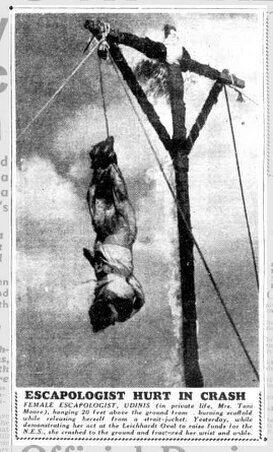 This is an incomplete documenting of a colourful character in the world of magic and the allied art of Escapology, and a serious accident which occurred in 1942.
On Sunday, September 27, 1942, a female escapologist, Mrs Joan Alice Moore, had been suspended head-down at a N.E.S. carnival at Leichhardt Oval (in Sydney) while restrained in a strait jacket and hung on scaffolding above a fire. The inflammable material placed directly under Mrs Moore’s suspended body was fanned by the wind, such that the flames rose and ignited the ropes. As she struggled to escape, the rope snapped, according to newspaper reports.
Moore fell several feet to the ground in front of 3,500 people, and suffered injuries which required her to be admitted to Balmain hospital; a fractured forearm and ankle, and damage to the lower part of her spine.
Joan Moore was reported to be aged 21, from Victoria St, Potts Point, Sydney. Her professional name was Udinis, though countless incorrect spellings of this name (eg. Eudiness or Udinus) add to the difficulty of tracing her story. The name is a poor attempt to capitalise on the fame of Harry Houdini. It seems, though, that Joan may have continued to perform, if she was indeed the same ‘Udinis’ advertised as late as 1946.
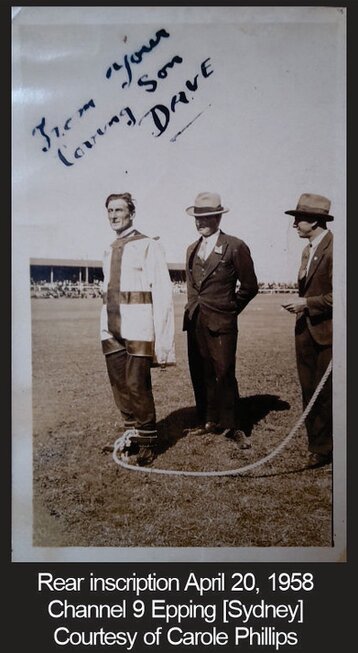
David Alberts – Daredevil Stirling
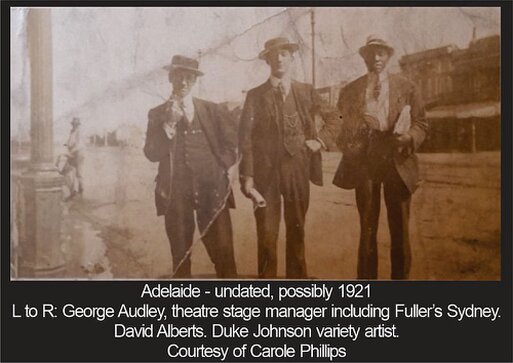
The name “Udinis” was a title used for several of his partners, by a showman who called himself ‘Stirling the Great’, ‘Mysterious Stirling’ or, more often, ‘Daredevil Stirling’. While we will not attempt to document his every move, his adventurous life as a magician, escape artist, hypnotist and fire eater makes for some interesting stories.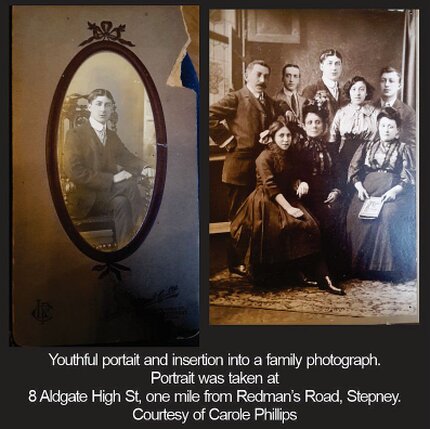
His real name was David Alberts, though by the later years of his life he seems to have called himself David Albert, and he lived in the Blacktown / Seven Hills area of Sydney. According to a 1938 newspaper story, (1) and his 1915 military enlistment papers (2), Alberts was born around 1893 in Buenos Aires and, by his own words, he came to Australia in 1911 to perform with Fuller’s theatres as a magician. This claim appears to be a deliberate obfuscation of his origins, as a family descendant (2a) confirms that he came from the East End of London. When, in 1923 he returned to England (2b) for a visit, it was reported that he was at 37 Redman’s Road in Stepney. If he was staying with family, there is a high probability that he had come to Australia to escape economic hardship, as Stepney at that time was known for poverty, overcrowding and violence, until much of the area was destroyed in the Blitz of WWII.
A family legend is that he left by ship with no money and arrived financially set up; that he was a card sharp and had fleeced many in the London East End markets doing the three card trick, amongst other sleight of hand tricks. The legend has it that he fleeced some of the ship’s passengers and crew on the long voyage to Australia.
A family legend is that he left by ship with no money and arrived financially set up; that he was a card sharp and had fleeced many in the London East End markets doing the three card trick, amongst other sleight of hand tricks. The legend has it that he fleeced some of the ship’s passengers and crew on the long voyage to Australia.
He was somewhat exaggerating this early career, as in 1913 (3) it was reported that on January 11 “he was ‘showing’ on a vacant piece of land, very adjacent to the Adelphi Theatre (4). Accused (Cyril Humby) was kicking about there, and he got him to hold a bag while he did the ‘egg trick’ …” and Humby was accused of stealing a candlestick belonging to Stirling, and was sentenced to three months.
Crime and Punishment
We will now refer to Alberts by his adopted stage name, Stirling. Since his arrival in Australia, he had landed himself in trouble on a regular basis. In November 1912 he escaped with a bond, on a charge of attempting to steal at the suburb of Manly (the press reporting him as a ‘comedy artist’ and ‘a music hall artist recently arrived in the state’, sometimes naming him as ‘Elberts’). 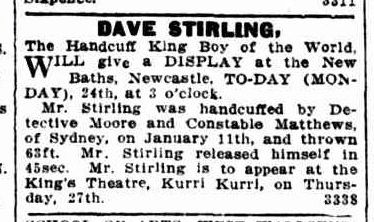 Then in both 1913 and 1914 he faced two separate charges of breaking, entering and stealing; the 1913 offences in Newcastle were alleged to have been a string of burglaries. These resulted in sentences of six months and eighteen months at Maitland and Pentridge gaols. Alberts was reported in the press as being a “Handcuff King” using the alias ‘Stirling’, and he had advertised to give a display at the Newcastle Ocean Baths on February 24 1913, followed by a theatre appearance a few days later. There was no shortage of other escapologists in Australia following Houdini’s tour in 1910; principally Hanco, Percy Verto, Raymond, the visiting Cirnocs, and later Murray Walters, with lesser lights including Martinelli, Mokano and even hypnotists P.H. McEwen and Louis Gascoigne.
Then in both 1913 and 1914 he faced two separate charges of breaking, entering and stealing; the 1913 offences in Newcastle were alleged to have been a string of burglaries. These resulted in sentences of six months and eighteen months at Maitland and Pentridge gaols. Alberts was reported in the press as being a “Handcuff King” using the alias ‘Stirling’, and he had advertised to give a display at the Newcastle Ocean Baths on February 24 1913, followed by a theatre appearance a few days later. There was no shortage of other escapologists in Australia following Houdini’s tour in 1910; principally Hanco, Percy Verto, Raymond, the visiting Cirnocs, and later Murray Walters, with lesser lights including Martinelli, Mokano and even hypnotists P.H. McEwen and Louis Gascoigne.Stirling was back in Australia by September 1916 and would have been working to establish himself as a performer. By 1919 he was performing as an actor at the Sydney Tivoli, in a successful war-themed comedy by Bruce Bairnsfather titled “The Better ‘Ole” (6) which was showing as both a play and a movie in Sydney.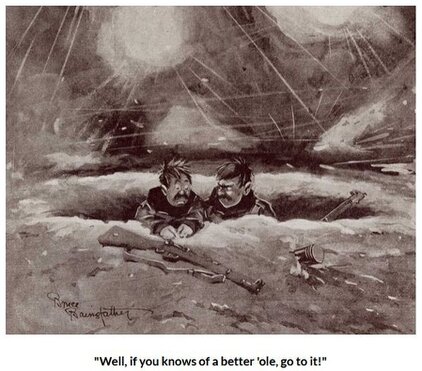
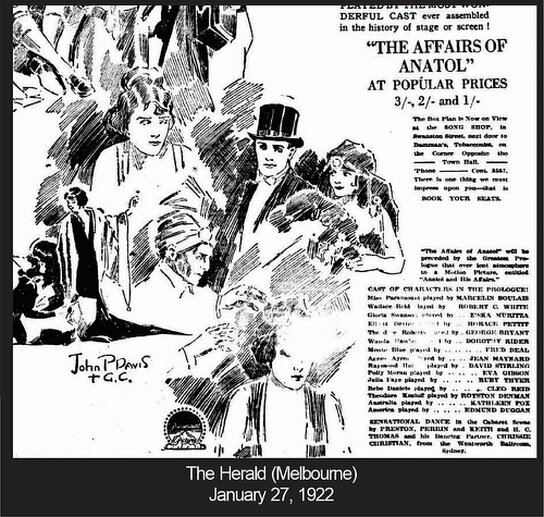
This was just one of Stirling’s brushes with crime, despite being no more than an innocent bystander. In January 1922, at Melbourne, he was called to give evidence and to identify a suspect he had briefly encountered around the time 12-year old Alma Tirtschke had been brutally attacked and murdered in what was known as the Gun Alley Murder. It would be many years before the accused, executed by the state, was granted a posthumous pardon (9) for wrongful conviction. Stirling was at this stage again employed as an actor, in a live-performance prologue to the movie “The Affairs of Anatol” at the Melbourne Town Hall.
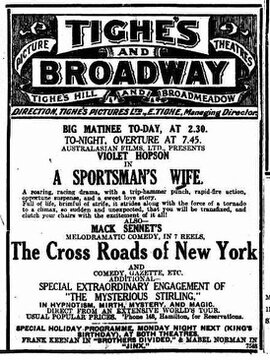
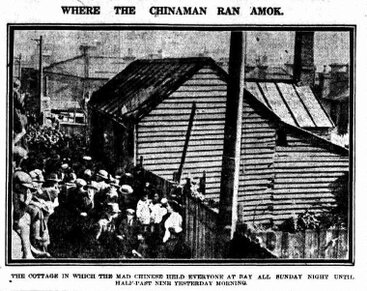
During this run he found himself embroiled in a chaotic scene through no fault of his own. In early June, Stirling was making his way home in Surry Hills, Sydney. A man later named as Lee Hing or Lee Sun, a Chinese cabinetmaker, bumped against him in an excited condition, and was engaged in throwing Chinese crackers which gave off a large quantity of smoke. Stirling observed him run to a nearby church (Church of Christ Chinese Mission School) where he was seen with two revolvers which he started to fire at members of the church. In the ensuing melee, Lee would injure seventeen people, one of whom later died. He then barricaded himself in a cottage taking up the length of Little Campbell Street, a tiny lane off Riley Street which was then a slum area of narrow laneways, (7) and kept the police at bay for fourteen hours, despite multiple efforts by police to shoot, to burn the house down, or to batter it in with fire hoses.
Stirling knew of another soldier friend, Private Phillips who, for reasons best known to himself, had brought home from the war a canister of poison gas known as Pineapple Gas (chlorine gas, known to act as a severe form of tear gas). Together the two diggers managed to get the canister in a window and set it off. Although it had some effect, the shooter remained inside and continued his exchange of gunfire.
Photographs taken during the siege show the laneways completely clogged by onlookers. (8) Ultimately the standoff was brought to an end by the amazing intervention of a civilian security guard, Albert H. Ryan, who demanded a gun from police, leapt through a window, and shot the gunman through the head. Ryan would later be commended on his bravery, but only a month later he was charged with having taken a shot at another civilian.
Several years later, he was criticised (9a) as being an unreliable witness in the Tirtschke case, on the grounds that as of 1925 he was serving time in prison. Sure enough, under the name Frederick David Stirling, he had been sentenced to five months in gaol for the opportunistic theft of copper with another man at Staghorn Flat, in the north east of Victoria. (9b) At his committal hearing, Stirling asked to be dealt with leniently, as he was a married man and recently lost his little son, and that he was suffering from an internal complaint, and that he had a crippled arm from the effects of war service. (His marriage was to Evelyn Mary Johnson, in 1920).
Escapologist and Hypnotist
After making a short trip to England in early 1923, Stirling’s profile in Australia had begun to be more prominent, and he is mentioned in the press performing hypnosis and conjuring in conjunction with movie features, “direct from an extensive world’s tour.” By 1928, under the title “Daredevil Stirling”, he was performing escapes from handcuffs and manacles, usually for outdoor exhibitions and carnivals. Now he introduced possibly the first of his female offsiders, this one named ‘Kammon the Queen of Escapology’, just 18 years old. Although Stirling was clearly her manager/mentor, she was promoted as being the head of a company of ten variety performers, ‘assisted by’ Stirling. Kammon presented escapes including an upside down straitjacket release, and general magic, while Stirling seems to have performed the Needles trick and a Thumb Tie routine.
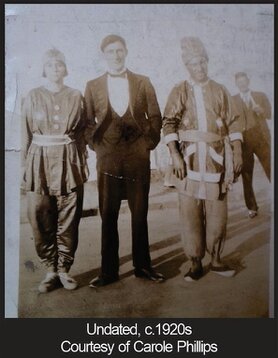
Stirling’s several proteges are not named over the years, until the accident involving Joan Moore. They are generally described as younger women, and though Stirling’s later death notice mentions being married to Evelyn, it would seem that she was not one of the performers.
Later, in November 1928, Daredevil made a feature escape at Melbourne’s Princes Bridge, being tied in a sack and thrown into the Yarra. Miss Kammon made her straitjacket escape while suspended from the same bridge. Stirling was also a regular performer of the suspended straitjacket escape when he did not have a sidekick.
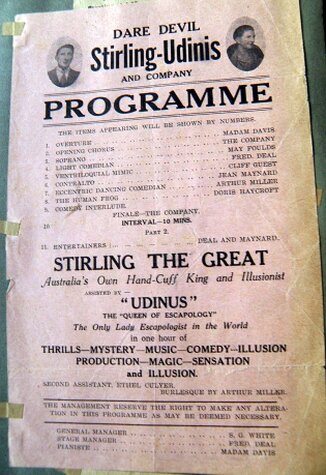
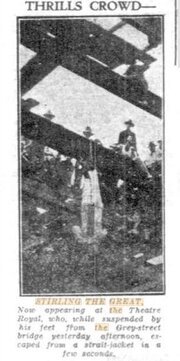
By October 1930 his female partner was operating under the name ‘Udinis’. Stirling was available to travel widely, and in Hobart he was noted performing magic and the ‘Canadian Trunk Mystery.’ He escaped while handcuffed and tied in a sack at the Grey Street bridge in Brisbane in late 1931, while he was appearing at the Theatre Royal.
Versatility was certainly Stirling’s forte. Travelling during the 1930s with several variety troupes, he featured his regular escapes and magic, mind-reading, and hypnotic routines which included the publicity stunt of putting a young woman asleep for a couple of days at a time, or using a sledgehammer to break a heavy stone placed across a person’s chest. He was also reported to have carried out “a remarkable blood transfusion, and also teeth extraction which will astound you.” The Daily Standard (Brisbane) reported that he had returned from a trip to Java in August 1935. Clearly he was of good repute in the performing world, appearing on bills with the great Indian Aussie Cass Mahomet, and with the Howard Brothers mindreading duo.
In 1936 he was working with “Lopez & Coy.” magic and variety company, alongside ‘Karaha the human volcano’, possibly acquiring those skills which he later showed off for a pictorial spread in PIX magazine of January 1941 (10).
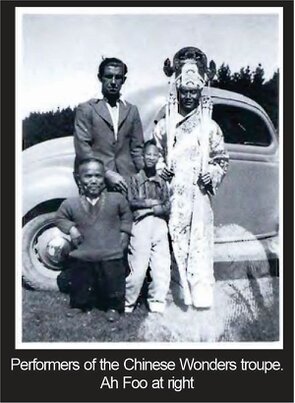
In 1937 Stirling was employed by the prominent showground promoter, Arthur Greenhalgh, to appear at Grafton with ‘The Chinese Wonders’ troupe which toured from about 1935-1939 featuring a number of Chinese artists and people of a ‘human curiosity’ nature, and a magician whose name, Ah Foo, sounds of dubious origin, but was genuine (he was later reported to have returned to China and been killed in a train smash).
An earlier ‘Chinese’ magician going by the name Ah Chong Foo was, in fact, Emil Ruch of Adelaide with the daughters of magician Jim Bennier.
An earlier ‘Chinese’ magician going by the name Ah Chong Foo was, in fact, Emil Ruch of Adelaide with the daughters of magician Jim Bennier.
In December 1940, Stirling performed his straitjacket escape, suspended head-down and fifty feet in the air, for the Benevolent Society carnival at the corner of Goulburn and Riley Streets, Sydney; just metres away from where he had once attempted to flush out Lee Hing with a canister of poison gas.
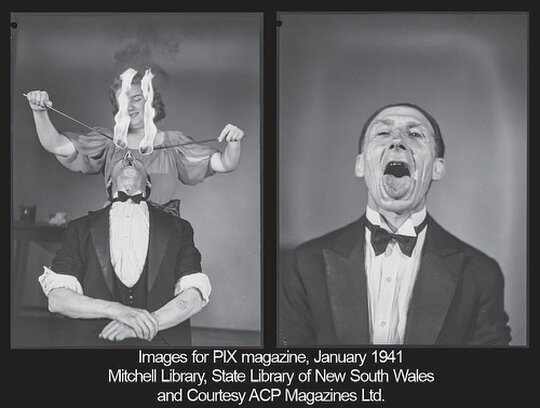
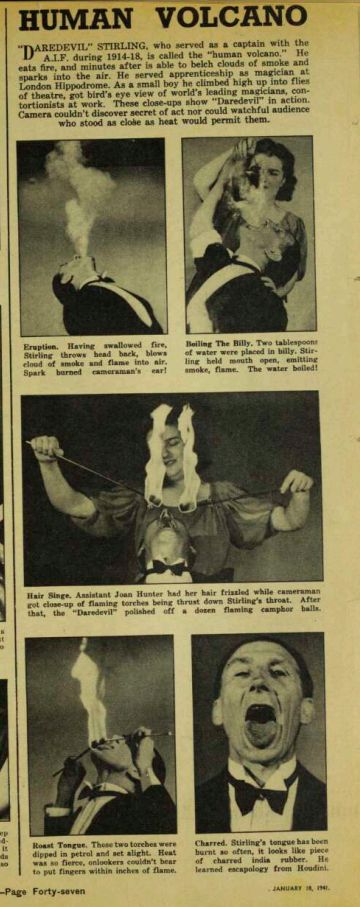
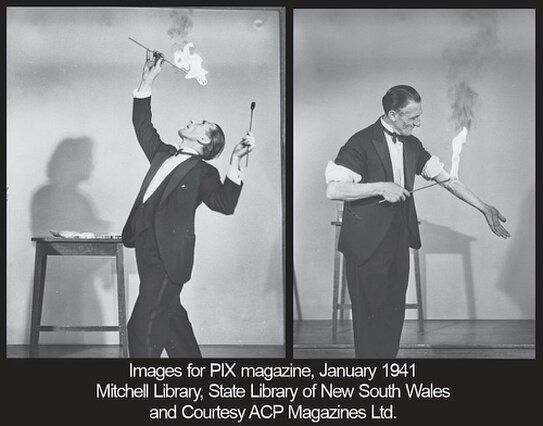
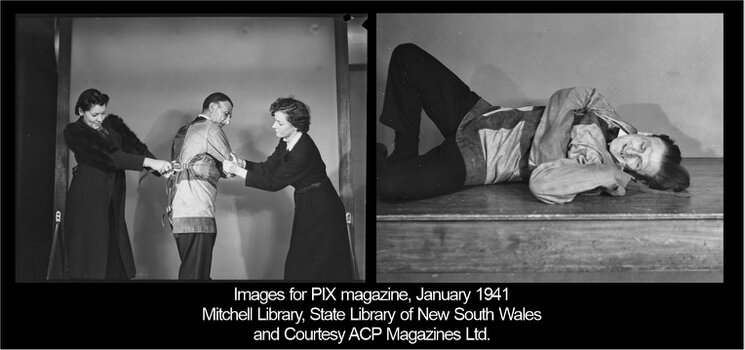
The 1940s were filled with dramatic events unrelated to Stirling’s theatrical profession, other than the high-publicised accident with Joan ‘Udinis’ Moore. In 1941 the truck in which he and several troupe members were performing, overturned, trapping those inside and damaging their equipment. In between engagements, Stirling was the manager of the Menzies Private Hotel in Elizabeth Street Sydney, opposite the War Memorial. This was a hotel for visiting country travellers, but during Stirling’s time to 1945 there were suspicious fires, an armed holdup in which the perpetrators hit Stirling over the head with a revolver, and a more worrying situation in late 1941 when he was accused of a sexual assault upon a young employee had just dismissed. The charge failed for lack of evidence only because the woman did not present at court.
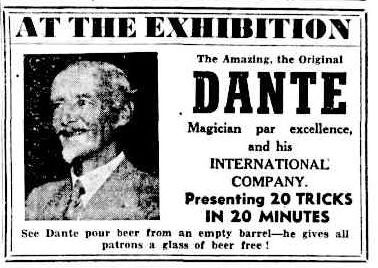
Between 1945 and 1946 Stirling created a variety troupe, the ‘Dandies of 1945’ which toured in country New South Wales and Victoria. Featured amongst the ’15 star acts’ was Jack ‘Dante’ Angus who, like Stirling, was a determinedly independent showman. With the tour over, Stirling took up as manager of the ‘Commodore’ residential apartments in Darlinghurst Road, Kings Cross. The Cross at that time may have been regarded as bohemian, in contrast to its later reputation for sleaze, drugs and crime; but in 1946 it was reported (11) that the Commodore was “the filthiest residential in Darlinghurst … described by other witnesses as the scene of drunken, immoral parties featuring undressed women, blackjack affrays and of a gunman and an attempted assault on a woman tenant.”
Performers must perform, however, and Stirling continued to appear wherever he was able, even advertising in Katoomba (1952) west of Sydney, for Christmas and Children’s Parties. Attempting to capitalise on the success of a child mind-reading prodigy named Argus the Prophet, Stirling announced a performance in Katoomba featuring little Janice Hollister, age 11, as ‘the youngest mind reader in the world’, answering questions while blindfolded. Apparently her mother thought otherwise, for on January 29, 1953 she advertised in the Blue Mountains Advertiser to advise readers that her daughter would not be appearing in the show.
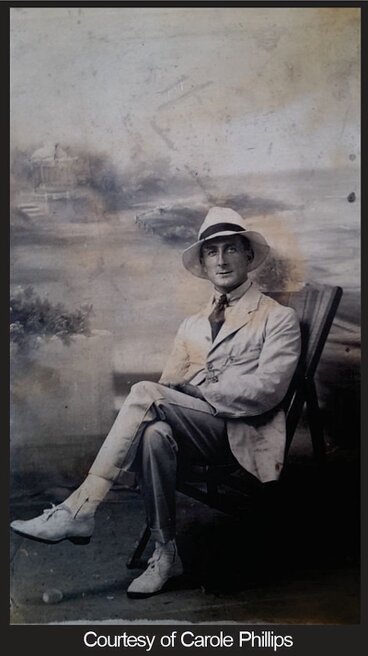
From a photograph in the family’s collection, it seems that Stirling was still performing occasionally as late as 1958. David Albert died on June 24, 1969 at Seven Hills in Sydney, leaving a wife and two daughters. He had certainly led a life which lived up to his title as Daredevil.
REFERENCES
(1) Cumberland Argus, June 22 1938
(2) Enlistment papers from National Archives, naa.gov.au, service number 1001.
David Alberts was stated to be a bootmaker by trade, and his father was William Alberts.
David Alberts was stated to be a bootmaker by trade, and his father was William Alberts.
(2a) With thanks to Carole Phillips, niece of David Alberts
(2b) Everyone’s magazine, March 21, 1923
(3) Truth, January 19 1913
(4) The Adelphi was at 329 Castlereagh Street, later to become the ‘New Tivoli’
(5) Australian Town and Country Journal, April 5, 1916
(6) Daily Telegraph, June 3 1919 p.4
(7) Little Campbell Street has not existed since about 1928 but the location is in the same block as Lower Campbell Street,
close to the large Police headquarters.
close to the large Police headquarters.
(8) The Sun, June 2, 1919 p.8
(9a) Truth magazine June 14, 1925
(9b) See, for example, Upper Murray and Mitta Herald, May 14, 1925, and Yackandandah Times April 3, 1925 p.4
(10) PIX – see trove.nla.gov.au item nla.obj-432716928-1, and the full set of 27 photographs taken for this article at https://collection.sl.nsw.gov.au/record/nvgPvLz1/B0E2Nkdm5lVLZ
(Mitchell Library, State Library of New South Wales and Courtesy ACP Magazines Ltd.)
(Mitchell Library, State Library of New South Wales and Courtesy ACP Magazines Ltd.)
(11) Mirror, Perth, July 13, 1946 p.20