George Waldo Heller and Maude Heller
Ideological
Mahatmas and Psychic Somnomists
Chapter 1 - Identity, Scotland, Australia |
“George Heller was a man who was liked by everyone.
He was one of the very few honest gentlemen in magic – a rare accolade for a touring showman.”
– Will Alma
He was one of the very few honest gentlemen in magic – a rare accolade for a touring showman.”
– Will Alma
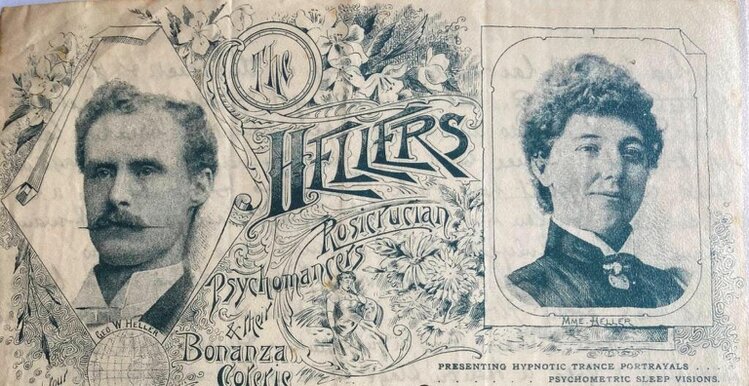
Hellers Letterhead, 1897. John Davenport collection
This is the fifth and last of my essays (1) connected to the life and times of the great magical entertainer, Robert Heller (W.H. Palmer) and his mind-reading partner, Haidee Heller. It has, however, only the most tenuous connection to the original Robert Heller; instead we will investigate the lives of one George Waldo Heller and his wife and pseudo-psychic partner, Maude Heller.
The Hellers spent almost forty years in Australia and New Zealand, relentlessly touring across the entire country with their mind-reading and spirit cabinet acts, together with small magic, larger illusions, and Biograph movies. In terms of sheer distance travelled, they outstripped that other great country touring act, Charles Sloggett. In their time, they were highly regarded and always welcomed, but today almost nothing has been documented about the Hellers except some reproductions of their exquisite posters.
Most significantly, the true identity of this duo is completely unknown to magic historians. Throughout their career, not the slightest trace can be found in newspapers which hints at their private lives. Even the foremost researcher of Australian magic history, Will Alma, admitted that he did not know who George Heller really was, despite having known Heller personally. That particular mystery will be solved here.
The standard format for most of my essays has been to chronologically follow a performer from state to state. In the case of the Hellers, they visited so many small townships and little country halls that a chronology is of no worth, though a summary will be added at the end. Our interest will be to identify the Hellers, track their repertoire and reputation, and to highlight some of the major events of their lives. And we must begin with the death of George Waldo Heller.
Identity and Origins – The First Clues
George and Maude Heller came to Australia in August 1889. George Heller claimed to be a nephew of the original Robert Heller (Palmer), who had died in 1878, but his claims can immediately be dismissed by examination of the Palmer family tree, and a denial by Heller’s own brother, Angelo Palmer, that any such nephew existed (2). What George Heller did have was a polished performance of second-sight mindreading, similar to that of Robert and Haidee Heller, and of Professor Samri Baldwin.
Some passing comments made by Robert Kudarz in the magicians’ magazine, ‘Mahatma’ (3) connect the name of G.W. Heller to the name ‘Wezner’, and this allows us to trace back to G.W. Heller’s pre-Australian existence. But Wezner was only a stage name, and brings us no closer to his real identity (1), other than narrowing down his likely birthplace to Scotland. We can be sure that there is no connection to George Washington Heller, a vice-President of the Society of American Magicians.
Will Alma (4), professional magician, mechanic to the Great Levante, craftsman, collector and historian, knew the Hellers in their final years. He actually commenced a tour with Heller in 1927. Yet he admitted that, to his sorrow, he had no information about the Hellers’ origins.
“George Heller, a man to whom I owe a lot. He was one of my mentors when I first contemplated taking a magic show on the road, during 1926 … Unfortunately my knowledge of George Heller’s background is vague… I have always been sorry that I did not seek information of their early work. During our association the talks were always centred on myself and the touring aspect (I was young and the past did not impress me, unfortunately.) … we started out on a Gippsland tour, but only did three shows, when George collapsed at Nyora, as we were setting up the projector outfit. I brought him back to his home at Parkville, then cancelled the tour. He never recovered and suffered much before he died, 20th August 1932 of cancer, in the Bendigo Base Hospital. Mrs Heller went to live with her sister in Perth, West Australia.” (5)Unfortunately, Alma had the date of death incorrect, and no clue as to the name under which Heller had died or was buried. His remarks concerning Maude going to live with her sister are useful.
It is, perhaps, either fate or very good fortune that this author has possession of the only clue which finally allows the mystery to be unlocked. Magician and collector, Harrie Ensor, compiled a fascinating series of scrapbooks (6) in which he make this brief notation:
“George Heller – Actually took the name of Heller after the original Robert Heller, who visited here years before. According to BRETON [magician Charles Stutley] his real name was GEORGE NAIRN or NAIRNE and he died at Bendigo, Victoria, on the 6th January, 1933. Aged about 60 years. Died of cancer, and was buried under the name of Nairn or Nairne. I saw Heller show a number of times at Coolgardie, West Australia. He was a very excellent performer, one of his illusions I consider very well performed – an assistant shot from a Cannon into a Nest of Boxes suspended from the dome of theatre.”
“George Heller – Actually took the name of Heller after the original Robert Heller, who visited here years before. According to BRETON [magician Charles Stutley] his real name was GEORGE NAIRN or NAIRNE and he died at Bendigo, Victoria, on the 6th January, 1933. Aged about 60 years. Died of cancer, and was buried under the name of Nairn or Nairne. I saw Heller show a number of times at Coolgardie, West Australia. He was a very excellent performer, one of his illusions I consider very well performed – an assistant shot from a Cannon into a Nest of Boxes suspended from the dome of theatre.”
Breton (said to be a good friend of Heller’s) and Ensor were correct. The death of George Nairn can be confirmed at Bendigo close to that date. The difficulty remaining is that Nairn’s death certificate lists his calling as “Labourer”, and there is nothing to confirm him as being the same person as G.W. Heller.
However, with the name Nairn in mind, that tiny clue can be pursued, and finally the smoking gun is found. In 1907 the Hellers had gone to England with their advance manager, George Callender. In August 1907, Shipping Arrivals lists for the Ortona, returning to Australia, reveal the name George Callender, travelling with George and Maud Nairn.
Finally, the link is complete and, although much is missing, with a confirmed name we can unearth marriage and death certificates, parental names and dates, leading us to unravel, at least, the basic origins and endings of the Hellers.
Family Connections and Early Career
George Nairn’s death certificate (7) documents his age as 73, so his birth date was c.1860. His father was James Nairn (b. uncertain-d.1884) (8), a builder/joiner who is buried at Cambusnethan Cemetery in North Lanarkshire, Scotland. George’s mother was Margaret Nairn, formerly Lockhart (c.1812-1887). In 1834 the pair were living in Lanark.
Maude Nairn’s history is a little more complex. Born c.1863, in the county of Peeblesshire, Scotland, her first name was Elizabeth, though it appears that she was always called Maude. Her father was William W. Broadley (born c.1837 in Peebles), a China merchant and general dealer, and her mother was formerly Margaret Ritchie (born c.1837). The spelling of ‘Broadley’ is seen on official records from Scottish sources but, on Australian documents, is sometimes seen as ‘Brodlay’. Maude’s marriage certificate clearly shows the name as Brodlay.
Maude also had a sister, who was named Margaret Ritchie Broadley after her mother. She appears to have been born in early 1861, and her relationship is significant, since both sisters would come together to Australia.
Robert Wezner and Miss Maude: 1883-1889
How young George may have learned his magic is not known. He was clearly influenced by the repertoire of Robert Heller, but Heller had died in 1878 so George would have been a teenager if he ever witnessed a live performance.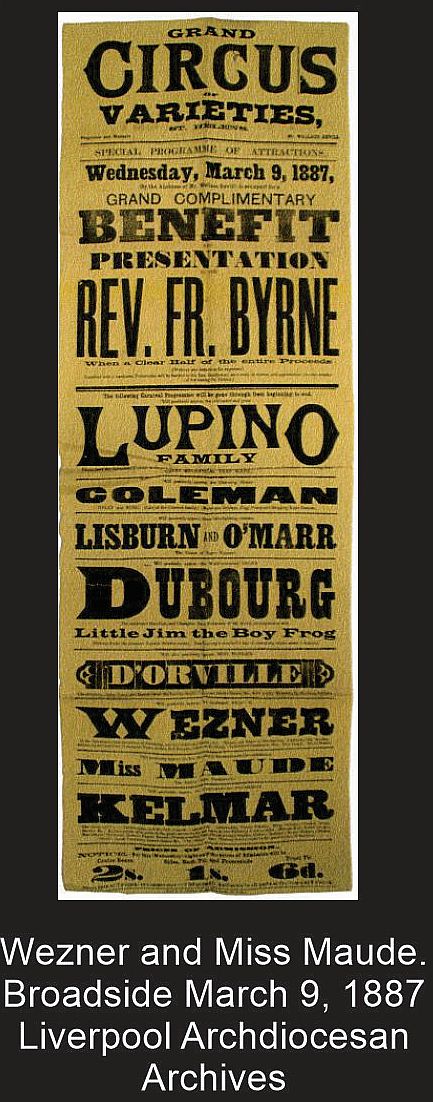
The first located performance by George Nairn was on January 24, 1883, under the stage name Robert Wezner, at the Galashiels Public Hall, south of Edinburgh, and not far from Peebles. His assistant was Miss Maude Wezner, and they appeared for five nights with their “world famous musical, mystical, magical and mirthful melange, which is unlike anything ever before seen here.” A review of the show refers to the production of three birds from eggs, which are ‘shot’ and restored to life. Of the young magician (Nairn would have been about 23, though he boldly declared himself “Heller’s Only Successor”), the Scottish Border Record said, “His stage and apparatus are elegant and artistic, and his manner is quiet, polished, and pleasing, the entertainment reminding one strongly of Heller’s, which for years was highly popular in Edinburgh. Like that prince of performers, Mr. Wezner also puts upon the stage a blindfolded lady, who can describe any article that any of the spectators chooses to hand to Mr. Wezner.”
Such a review, and the work entailed in learning the Supernatural Vision act, suggests strongly that Wezner and Maude had either been performing earlier, or had been strenuously rehearsing. It was an auspicious beginning, and while the blindfold act was similar in style to Robert Heller’s, it would later evolve into a more complex question-and-answer routine, and more. Other parts of the show at that time were named as the Talasmanic Handkerchief, Cards and Cash, With an Orange and Rice, Silver Rings, and the Saratoga Trunk mystery. In a few months he had added some other Heller feats such as Lucifer’s Punch Bowl, Blood Writing, and the Aerial Bell.
The Wezners continued their appearances throughout 1883, while seeking a responsible Manager, via addresses in Edinburgh. In September, Part III of their show introduced ‘Spiritualism Exposed – Spirit Faces, Spirit Hands, Katie King Mystery.’ Along with the blindfold act, this would become a mainstay of the show for the rest of their careers. The spirit cabinet performance, in which Wezner was tied hand and foot, and escaped only to return to his cabinet and be discovered fully bound again, was by no means original (The Era said, “It is very wonderful but has not the charm of novelty”) but it suited Wezner perfectly as a one-man routine. Early advertising referred to this routine as a “Goblinical Séance”, imitating Robert Heller’s turn of phrase.
Mr Wezner was usually promoted as just ‘Wezner’ or ‘Professor Wezner’, but on occasion he is mentioned as ‘Robert Wezner’ or ‘R. H. Wezner’, in clear attempt to connect himself to the original Heller. A curious reference is found in The Stage newspaper of March 28, 1884, mentioning that Wezner was “assisted by Miss Wezner and Miss Maude Wezner.” If this was not simply a poor wording, it may indicate that Maude’s (Elizabeth) sister (Margaret) was also involved in the show at times. From the start, reviews of the Wezners were very positive; indeed they continued to be so throughout the entirety of their careers.
Having established themselves, the Wezners continued playing Provincial theatres right through to January 1889, chiefly within Scotland and the northerly parts of England down to Manchester (9). One advertisement places their residence at 42 Balfour Street, Edinburgh. ‘The Era’ of February 7, 1885 makes mention of their “Splendid Posters and Lithos”, a feature which would be confirmed by the later gorgeous lithographs of The Hellers. No extant posters of The Wezners are known, aside from a text broadside held at the Liverpool Archdiocesan Archives.
To Australia: 1889
British businessman, Frederick E. Hiscocks, had successfully managed large Minstrel troupes in Britain and Australia. His best-known was Hiscock’s Federal Minstrels (1883-1889), but he disbanded this company in order to concentrate on a new venture, Hiscock’s London Pavilion Company. In mid-1889 he brought two teams of performers from Britain, one for the Pavilion Company, the other being the Silbon-Stirks company, said to be from P.T. Barnum’s troupe in America.
For the Pavilion Company, Robert and Maude Wezner were engaged to travel from Britain, sailing on June 22 under the direction of Mr. J. Saville Smith. Most of the other performers sailed on the R.M.S. Cuzco, a few aboard the Garonne. The Cuzco, sailing via Colombo, landed at Albany on July 27, departing again quickly for Adelaide, Melbourne on August 3, then to Sydney. The Argus of August 1 featured an advertisement from “Heller” seeking a manager or partner with capital who knows the colonies, to work a high-class entertainment arriving per s.s. Cuzco from London.
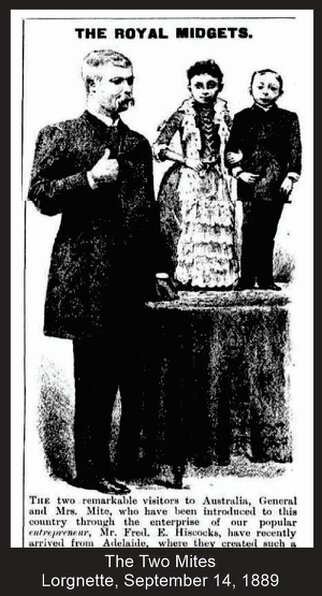
Somewhat mysteriously, the Cuzco’s passenger list, and disembarkation lists at each port, do not show our performers under any version of their known names; Nairn/Heller/Broadley. A single ‘Brodley’ is mentioned but passenger lists reveal this person was a gardener. Newspaper reports, eagerly welcoming the new artistes to town, mentioned comedian John ‘Jolly’ Nash, made a fuss over two midget performers, General and Mrs. Mite, and youthful sharpshooter Ettie Gray. Yet there was no mention of any forthcoming mindreaders.
When the London Pavilion Company opened at St. George’s Hall, Melbourne, on August 10, the long list of performers showed no sign of the Wezners. This is a mystery yet to be solved; but the magicians had arrived in Melbourne by whatever means, and on August 7, 1889, the ‘Sportsman’ wrote, “One of the latest show arrivals is G. W. Heller, a psychognotist and monologue entertainer. He has just come from home, where he has done good biz, and he is a nephew, he tells me, of Robert Heller, who was a smart sleight-of-hand man. He’ll be seen about shortly.”
They were not the only ones to come to Australia. Melbourne Punch (August 15) said, “The Hellers (brother and two sisters) have recently [landed] in Melbourne from Manchester, and will probably by in the city ere long.” The brother would have been George, while the sisters were Maude (Elizabeth Nairn) and her true sister, Margaret Broadley, who would then go her own way. Since George and Maude were, at this stage, not married, moral protocol would have cast them as brother and sister. George was just 29 years old.
So the performers were in Australia, and since the name ‘Wezner’ had been abandoned for that of ‘Heller’, we will now refer to them by their adopted names, George and Maude Heller.
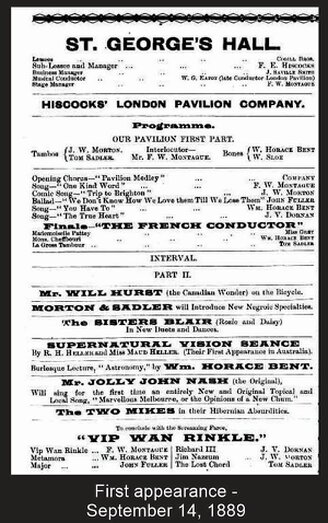
It was a full month before the Hellers made their first appearance with the London Pavilion Company,
at St. George’s Hall on September 14, 1889, with a successful presentation of their ‘Marvellous Supernatural Vision Séance’, which The Age said was quite an acquisition to the troupe. ‘Punch’
reported that the Professor had a happy knack of firing off little jokes whenever the opportunity arose.
at St. George’s Hall on September 14, 1889, with a successful presentation of their ‘Marvellous Supernatural Vision Séance’, which The Age said was quite an acquisition to the troupe. ‘Punch’
reported that the Professor had a happy knack of firing off little jokes whenever the opportunity arose.
George’s initials took a while to settle down as ‘G. W.’, and in the first weeks he was seen as ‘R. S. Heller’ or ‘R. H. Heller’. In one of their few unfavourable reviews, remarks by the gossipy ‘Scalfax’ in The Otago Witness (New Zealand) mentioned that they had tried to “revive memories of the famous Robert and Haidee Heller, and do not do it very much.” It had been eighteen years since the original Hellers had been in Australia.
At the beginning of October the Pavilion Company moved north towards Sydney, and at Goulburn (10) the paper said “the performance altogether was very good, though in some respects hardly up to expectations that had been formed”; a slightly foreboding remark.
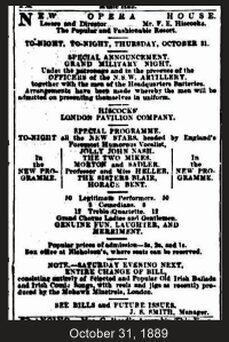
They moved into the New Opera House (York and King Streets) hot on the heels of departing illusionist, Professor Jensen. Here, the company of fifty performers was praised for its variety acts, if not for the newness of its Minstrel jokes. Houses were full, and the Hellers were always among the acts mentioned in very positive terms; they were presenting just the Supernatural Vision act in which Maude would identify objects handed to George by members of the audience.
A fairly brief journey up to Queensland took the company into early December, returning on the eleventh to Sydney, again at the New Opera House. George Heller introduced his Cabinet Séance, reproducing some of the feats of the Davenport Brothers. The Hellers were still with the company to January 1890, but when the Pavilion moved on towards Broken Hill and Adelaide, George and Maude were not with them. Ultimately, Hiscocks found that the Pavilion Company had not met the same level of acceptance as his previous troupe, and although he attempted in later years to re-form his Federal Minstrels, he did not recapture his old successes. It was said that the Pavilion’s featured tenor, John Fuller snr, was left £50 out of pocket, which Hiscocks never repaid. Fuller did remain in the Antipodes, and would go on to head up the largest and most influential vaudeville circuit in New Zealand.
And so, the Hellers were under their own management and would remain so for the rest of their careers. By January 13, 1890 they were presenting the Cabinet Mystery at the Coogee Palace Aquarium (Sydney), a place featuring all kinds of variety and novelty acts. Soon they were hired for a short season in the city, at what used to be the Australian Waxworks, but was now called Solomon’s Royal Museum, proprietor John Solomon, an auctioneer and theatrical entrepreneur. The manager of the Museum was A. Litherland Cunard (former partner of Harry Kellar), and magician Alfred S. Silvester (son of the original Fakir of Oolu) was also part of the business which displayed the illusion ‘Amphitrite’ amongst others.
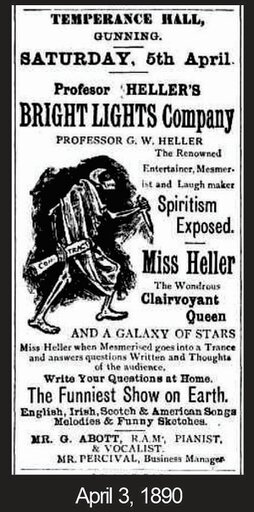
Finally the Hellers created their own small company, the ‘Bright Lights Company’ which was announced to be “a galaxy of stars” but was likely composed of George, Maude, and their pianist, vocalist and manager, Mr. Percy Abbott. They appeared firstly at Parramatta in early March. Professor Heller presented a number of small magic effects, the Supernatural Vision was a hit, and many songs were given by the trio. 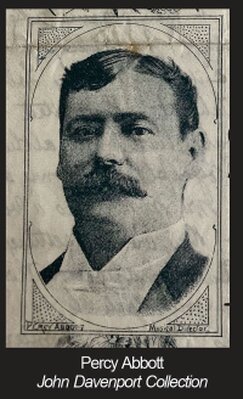
Percy Abbott, or Perce as he is often noted, was a multi-faceted character. Apparently from the United States, he worked in a lawyer’s office, then was attached to the U.S. consulate in Dunedin, NZ. He ended up at Hay in Australia where he taught music and played piano for concerts. For a while in 1888 he ran the “Record” newspaper in Hay, but ultimately gave it all away to travel with the Hellers, which he did for twelve years, playing banjo and piano and presenting songs, in addition to being the Touring Manager for some time. As such, he was an important part of the troupe which relied on comedy and music to round out the magical side of the show.
Abbott was also a story writer, published in The Bulletin magazine (11), and a composer of songs which were published, and sold at shows; one of these was ‘The White Mahatma March’ (1900) dedicated to Maude Heller. It was published and sold, but to date no copy has been found.
Abbott was also a story writer, published in The Bulletin magazine (11), and a composer of songs which were published, and sold at shows; one of these was ‘The White Mahatma March’ (1900) dedicated to Maude Heller. It was published and sold, but to date no copy has been found.
The Bright Lights headed off on a tour of New South Wales townships, starting an almost 40-year touring tradition which would take them to every state in the country with the exception of what is now the Northern Territory, and lengthy tours of New Zealand. The sheer number of towns they visited makes it impractical (and uninteresting) to list fully, and the reader is referred to a summary at the end of this essay. Everywhere they went, reviews were excellent, with the Supernatural Vision singled out as the bright feature of the show; and again it would be redundant to quote every good review that the Hellers received.
Maude’s clairvoyant act was evolving, and from April she was not only doing the old routine of guessing what object George was holding up, but also answering questions from the audience. The psychic part of the routine was that these questions had mostly been written down by the audience in advance, and Maude was both divining the questions and giving (often bold and risky) answers. At Moss Vale she was asked when the Moss Vale to Robertson railway would be approved. “Never!” she replied and, and two days later, word came that the Minister had decided against the rail link. Maude also tipped the winner of an upcoming rifle match.
Soon, the company name was changed to ‘Heller’s Odds and Ends’
[Blackheath NSW, July 5, 1890] “Mr G.W. Heller, assisted by Miss Heller, gave one of his entertainments on Friday evening last in the Rink, and surprised us with feats of legerdemain. Miss Heller sang comic songs in a pleasing style, and afterwards fairly puzzled the audience by the correct description of every article Mr. Heller asked for. A coin belonging to a gentleman was correctly described, also the exact date. Mr. Heller in the knot tying trick, which in the cabinet with two resident gentlemen on the stage as a committee, must be seen to be properly understood. His comic songs, in character, were worth listening to. They finished up with a negro farce.”
[Blackheath NSW, July 5, 1890] “Mr G.W. Heller, assisted by Miss Heller, gave one of his entertainments on Friday evening last in the Rink, and surprised us with feats of legerdemain. Miss Heller sang comic songs in a pleasing style, and afterwards fairly puzzled the audience by the correct description of every article Mr. Heller asked for. A coin belonging to a gentleman was correctly described, also the exact date. Mr. Heller in the knot tying trick, which in the cabinet with two resident gentlemen on the stage as a committee, must be seen to be properly understood. His comic songs, in character, were worth listening to. They finished up with a negro farce.”
[Shepparton VIC, September 12] “… on each occasion met with a perfect ovation. Mr. Heller showed himself possessed of an unusual fund of humor, and, from the moment he took the stage, completely carried the audience with him. His tricks were, without exception, cleverly executed, and the manner in which he acquitted himself in several character impersonations cannot be other than highly commended. Miss Maude Heller proved a host in herself, her second sight readings exciting considerable bewilderment. Mr. Abbott, a tenor of good compass and a brilliant pianist, also took part, the entertainment, on the whole, surpassing anything of the kind given in Shepparton for some time.”
The Spirit Cabinet
In late September 1891, we see Heller advertising a ‘new and startling illusion’ which he titled The Enchanted Sentry Box. Unfortunately, this was nothing more than a re-branding of his Spirit Cabinet routine, which is described here from a later (1893) review. (12) It cannot be said that Heller’s routine was greatly different from that of many other magicians who had leapt on the anti-spiritualist bandwagon (Chapman, Tolmaque, Baldwin and Silvester had been performing such feats in Australia since 1870), but he was skilled at keeping the fun moving along at a great pace.“Mr. Heller was fastened to a chair on Monday night by a pair of young gentlemen who spared neither themselves or the magician in the manipulation of the rope. His wrists were fastened tightly behind his back, and his legs to the legs of the chair. He then entered the ‘sentry box’ which consists of a framework covered with green baize. While in this position he caused bells to ring and jump over the curtain. Then he invited one of the judges in and, while the latter was in a blindfold condition, relieved him of his coat and threw him into a general state of dishabille and flurry, and when he looked round the professor was quietly sitting in his chair tied hand and feet wearing his (the judge's) coat, and he was adorned in the long-tailed dress-coat of the enchanter. Then Mr. Heller offered to race the judge in re-swapping coats for a box of cigars, and when the latter, assisted by a confederate, hastened to re-adorn himself he found the sleeves inside out. Before he could replace one, Mr. Heller, cool, calm and collected, was exhibited squatting in his sentry-box tied as firmly as ever. In a minute he had released himself of his fetters and appeared before a tumultuous audience free as air. More wonderful still, another minute sufficed to bind him to the chair again in knots, which the judges allowed were faster than they had themselves tied, and eight seconds only elapsed before Mr. Heller reappeared dangling the loose rope in his hands amidst a splendid ovation.”
George Callender and Prognostication
Around December 1891, George made one of his best ever career moves. He took on an advance agent, and eventually business manager, named George Tait Callender.
Surprisingly little information can be discovered about Callender’s origins, but in 1891 he was only around 28 years old, a little younger than Heller. From multiple references to “Midget Callender” and “The Midget Globe Trotter” it is apparent that he was a little person. Aside from that, and his later death details, George Callender is something of a mystery. He was, however, dedicated solely to managing and promoting the Hellers for 25 years, with only a brief exception in 1901, when it seemed that the duo was going to remain back in Scotland.
Callender was also the ideal advance man. In every township and backwater that could boast its own news outlet, there was always an advertisement, or a friendly puff-piece for the upcoming show. Callender extolled the virtues of the Hellers without going to extremes, and one of his talents was to remind his readers of how many years had elapsed since George and Maude had last visited their town. He was a familiar face and well-liked wherever he went; and if his ticket receipts, quoted in 1894, were correct, he was sometimes able to earn the Hellers upwards of £800 over a two-week season. Callender was also canny enough to make his own arrival in town a newsworthy story. And, for those who know some of Maude's techniques, Callender must have been a useful 'advance researcher.'
The clairvoyant entertainment had, by 1891, evolved into a three-act routine. Firstly, Maude and George performed the well-known two-person communication with Maude describing obscure articles held by George in the audience. Following this, Maude stood by a blackboard and rapidly wrote a list of questions which had been written on slips of paper by audience members and, and a most daring fashion, she finished by making bold claims in answer to some of those questions; about the winner of an upcoming horse race, or the whereabouts of a lost ring. On occasion her statements were accurate enough to cause a sensation in the town; at Shoalhaven she claimed that a boat, lost for weeks, had been “taken away by a dark man and sunk in three fathoms of water, about three miles down from the Nowra bridge, and was lying near the river bank opposite one large gum tree” – and sure enough the boat was soon located.
Some of these astonishing revelations (which modern-day mentalist David Hoy described as ‘Hurling the Headlines’) would have been the result of research and discovered knowledge, not to mention answering some questions which had been ‘loaded in’. Maude was able to throw out other predictions which would only be tested long after the duo had moved on to another town. In the event the prediction proved true, much was made of it, and when Maude (frequently) was inaccurate in guessing the score of the next big football match, nobody remembered. In 1892 she routinely forecast that the favourite, Zalinski, would win the Melbourne Cup; but it was won by Glenloth.
Some of these astonishing revelations (which modern-day mentalist David Hoy described as ‘Hurling the Headlines’) would have been the result of research and discovered knowledge, not to mention answering some questions which had been ‘loaded in’. Maude was able to throw out other predictions which would only be tested long after the duo had moved on to another town. In the event the prediction proved true, much was made of it, and when Maude (frequently) was inaccurate in guessing the score of the next big football match, nobody remembered. In 1892 she routinely forecast that the favourite, Zalinski, would win the Melbourne Cup; but it was won by Glenloth.
Amongst other comic skits and songs, the clairvoyance was always the most sensational feature of the ‘Odds and Ends’ show, and was always remarked upon by the press. George was also noted with a presentation of the Linking Rings, which had only recently been popularised in the Western world. In 1894 a review would mention him working with twenty rings!
By the end of 1891, the Hellers had travelled extensively throughout Victoria, New South Wales and Queensland, and had been considering a visit to India. However it was the following year that the show departed Australia, and on September 14, 1892, Percy Abbott, George Callender and the Hellers set sail from Sydney aboard the Hauroto, bound for Wellington, New Zealand.
First New Zealand Tour - 1892
The initial tour in New Zealand was a brief one, and historian Bernard Reid (13) in his book ‘Conjurors, Cardsharps and Conmen’ points out that the troupe may have been undertaking reconnaissance for a later tour, since their appearances were confined exclusively to the South Island, and with the exception of a short Christchurch season over Christmas, they showed only in small (sometimes tiny) townships. On November 3 they played a single night at Rimu which, even today, is scarcely more than one main road and some small side tracks. Reid, whose book covers all the Hellers’ New Zealand visits in some detail, points out that these would have been promoted by handbills and posters, rather than newspaper advertising; and the Hellers certainly produced some beautiful billing over the years.
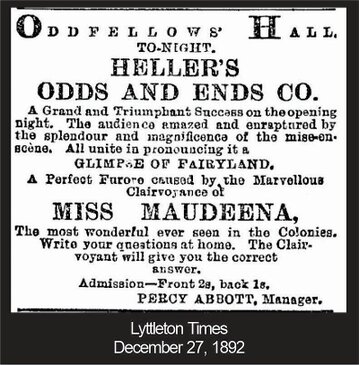
Show business at that time in New Zealand was also vastly over-crowded with foreign performers. The Bendigo Independent carried a long article (15) bemoaning that there were no less than thirty companies inundating a relatively small country, and saying, “With many, the business has been so bad that they have found themselves completely stranded, in inland towns with not sufficient to pay their train fares.”
By January 10, 1893, the team had returned to Sydney aboard the Rotomahana, and they launched immediately into travels in mid-western NSW and then into Victoria, before heading across the strait to Tasmania in June. Despite the fact that Australia was in the grip of a severe depression (1892-93 in particular) they continued to experience success and strong houses. Maude, now being billed as a ‘Rosicrucian Somnomist’ had added ‘The Knight’s Tour’ to her repertoire; a dramatic feat in which she would direct a chess knight to every square of the board without repetition. Whether she used the more difficult memory system, or spied a cue sheet from behind her blindfold, is not known. In April, she received one of her very few negative notices for her singing, the Nepean Times of April 22 stating that “Her voice is neither strong nor sweet, and her attitudinising and affected manner in this part of the performance sits ill upon her.” Similarly, George was criticised once in Tasmania – “This lady is surely entitled to a high place in the ranks of the acknowledged clairvoyants of the universe. Mr Heller, however, lacks the one great essential of the successful amusement caterer – he does not know how to boom.” (14) The Hellers concluded their Tasmanian run in mid-August and travelled to Sydney, where some family matters were to take place.
Marriages in the Family - 1893
 George and Maude were staying at a boarding house at 315 Crown Street, when they went to be married as George Nairn and Elizabeth Brodlay under the rites of the Presbyterian Church on September 21, 1893. Up to this point they had been mentioned in the press as brother and sister. Witness to the wedding was Maude’s sister, Margaret, and is notable that both gave their name as Brodlay, as opposed to the family name from Scotland, Broadley.
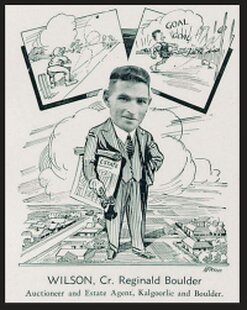
 Margaret and William had two sons, Wallace Henry Wilson (1895-1967, wounded twice as a Private machine gunner in 1916) and Reginald Boulder Wilson (1899-1976, a boxer to 1919, known as ‘Bruiser’, later a Councillor for Boulder). Both brothers followed their father into the auction and real estate business. William Wilson lived until 1926, and only a few years later Maude Heller would travel to Western Australia to live with her sister.