George Waldo Heller and Maude Heller
Ideological Mahatmas and Psychic Somnomists
Chapter Three
Country Touring 1904 - 1906
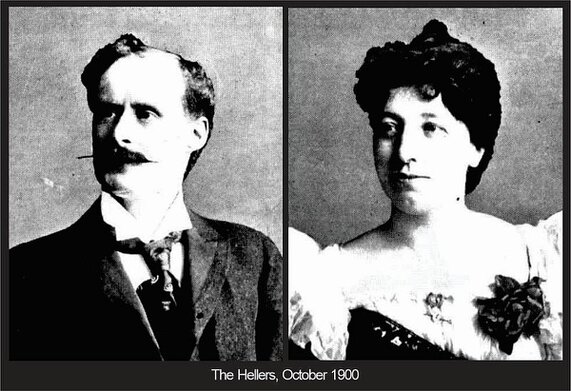
There is not much of novelty to be said about the next few years. The Hellers travelled relentlessly, appearing in all manner of townships with perhaps a town hall or other suitable venue. They returned again to Western Australia in April 1906. Though their repertoire may have remained the same, so did the warmth of their reception everywhere they went:
Geraldton Express May 30, 1906 – “The Hellers, who had previously visited our town about seven years ago, renewed their acquaintance with Geraldton on Monday night, when the performed to one of the largest audiences seen in the Masonic Hall for a long time past. Every foot of available space in the building was occupied, and it was a matter impossibility to find seating accommodation for all. It is satisfactory to be able to state that the entertainment amply justified the extensive patronage accorded it. Few travelling companies of entertainers have given an audience so much for their money as Mr. G. W. Heller’s combination.”
Geraldton Express May 30, 1906 – “The Hellers, who had previously visited our town about seven years ago, renewed their acquaintance with Geraldton on Monday night, when the performed to one of the largest audiences seen in the Masonic Hall for a long time past. Every foot of available space in the building was occupied, and it was a matter impossibility to find seating accommodation for all. It is satisfactory to be able to state that the entertainment amply justified the extensive patronage accorded it. Few travelling companies of entertainers have given an audience so much for their money as Mr. G. W. Heller’s combination.”
George Callender earned his money, placing appropriate advertising and advance teasers in every available newspaper. The Hellers were not touring the smaller towns because they were unable to work elsewhere; it was a strategic choice, as Will Alma (34) would learn when he was mentored by George Heller in later years. Other significant country magicians were Charles Sloggett and Alf Silvester.
“The high expenses charged in the cities and large towns made them unplayable – hall rents and advertising costs being excessive. It was in the ‘smalls’, commonly called ‘tank towns’, the travelling showman made money … It was quite likely that the show was the first for many months, hence the enthusiasm. Most of the ladies ‘brought a plate’ of cakes, scones, etc. for supper. This was more like a meal; it was a ritual providing a time to chat with old friends, discuss farm problems and reminisce about old times.
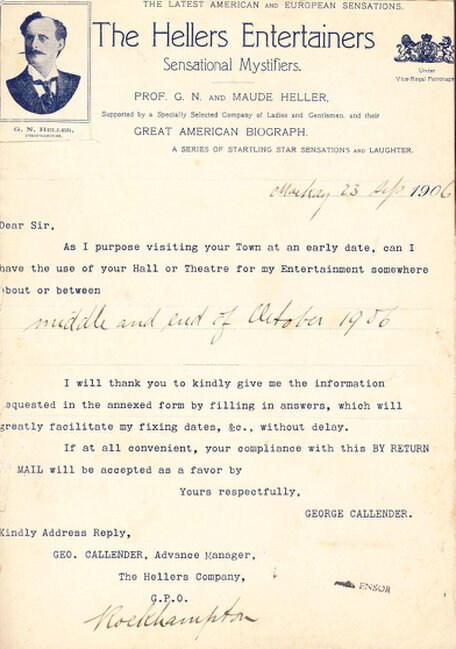
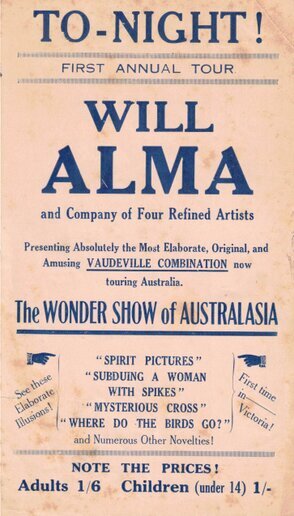
… Postage at the time was one penny for printed matter, and the cost of regular newspaper advertisements for touring shows was thirty shillings. This meant 360 letters could be posted for that amount. Considering that most tank towns were populated by groups of related people, it was seldom necessary to mail more than a dozen or so letters to the principal farms, a poster to the store or post office, and one to the schoolmaster. At no time was it necessary to send out more than 100 letters in the closer settled towns, or districts. Our mailing list was made up from Electoral Rolls.
Another innovation was to play a town, miss a town, right through the week – the following week we would double back and play the missed towns. The whole idea was to create talk and profit by recommendation.” [Will Alma]
1907 – Harry Carmo and the Suevic Disaster
Some rather pedantic research is needed here, to correct a story concerning the Hellers and magician Harry Cameron a.k.a. The Great Carmo. There are perhaps three or four in-depth examinations of the life of Cameron, and each repeats a version of the same tale originally written by Val Andrews in his limited edition book, ‘The Great Carmo’ (35)
“The Australian big-time, due to the small population was somewhat limited. An act could play the Tivoli circuit and would then have to find other outlets for a year or even longer before being considered for another round of the theatres. So with this in mind Harry and Nellie toured with an outfit called Heller’s Entertainers. This tour was cut short when in the February of 1907, professor George Heller and his wife, Maud, decided to sail for England to purchase some illusions. (Heller, being like his more famous namesake, a magician, may or may not have had some influence on Harry’s increasing leaning toward the magician’s art.)
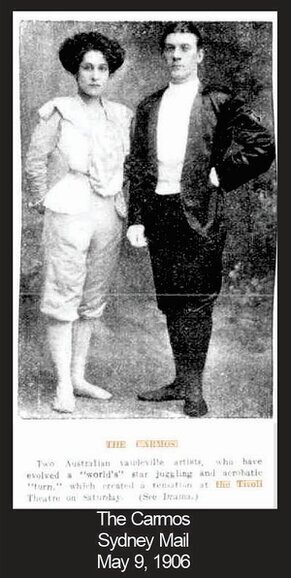 The four of them sailed on the “The Suevik” [sic. – Suevic ], a White Star liner that unfortunately proved ill fated. After a very pleasant voyage, what threatened to be a major tragedy occurred when a severe storm cast the liner upon the rocks of Lizards Point [Cornwall], with such force that the vessel was broken completely into fore and aft sections. Fortunately there was no loss of life, the passengers being rescued by breeches buoy, although it was some days before most of them were re-united with their luggage. Amazing, as it may seem, the front half of the liner was later fitted with a new stern and continued to sail. The Hellers returned to Australia the next year, but the Carmos had started to have their first taste of English variety, so much more extensive than they had experienced at home.”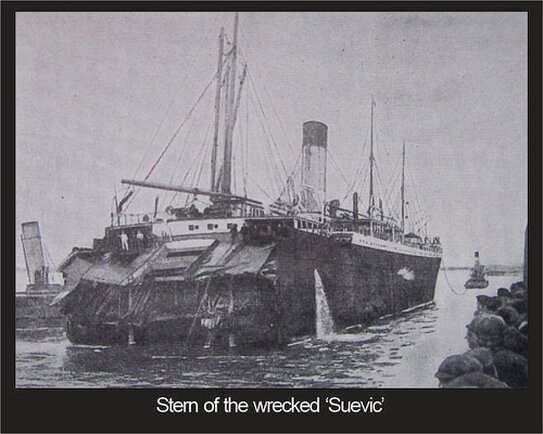
Australian Harry Cameron would go on to an extensive but tragic career as The Great Carmo in both grand magic and circus; his story makes for fascinating reading. Carmo was a dauntless performer against all the odds, including the 1930 loss of his circus big top to fire. (35)
In 1906, however, Cameron was only at the very start of his career. In the press, he can be traced back to appearances in ‘People’s Concerts’ and Rowley’s Waxworks in Melbourne during October 1901, as a “marvellous equilibrist, juggler and contortionist”, his act gradually developing into a display of Herculean strength carrying, balancing and juggling heavy weights – his wife Nellie would stand on a ladder which Cameron then balanced on his chin by one leg only, and walked it across the stage. His first big engagement was in March 1906 at the Adelaide Tivoli, where the Carmos shared the bill with the magical trio, Le Roy Talma and Bosco. Cameron would in later years return to Australia, anonymously, to perform with the Le Roy troupe as “The Great Unknown.”
Val Andrews, unfortunately, has several of his facts wrong in the above anecdote, according to primary sources. From September 1906 until early January 1907, the Carmos were in New Zealand with the Fuller’s Vaudeville company. At the same time, the Hellers were touring in Queensland before returning towards home in December 1906. There is no record located that shows Cameron ever working or touring with the Heller troupe. It is certainly possible that they knew each other, and not unlikely that they consulted about plans to travel to Britain in early 1907.
In 1907, the ‘Suevic’ departed Sydney on January 26, and Mr & Mrs H. Cameron were listed on board (refer note 36 for sources), arriving at its final Australian port, Albany W.A., on February 7, 1907. The Suevic departed Australia on February 8, and passenger lists show Harry and Nellie aboard, but the Hellers are not listed. The route of the Suevic was Sydney, Melbourne, Adelaide, Albany (Western Australia) then to Cape Town (Sth. Africa), Tenerife and Liverpool.
The Hellers, along with George Callender, however, are seen leaving Melbourne on the ‘Ortona’, January 15, 1907 and arriving at Fremantle on January 21, the ship then departing Australia the same day. The Ortona ran a different route, from Sydney, Melbourne, Adelaide, Fremantle, then on to Colombo, Egypt, and London, where it arrived around February 17. Although a departing passenger list has not been located for the ‘Ortona’, it seems unlikely that the Hellers would not have stayed aboard that ship.
The best that can be said, then, is that both Carmo and Heller headed for Britain at more or less the same time, and perhaps Heller had been instrumental in encouraging young Harry to venture into the world. And so, for the second time, George Heller avoided involvement in a shipwreck.
The Hellers and Callender did not return the “following year”, but arrived back at Fremantle on August 10, 1907, aboard the returning ‘Ortona’. It is the passenger lists from this voyage that provided the first definitive proof that George Heller was George Nairn.
Had they, in fact, been away on a business venture? It seems very likely. Only the trio voyaged away, and no record has been found of any performances given by the Hellers in Britain, though Callender was noted as being “with the combination in Scotland”. Will Alma mentions that he was given two dealer catalogues by George Heller, from German magic manufacturers, Conradi and Willmann, with whom George did business. In 1908 the ‘Conjurers Monthly’ reported that Heller had returned with a number of mystic novelties, and most likely this included the Cannon & Boxes and Bridal Chamber illusions which would be seen, if only for a short time, during late 1908.
The best evidence that George was on business, is the two magnificent posters printed by Adolph Friedländer of Hamburg, both dating to 1907 (Shown in Chapter Two). The first is a stock poster which, though beautiful, shows nothing resembling Heller’s show. Friedländer had two similar posters of the same ancient wizard, decapitated woman, demons and skeletons, and the image that Heller selected was also used by Dr. Ormonde’s Great Sunflower Coterie (Scottish magician Andrew Garrioch Ormond) – Friedländer No. 4061.
The second, believed to date from the same year, depicts a lifelike image of George Heller, somewhat incongruously waving an American flag, while the devil and flocks of animals are reminiscent of the posters of Servais Le Roy. Reviews of the Heller show do mention George “producing a quantity of poultry from flags of all nations” and the poster must have attracted attention with its vibrant colours and energetic poses.
Other lithographs produced for the Hellers are more difficult to date. The newer version of “A Few Minutes in Spiritland”, and the evocative image of “Mme Maudeena Heller in her Mesmeric Trance Portrayals” were created by Melbourne printers, P.C. Grosser of Melbourne. Both posters are marked as Queen St, Melbourne, which dates them to at least 1911 or later, since P.C. Grosser’s new building in Queen Street was still under construction in January 1911 (37)
Fifth New Zealand Tour – 1908-1909
Upon their return to Australia in August 1907, the Hellers were once more on the road, playing the small towns with an assortment of supporting variety acts including baritone Harry Fleet, and notably a Mr. Jas. Carson in charge of the coloured movie projections, which were now being promoted as ‘Carson’s Pictures – Two Great Shows in One’ in a distinct move to have a magical first part, followed by movies in the second.
Through 1908, the Hellers were seen in Tasmania, Victoria and New South Wales until, in October, they made their way back to New Zealand for their fifth and final extended tour. Looking to spend a full six months in the islands, they opened on October 31 at Wellington’s Theatre Royal.
For the first and, it seems, only time, George brought out his big new illusions which it may be assumed were purchased during the 1907 trip to Europe.
Free Lance, November 7, 1908 – “The Theatre Royal was packed with a delighted crowd on Saturday evening last, when that gifted company, "The Hellers," opened a season there. Throughout the week the continuance of good houses has attested the high order of the show. Mr. and Mrs. Heller have quite caught on with the crowd. The programme begins with a series of sleight-of-hand tricks of a not altogether novel character, but surpassingly well performed. A series of card tricks defied explanation. Apparently solid rings, after the usual careful examination by the front rows of the pit, became linked and unlinked at the will of the magician while he juggled with them. A very fine item was that in which a "Bridal Chamber," containing the blushing bride and all the furniture and fixings of her apartment, came out of apparent nothingness in four and a half minutes. Another spectacular performance [billed as ‘Big Gun Practice’] was concerned with a lady, a wooden cannon, and a big box. The box was hoisted up to the ceiling, over the dress circle, the lady was placed in the cannon, and the implement was "fired.” When the box was opened on the stage, and one or two other boxes taken out of it, the lady appeared at last, apparently none the worse for the shooting business.
The second part of the programme leads off with "Fifteen Minutes in Spiritland." A green-curtained cabinet, and one or two other trifles, enabled the "spirits" to perform wonders and miracles. Some surprising performances were put up by the conjurer whilst securely bound. One of the two gentlemen taken out of the audience and seated upon the stage was blindfolded and shut up in the cabinet with the magician. A sudden transformation speedily disclosed him arrayed in a white sheet and wearing underneath it, half off and half on, the coat of the conjurer, the latter having donned the other's lost garment. It was a veritable hair-raiser. By way of a climax, the conjurer, having been, declared by the two gentlemen from the auditorium to be firmly tied was, on the removal of the curtain, instantly discovered free. Some fine moving pictures, humorous and illusive, followed, and finally came Mrs. Heller's seance, or mesmeric sleep, in which she answered questions written by persons in, the audience. The results were admitted to be wonderful as to accuracy, and the whole entertainment gave the greatest pleasure and satisfaction.”
The second part of the programme leads off with "Fifteen Minutes in Spiritland." A green-curtained cabinet, and one or two other trifles, enabled the "spirits" to perform wonders and miracles. Some surprising performances were put up by the conjurer whilst securely bound. One of the two gentlemen taken out of the audience and seated upon the stage was blindfolded and shut up in the cabinet with the magician. A sudden transformation speedily disclosed him arrayed in a white sheet and wearing underneath it, half off and half on, the coat of the conjurer, the latter having donned the other's lost garment. It was a veritable hair-raiser. By way of a climax, the conjurer, having been, declared by the two gentlemen from the auditorium to be firmly tied was, on the removal of the curtain, instantly discovered free. Some fine moving pictures, humorous and illusive, followed, and finally came Mrs. Heller's seance, or mesmeric sleep, in which she answered questions written by persons in, the audience. The results were admitted to be wonderful as to accuracy, and the whole entertainment gave the greatest pleasure and satisfaction.”
Historian Bernard Reid (13) names Wellington, Nelson and Blenheim as the places where the ‘Bridal Chamber, and the Cannon and Boxes illusion were performed, but both of the illusions disappeared and were never again seen. Unable to perform such tricks in small town halls, it seems that George had been dazzled by reading some magic dealer’s catalogues, like a dreamy-eyed youngster, and had bought something which suited neither his personality nor his venues. He advertised the props for sale in 1916.
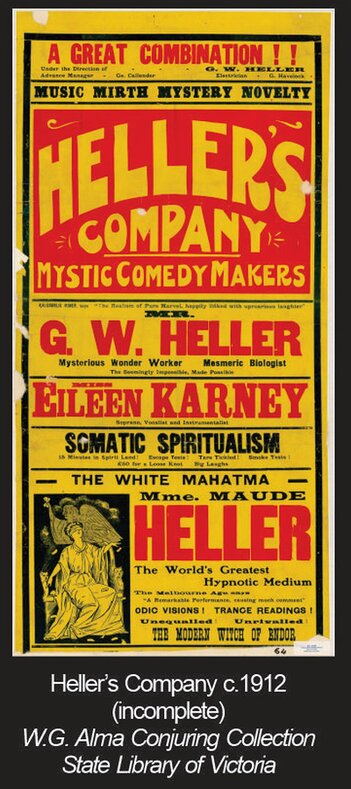
With only a rare occasion on which the audience numbers were small, George and Maude’s tour, once again encompassing small townships, was as successful and well-reviewed as any of their previous visits. In July 1909, the Taranaki Herald included a four-page promotional supplement for the troupe, which included baritone Andrew Black, Jas. Carson on movie duty, and Havelock & Mora, specialty sketch artists (Havelock does not seem to have been related to Vera Havlock of serpentine dance fame).
The ‘Magic Mirror’ magazine of June 1909 reported that “Heller caused a sensation lately at Dargaville, NZ. During Mrs Heller’s description of a murder, in her clairvoyant vision, a startling scream resounded through the hall, and a lady who had heard the description of Madame’s frightful vision had to be carried into the open air, struggling in the throes of a violent attack of hysteria.”
It was a busy time in New Zealand; quite apart from the magical competition in the shape of Chung Ling Soo, Charles Carter and the ‘Maskelyne & Devant’s Mysteries’ with Owen Clark, the country was crowded with every form of hopeful theatrical venture, and George wrote to The Referee (March 3), that “it’s a dead cert some of them will get cold feet … I enclose for you a list for Oamaru … there is a show for almost every day of the month.” New Zealand had been very good indeed to George and Maude, and they were still there until October 1909 before returning to tour in Victoria from mid-November.
Shake-up: 1910 - 1917
In 1910 the company drifted across from Victoria to South Australia heading for Western Australia yet again, and the paragraphs of news text concerning their appearances seem to come more from the pen of George Callender than any local reporter. The distances travelled are quite eye-opening; from Melbourne to Perth is over 3,300 kilometres, in a simple Dodge car. By August they had arrived once again in Western Australia and, as example of their ability to play anywhere, they “opened to a good house” at Day Dawn using their own electric light plant. Day Dawn, once a significant mining town, may have been little more than a crossroads by 1910, and is now a ghost town. At Laverton, Maude’s clairvoyancy took a somewhat astonishing reverse, the Laverton Mercury describing is as “dull and disinteresting, and like similar seances elsewhere, appears to have signally failed in its effect on an enlightened audience.” Elsewhere, the locals were more inclined to remark, “No one but a scientist could tell whether this portion of the programme is genuine or is only a clever fake, but to the outsider certainly it seems genuine and so is weird to the extreme.”
1911 saw a distinct slowing down of the company’s touring, and it seems that some attempt was being made at a partial retirement. Although they were out and about in Victoria, and in the Hunter Valley of NSW, the number of advertised shows was small. There was some gentle ribbing - The ‘Hawklet’ had reported in November 1911, “Heller’s Entertainers, who have been spelling in Melbourne for some weeks, are on the move again, lighting last Monday on a tour built till Christmas.” The Magic Mirror said, “G.W. Heller, in spite of resolutions to the contrary, is on the road again. Now in Gippsland [S.E. Victoria].” And from the ‘Mirror’ of February 5, 1912, “G.W. Heller and Co, doing well on Gippsland tour. Thus fails G.W.’s hundred and first resolution to quit the biz. and take life easy. ‘Once in the business, always in’ comes true very often.”
To make up for the quiet year preceding, the company now travelled north into Queensland, as far up as Cooktown, almost at the northerly tip of the continent. The ‘Magic Mirror’ reported that they struck flooding and in places resorted to travel by boat instead of train, but that business had been good. They had with them once again Mr. W.E. Scott, the ventriloquist and conjurer known as ‘Great Scott’, of whom Will Alma would later write “Few men since Fred MacCabe have been so successful as Great Scott who has always been able to secure a big house on return visits … Great Scott was a one-man show for years, he was a good performer and put on a small apparatus magic show. His unique method of working will interest you ... He would stay in a town for a week and while there advertised and talked about the Great Scott, and billed the town for the Saturday night show of the "Great Scott Company”. He got big houses and the audience got a big surprise when the curtain went up to reveal him as the performer - Great Scott.”
By April 1913 the Hellers were over at South Australia where “Mr. Heller wishes to notify the public that the company will go in recess for an indefinite period on completion of their present tour.” (39) They seem to have almost achieved this between September and December, with a few outbreaks of performing in Victoria, and then by the end of the year the west coast of Tasmania beckoned, travelling with the Sisters Litherland (Cunard), Miss Helen Cunard, Will Fairbank, character comedian, and the Orpheus Trio of instrumentalists. On this occasion, the movie projector seems to have been absent.
The years 1914 and 1915 were significant ones, not for any variety in the Hellers’ show, as they kept on the move through South Australia, Victoria and New South Wales through most of 1914. In December, however, it was reported (32) that Maude had recovered from an accident, being knocked down by a motor car. Her injury may have been more severe than expected, because through all of 1915 there are barely five performances promoted, all in the region of upper NSW and Queensland.
Will Alma’s notes at July 1916 say “Professor Heller, of White Mahatma fame, is still resting in Melbourne since the sad motor accident to his wife.” It was not until August of 1916 that they once again started to perform, and only within Victoria.
Will Alma’s notes at July 1916 say “Professor Heller, of White Mahatma fame, is still resting in Melbourne since the sad motor accident to his wife.” It was not until August of 1916 that they once again started to perform, and only within Victoria.
The other significant event in the world was, of course, the Great War – but if it impacted on the Hellers’ touring or business, there is no sign. The movies shown now included regular clips of “our gallant ANZACs at work in the trenches.” George may have gone out on his own during November 1916, working towns in the southern region of NSW. A much later comment, in April 1919, that “his wife Maudeena is improving in health” indicates just how long she might have been limited in her ability to perform.
In December, before the show was fully back in its stride, another blow fell. In December, advance manager George Tait Callender was reportedly confined to hospital; and on January 18, 1917 he died of pneumonia at Melbourne Hospital, aged 54. Little can be discovered of Callender’s origins or life outside of his twenty years with the Hellers, other than that he had an uncle Mr. Jas Matheson, and it seems that he was effectively alone in the world. George Heller arranged his burial at Burwood Cemetery (40).
George Callender’s contribution to the success of the Heller troupe is inestimable. He had travelled with, and paved the way for, George and Maude in their hundreds of appearances in Australia, New Zealand, and all the other countries they had visited. They acted quickly to take on another agent in Walter A. Price, a busy theatrical manager and promoter who would manage tours and productions for major companies including J.C. Williamson and William Anderson. While Price was regarded as a ‘live wire’, Callender had been solely devoted to acting for the Hellers and nobody could really replace him. Other managers were seen in later years, including W.R. Thompson.
George Heller was now about 57, and Maude 54. They had at some stage found a permanent home base in Melbourne, an attractive but modest terrace house at 60 Story Street in Parkville, just outside the central city. How often they may have been able to stay there is questionable, considering their restless touring. Now, it would have seemed entirely reasonable to give away the travel and work, to enjoy some sort of settled existence. It was not to be.
Resurgence: 1917 – 1922
After Callender’s death in January 1917, it was April before touring resumed, and confined to Victoria and New South Wales with a reduced number of towns visited, some additional support acts, and a reliance on Chaplin films to fill the second half of the show. Business seems to have remained strong, and the usual compliments were given about the quality of the shows. They moved further afield in 1918, back to Tasmania and South Australia, and the press spoke on several occasions about the Heller’s plans to travel to South Africa; even in December, a reference to imminent departure for New Zealand and America, none of which eventuated.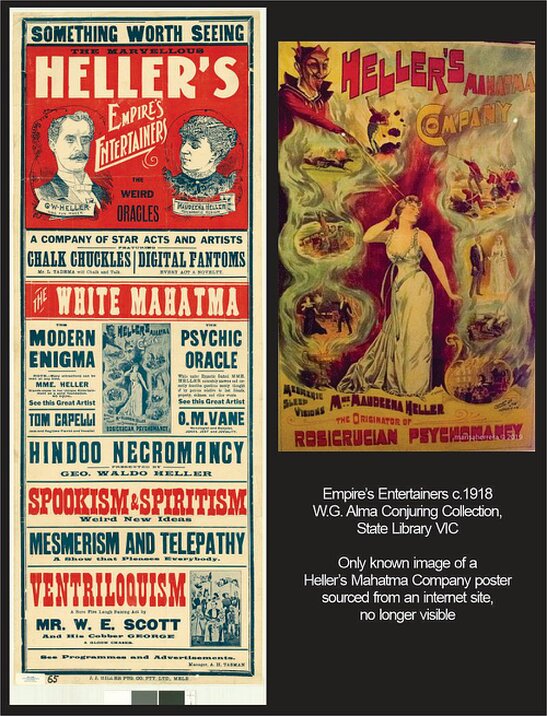
Will Alma's notes covering 1919 include a mention that [April 1919] "G.W. Heller is on the road again, his wife Maude is improving in health and they are able to play West Wyalong, Cargelligo, and Barmedman. George has escaped the flu epidemic. They have been held up in Cootamundra since February.” The influenza epidemic, which infected nearly 40% of the Australian population, had limited their travel, and would continue to be a problem well into 1920 . The Elmore Standard said, “Considering the ravages of the ‘flu, visiting companies are lucky if they get a payable house together these times. Our old friends, the Hellers, are always worthy of patronage of the ‘bumper’ variety.” The year passed with some more travel, but all within Victoria.
Undaunted, the Heller company headed towards Western Australia once more, via towns in South Australia. Along with W.E. Scott were Signor Capelli the eminent pianist, Mons. Bara De Lineo (or some other wide variety of names such as Talema or L. Fadema) who was a ‘chalkographist’, and Will Dane, eccentric banjoist and monologist. The fact that none of those names can be located except in connection with the Hellers would indicate that they were using stage names, or were short-term performers recruited locally. It might be questioned whether Will Dane (or Vane), was Will Van Allen, a more widely known banjoist and comic. Tom Capelli seems to have been a West Australian.
The ‘Westonian’, on June 26, decided to become difficult, and raised the question as to whether all of the questions answered by Maude in her ‘hypnotic state’ were genuine. “In order to prove her contention, will any person in the audience who held the question, ‘Who is right, Hughes or Watt?’ and signed E.L.G. communicate with this office. By doing so it will prove that that question was not held by some members of the company. In like manner would the gentleman who wrote the question, ‘Is the girl pulling my leg? – Jim’ also communicate with this office…” It scarcely mattered, as the company had already moved on. The company successfully filled in till November 1920 in Western Australia, and doubtless Maude took the opportunity to visit with her sister, Margaret, at Boulder.
After a short rest and a journey back east, 1921 saw the troupe in New South Wales from February, with just a couple of incursions into Queensland towards the end of the year. There was a noticeable slowdown in the pace and number of performances; and, possibly for the first time ever, at Port Macquarie on August 27, the Marvellous Hellers Company was billed as the second half of the programme headed up by Och’s Picture, following a drama, a western, and a Chaplin comedy.
Final Run: 1922 - 1927
After returning from Queensland in February 1922, the Heller’s appearances in the press suddenly nose-dived to just a handful of shows during the year, and notably these were in conjunction with a programme of movies, as the cinema began to seriously intrude into the live entertainment business. It seems that the Hellers had almost hung up their hats – in 1923 only a single performance can be located, at Cobram in Victoria, and one more in 1926. It might be that some small-town shows were still undertaken, but effectively the days of touring were done.
Will Alma's notes quote an alarming, but unsourced news item from June 1925 saying "George Heller was accidentally poisoned in an outback hotel, and is seriously ill." We have no further information, but Alma says he never really recovered.
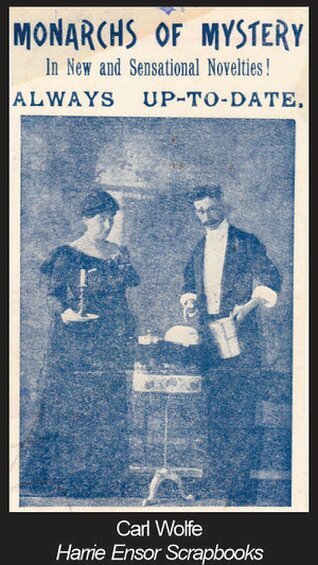
So it is that, in his formative years, magician and historian Will Alma met the Hellers via an introduction from magician Carl Wolfe.
“A nostalgia for information about magic and magicians who have appeared in Australia has been a never ending source of interest for me since my early days. It started in my boyhood, when my father [Oswald Henry Bishop, the magician known as ‘Alma the Mysterious’ and ‘Pharos’] and other old-time magicians like George Heller, Carl Wolfe, Breton, Sylvesto, and Rowe to name just a few, would engross me with their reminiscing. It was not until 1935, when Charles Waller gave me a series of articles for inclusion in a shop magazine I published when conducting the Alma Magic Co, that the ambition to do my own research on our magic pioneers, was established.” (41)
Alma, then, had met up with Heller long before he began his distinguished calling as a historian of Australian magic. (34) “Both of these gentlemen [Wolfe and Heller] gave me, a tyro in magic, valuable advice on the hazards of country touring in the ‘tank towns’ of Australia; where to show, where to avoid, the best way to advertise, and the conditions under which one would have to perform.”
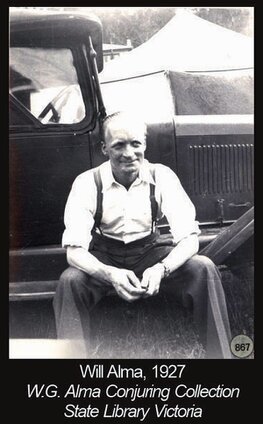
Will Alma, real name Oswald George William Bishop (b.1904), had toured as a child with his parents until 1912. His father had left home in 1913. Around 1919, young Will gave his first performance of magic at a church concert. In May 1927 at the age of just twenty-three, Alma was given the privilege of being mentored by George Heller.
“He was failing in health when we joined forces in 1927, having never fully recovered from being accidentally poisoned a couple of years previous. Our partnership, The Heller-Alma Wonder Show, was primarily arranged to enable him to give me a working insight into country touring. The arrangement being for them to provide pictures and Mrs Heller’s second-sight, and I did the magic and illusions. We started out on a Gippsland tour, but only did three shows, when George collapsed at Nyora, as we were setting up the projector outfit. I brought him back to his home at Parkville, then cancelled the tour. He never recovered, and suffered much before he died [incorrect date] of cancer, in the Bendigo Base Hospital.”
“He was failing in health when we joined forces in 1927, having never fully recovered from being accidentally poisoned a couple of years previous. Our partnership, The Heller-Alma Wonder Show, was primarily arranged to enable him to give me a working insight into country touring. The arrangement being for them to provide pictures and Mrs Heller’s second-sight, and I did the magic and illusions. We started out on a Gippsland tour, but only did three shows, when George collapsed at Nyora, as we were setting up the projector outfit. I brought him back to his home at Parkville, then cancelled the tour. He never recovered, and suffered much before he died [incorrect date] of cancer, in the Bendigo Base Hospital.”
End of the Heller Era: 1933
The final five years of George Waldo Heller’s life are undocumented and probably filled with pain. The Hellers were still at Story St, Parkville, until 1931. On July 8, 1932, under his real name of George Nairn, he was admitted to the Bendigo Benevolent Asylum with stomach cancer, dying six months later on January 3, 1933, aged 73. He is buried at the Kangaroo Flat Public Cemetery, Bendigo, in grave 3939 (Presbyterian section).
George’s death certificate has a couple of unanswered questions. His occupation is shown as ‘labourer’ which either reflects some work he undertook during his final years, or as mentioned previously, that a Theatrical was not regarded as being deserving of the dignity of that title. Australia’s first professional magician, Thomas Amott, was also declared to be a labourer on his death certificate.
As well, two children are mentioned :- “John – dead” would probably indicate an infant mortality, but “Maude – 42” presents a query that has not been answered. If we go by an accurate age, ‘Maude’ would have been born in 1891, two years after the couple arrived in Australia, but two years before they married. The complexities of their marriage, separate surnames, and that ‘Maude’ may have been a pet name like her mother’s, has made it impossible to discover any birth in Australia. The hectic touring life of the Hellers would have left little room for a child who, if she had lived with them, would surely have been introduced as a performer in the company, in the usual tradition of show families.
Given the circumstances, it might be questioned whether mother Elizabeth/Maude Broadley had actually given birth, unwed, in Scotland, and been compelled to give up the child. If so, that might have been the incentive to leave Scotland behind and escape to the other side of the world; but we can only speculate.
Given the circumstances, it might be questioned whether mother Elizabeth/Maude Broadley had actually given birth, unwed, in Scotland, and been compelled to give up the child. If so, that might have been the incentive to leave Scotland behind and escape to the other side of the world; but we can only speculate.
Will Alma went on to tour successfully in both country and city Victoria, including the Tivoli circuit. In later years he made efforts to locate the facts about George and Maude, but without knowing the name ‘Nairn’ he made no progress. He stated later, “I believe his films and projector were sold, and a considerable quantity of his publicity material. The purchaser took out a show using same during 1928. I have not been able to discover who this was.” (34)
The general word was that Maude had gone to Western Australia to live with her sister; and that is exactly what happened. For the next fourteen years, Maude lived in Boulder, with her sister Margaret Ritchie Wilson, whose husband William had died in 1926. Did Maude miss the travelling life? Was it a loss, or a relief, to no longer be ‘the world’s greatest hypnotic medium’?
Margaret Ritchie [Broadley] Wilson passed away at 92 Piesse street, Boulder, on July 9, 1946 leaving two sons, Wallace H. and Reginald B. Wilson.
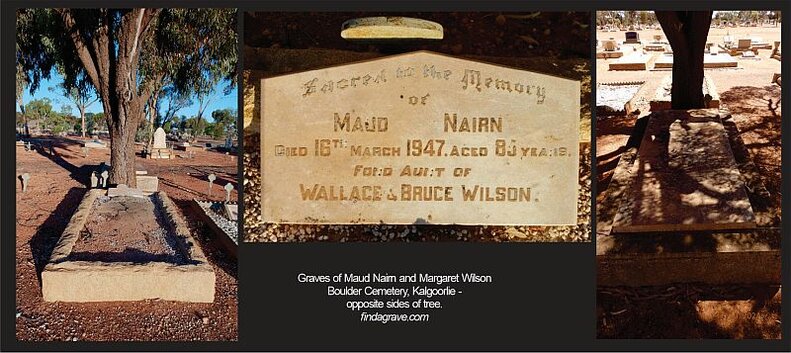
Less than a year later, Elizabeth/Maude Broadley/Nairn/Heller died on March 16, 1947. The sisters are buried in back-to-back graves at the Boulder Cemetery.
Less than a year later, Elizabeth/Maude Broadley/Nairn/Heller died on March 16, 1947. The sisters are buried in back-to-back graves at the Boulder Cemetery.
“In 1890, I saw a real magician. George Waldo Heller …
for nearly forty years, from top to bottom,
and from side to side, of Australia, with just a few temporary ‘retirements’, he presented his night of magic.
I was entranced by his show, and as I walked home that night I registered a vow that I, too, would be a wizard.” – Charles Waller (43)
for nearly forty years, from top to bottom,
and from side to side, of Australia, with just a few temporary ‘retirements’, he presented his night of magic.
I was entranced by his show, and as I walked home that night I registered a vow that I, too, would be a wizard.” – Charles Waller (43)
REFERENCES
(1) Robert Heller and associated tales by Kent Blackmore:My original article on the mystery of Heller’s identity was published in the August 2023 (#29) issue of Jim Hagy’s Perennial Mystics, Squared.
(2) Hamilton Spectator August 9, 1892. Angelo Crotch Palmer, brother of William Henry Palmer (Robert Heller), lived in Australia, where he worked as a solicitor in Hamilton, Victoria. Angelo had a son, Saxon Harold Palmer, who died in 1932 – a true nephew of Robert Heller.
(3) Mahatma, September 1898 and October 1899 commentary by Robert Kudarz (Tom Driver)
(4) Alma’s collection is the W.G. Alma Conjuring Collection at the State Library of Victoria
https://www.slv.vic.gov.au/search-discover/explore-collections-theme/film-performing-arts/magic/wg-alma-conjuring-collection
https://www.slv.vic.gov.au/search-discover/explore-collections-theme/film-performing-arts/magic/wg-alma-conjuring-collection
(5) W.G. Alma file on George Waldo Heller, held at the above collection.
(6) Ensor Scrapbooks https://sydneymagic.net/ensor.html in Volume 6, image 9
(7) Deaths registered in Bendigo, Victoria – entry 10204, 3rd January 1933. Death notice in The Age, January 5, 1933, “beloved husband of Elizabeth Nairn”.
(8) James Nairn’s grave details at https://www.findagrave.com/memorial/272921112/james-nairn show his birth date as 1799, death at 1884, which would make him 84-85 at death. However the transcription comments below, and his death notice (Wishaw Press, May 24, 1884) say he was 74. The same site says Margaret Nairn died March 24, 1887.
(9) An approximate list of the towns covered between 1883-1889 is:
Aberdeen, Alloa, Ardrossan, Ashton, Blackburn, Blyth, Bradford, Bury, Cockermouth, Cowdenbeath, Crewe, Darlington, Dundee, Dysart, Earlston, Edinburgh, Falkirk, Fife, Galashiels, Glasgow, Greenock, Haddington, Hamilton, Hartlepool, Huddersfield, Irvine, Kirkcaldy, Leeds, Linlithgow, Liverpool (Bijou Opera House), Longton, Magpie, Manchester, Markinch, Melrose, Muirkirk, Oldbury, Oldham, Peebles, Preston, Selkirk, Shields, Sunderland, Warrington, Whitburn, Wigan, Wigton, Wolverhampton, Workington.
Aberdeen, Alloa, Ardrossan, Ashton, Blackburn, Blyth, Bradford, Bury, Cockermouth, Cowdenbeath, Crewe, Darlington, Dundee, Dysart, Earlston, Edinburgh, Falkirk, Fife, Galashiels, Glasgow, Greenock, Haddington, Hamilton, Hartlepool, Huddersfield, Irvine, Kirkcaldy, Leeds, Linlithgow, Liverpool (Bijou Opera House), Longton, Magpie, Manchester, Markinch, Melrose, Muirkirk, Oldbury, Oldham, Peebles, Preston, Selkirk, Shields, Sunderland, Warrington, Whitburn, Wigan, Wigton, Wolverhampton, Workington.
(10) Goulburn Evening Penny Post, October 5, 1889
(11) This Percy Abbott was not the same Abbott who later became famous as a magic dealer in the U.S.A. His published songs include ‘My Lad’ (1893), ‘The Man Behind the Gun’, ‘Gwendolyn’, ‘La Beau Sabreur’, ‘Messenger Birds’ and ‘Tis Not Forever’.
Abbott’s stories for The Bulletin can be viewed at https://trove.nla.gov.au/search/category/magazines?keyword=%22Perce%20Abbott%22%20bulletin including a tale, ‘Bar Bound at Ballina’ which might be suspected to have come from experiences in travelling with the Heller show.
Abbott’s stories for The Bulletin can be viewed at https://trove.nla.gov.au/search/category/magazines?keyword=%22Perce%20Abbott%22%20bulletin including a tale, ‘Bar Bound at Ballina’ which might be suspected to have come from experiences in travelling with the Heller show.
(12) This description is from Nepean Times, April 22, 1893
(13) Bernard Reid’s first volume of New Zealand magic history, Conjurors, Cardsharps and Conmen’ was published in 2015 by Mary Egan Publishing, in an edition of 200 copies. Presently there are no plans to re-publish this volume. Reid’s four volumes ‘Magicians in the Golden Age of New Zealand Vaudeville’ are available from Lulu.com https://sydneymagic.net/reid-books.html
(14) The Tamanian (Launceston) August 12, 1893.
(15) Bendigo Independent, November 5, 1892 p. 2
(16) Hawera & Normanby Star, November 14, 1893
(17) From a letter written by Will Alma to Bayard Grimshaw in 1972. W.G Alma Conjuring Collection, State Library of Victoria.
(18) People’s Weekly (Moonta, S.A.) March 30, 1895
(19) Otago Witness, recollection from January 25, 1900
(20) The Jameson Raid https://en.wikipedia.org/wiki/Jameson_Raid
(21) Salon Lumiere, September 1896 under the direction of Marius Sestier, and later under James McMahon as the Salon Cinematographe.
(22) Mr William C. Bays, a well-known advance agent, was acting for the Hellers for a short time before George Callender took up the role again.
(23) Passengers aboard the Tasmania https://www.sooty.nz/1897SStasmania.html
(24) George Heller’s letter to David Devant is reproduced with kind permission of the owner John Davenport - https://www.davenportcollection.co.uk/ and thanks to Ian Keable.
(25) This was Morritt’s “Turkish Delight” illusion presented in Australia in 1897-1898, using the same principles as the Convict’s Escape, or Morritt Cage, illusion.
(26) Bernard Reid (see note 13) has for some reason missed much of the Heller’s tour, stating that they were not seen between April 1898 and the end of the year. They were, in fact, highly visible and touring constantly.
(27) The Magic Circle Mirror magazine, August 1973.
(28) Brisbane Courier, June 5, 1899
(29) Hercat claimed the invention of ‘She’ in his 1903 book, Dean’s Practical Guide Books series Latest Sleights, Illusions, Mind Reading and New Card Effects. See Edwin A. Dawes’ ‘A Rich Cabinet of Magical Curiosities’ No.33 for a detailed essay on Hercat and ‘She’.
Unconfirmed credits for the ‘She’ illusion are also proposed in Harrie Ensor’s “Magical Reminiscences” saying that the origins go back to 1884 with a Charles McDonald, and Professor Seeman (probably Baron Hartwig Seeman.)
Unconfirmed credits for the ‘She’ illusion are also proposed in Harrie Ensor’s “Magical Reminiscences” saying that the origins go back to 1884 with a Charles McDonald, and Professor Seeman (probably Baron Hartwig Seeman.)
(30) See ‘Lost Morritt’ by Jim Steinmeyer, a Hahne publication, 2019.
At https://www.ishilearn.com/staged-identities-they-see-nothing-at-all , Jamie Barras connects the Morritt Cage / Convict’s Escape to another illusion named Flyto, which had a theme using two cages, which Morritt presented, but had likely purloined from Chevalier Ernest Thorn’s illusion ‘The Dream of the Chalif’.
Barras states that “Flyto became ‘The Convict’s Escape’ by simple virtue of reducing the number of cages from two to one”; a claim that does not stand up when the methods of each illusion are known. Flyto used a Black Art principle. The Convict’s Escape, as Jim Steinmeyer points out, was an evolutionary copy of Maskelyne’s “Will, the Witch and the Watchman” cabinet, using principles of reflection. Leon Herrman did present a transposition illusion using a convict in cage, probably using the Flyto principle, and Flyto was a feature of both Kellar and Carter’s shows.
At https://www.ishilearn.com/staged-identities-they-see-nothing-at-all , Jamie Barras connects the Morritt Cage / Convict’s Escape to another illusion named Flyto, which had a theme using two cages, which Morritt presented, but had likely purloined from Chevalier Ernest Thorn’s illusion ‘The Dream of the Chalif’.
Barras states that “Flyto became ‘The Convict’s Escape’ by simple virtue of reducing the number of cages from two to one”; a claim that does not stand up when the methods of each illusion are known. Flyto used a Black Art principle. The Convict’s Escape, as Jim Steinmeyer points out, was an evolutionary copy of Maskelyne’s “Will, the Witch and the Watchman” cabinet, using principles of reflection. Leon Herrman did present a transposition illusion using a convict in cage, probably using the Flyto principle, and Flyto was a feature of both Kellar and Carter’s shows.
See Hercat’s book at (30), Harper’s Round Table July 21, 1896 p.922 – article by Henry Hatton
https://www.gutenberg.org/cache/epub/58868/pg58868-images.html
and ‘Kellar’s Wonders’ by Mike Caveney and Bill Miesel, Mike Caveney’s Magic Words 2003.
(31) See Magic Stage Illusions and Scientific Diversions, by Albert A. Hopkins 1897 p.520.
(32) Most of Will Alma’s notes are meticulously referenced to their primary source. However, he has three typed pages of valuable short news items, dated, about the Hellers, which seem to come from some (theatrical?) magazine source which is not named and cannot be identified. Alma heads these pages as “Extracts from the Notebooks of Will Alma (Magicians Doings file)” but any such notebooks are yet to be traced within the W.G. Alma Conjuring Collection at the State Library of Victoria. The accuracy of the stories is not in doubt.
(33) With thanks to The Australian Performing Arts Collection, Arts Centre Melbourne https://collections.artscentremelbourne.com.au/ for permission to reproduce their Dante and Heller posters.
(34) Extracts from a three-page article by Will Alma for The Perennial Mystics (Jim Hagy), No. 8, 1990, titled “Touring In Australia Before the Talkies”. This basic story was also used by Alma in other letters held in the ‘Heller’ folder at SLVIC.
(35) Carmo’s tale can be found in Val Andrews’ book ‘The Great Carmo’ (2001 – available at library.com), and Stuart McMillan’s ‘The Great Carmo’ (2025). Andrews mentions having passed all his research material to Bayard Grimshaw who was planning to write a book as early as 1958; Grimshaw did not complete the book. Grimshaw’s research items were sold by Potter & Potter Auctions in their September 2020 Circus auction, and McMillan’s book draws upon his papers.
https://auctions.potterauctions.com/_Carmo__Harry_Cameron___The_Great_Carmo_Circus_Res-LOT31689.aspx
https://auctions.potterauctions.com/_Carmo__Harry_Cameron___The_Great_Carmo_Circus_Res-LOT31689.aspx
The Suevic tale is also retold in ‘Paul Daniels and the Story of Magic’, by John Fisher (1987)
Will Alma’s typewritten notes also tell the same tale, but there is again no source reference.
Will Alma’s typewritten notes also tell the same tale, but there is again no source reference.
(36)
- Departure of Suevic from Sydney – Daily Telegraph January 26, 1907 p.12
- Arrival of Suevic at Albany – Albany Advertiser, January 9, 1907 p.2
- Passenger list of Suevic upon departure from Albany sighted, and extract provided by, Curator at State Records WA:
https://archive.sro.wa.gov.au/index.php/suevic-t-j-jones-master-bound-to-london-11-1925
- Hellers departure from Melbourne on ‘Ortona’:
https://prov.vic.gov.au/archive/299234A7-F7F0-11E9-AE98-0B0FA862649F?image=164
- Departure of the ‘Ortona’ from Fremantle – The West Australian February 20, 1907
- Departure of Suevic from Sydney – Daily Telegraph January 26, 1907 p.12
- Arrival of Suevic at Albany – Albany Advertiser, January 9, 1907 p.2
- Passenger list of Suevic upon departure from Albany sighted, and extract provided by, Curator at State Records WA:
https://archive.sro.wa.gov.au/index.php/suevic-t-j-jones-master-bound-to-london-11-1925
- Hellers departure from Melbourne on ‘Ortona’:
https://prov.vic.gov.au/archive/299234A7-F7F0-11E9-AE98-0B0FA862649F?image=164
- Departure of the ‘Ortona’ from Fremantle – The West Australian February 20, 1907
(37) The Herald January 12, 1911 p.3 – new construction by H.R. Crawford
(38) J. Carson might be suspected to be John Thomas Carson, later the proprietor of Taree’s Boomerang Theatre, except that a news article states that he became involved with cinema in 1910 Britain, only moving to Australia in 1910.
(39) Southern Argus April 24, 1913
(40) George Tait Callender is buried at Burwood Cemetery, Melbourne, plot CE 4 M 27.
(41) Will Alma’s “The Magic Circle Mirror / Australian Magic Review” Vol 1. No.2, April 1971
(42) https://www.bendigofamilyhistory.au/layout.php?p=31 record of admission to Bendigo Benevolent Asylum.
(43) Charles Waller in The Magic Circle Mirror, January 1977
General travels of George Waldo Heller 1889-1923
This is an approximate indication of his major travels during a particular year.NSW – New South Wales SA – South Australia QLD – Queensland TAS – Tasmania
VIC- Victoria WA – Western Australia
1889 – SA, Melbourne, Sydney, Brisbane
1890 – Sydney, NSW, VIC
1891 – NSW, QLD
1892 – NSW, VIC, New Zealand
1893 – New Zealand, NSW, TAS, New Zealand
1894 – New Zealand, NSW
1895 – VIC, SA, WA
1896 – South Africa, Britain
1897 – NSW, QLD, New Zealand
1898 – New Zealand
1899 – New Zealand, NSW, QLD
1900 – NSW, TAS, VIC, WA
1901 – WA, VIC, Colombo
1902 – Bengal, Pakistan, India, Burmah
1903 – ‘Retired’ to Scotland
1904 – VIC
1905 – TAS, VIC, NSW
1906 – WA, VIC, QLD
1907 – Britain, VIC
1908 – TAS, VIC, NSW, New Zealand
1909 – New Zealand, NSW, VIC
1910 – SA, WA
1911 – VIC, NSW
1912 – VIC, NSW, QLD
1913 – SA, TAS
1914 – VIC, NSW
1915 – NSW, QLD
1916 - VIC
1917 – VIC, NSW
1918 – VIC, TAS, SA
1919 - VIC
1920 – SA, WA
1921 – NSW, QLD
1922 – QLD, NSW
1923 - VIC