George Waldo Heller and Maude Heller
Ideological Mahatmas and Psychic Somnomists
Chapter Two
Chapter 2 - Australia and New Zealand 1893-1906 |
Second New Zealand Tour – 1893
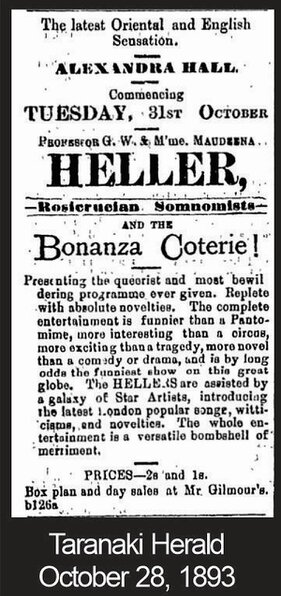 George and Maude could not have been present at Margaret’s wedding. Scarcely drawing breath after their own marriage, they had returned to New Zealand in early October, commencing October 9 at the small town of Feilding on the North Island. Maude had now become ‘Mme. Maudeena’ rather than ‘Miss Maude’, and the company was billed as the Bonanza Coterie.
Again we leave the most detailed description to Bernard Reid (13), but it was the start of a remarkable tour in which the Hellers travelled relentlessly and drew overflowing houses wherever they went:-
“The third performance of the Hellers was given on Monday evening, (16) when there was a packed house. The interest of the audience was held from the start to the close of the entertainment, and the performers were accorded applause for every effort. Some very clever feats in conjuring were performed by Mr. Heller with a neatness that stamped him as an artist of the first rank. The songs of Mr Abbott were well received, and he had to respond to a recall … the somnomancy portion of the entertainment was, however, the most wonderful. Miss Heller answered a very large number of questions with startling correctness, and was most exact in her details. One lady in the audience was so overcome by the answer to a question that she partially lost consciousness, and restorative had to be applied … Mr. Heller has decided to play again this evening, then another full house will doubtless be obtained.”
From October to December, the Coterie visited at least twenty townships. The focus of most reviews was heavily weighted towards Maude’s clairvoyant routine. Though the Hellers were clear that their act was ‘for entertainment purposes only’, audiences were astonished at the bold statements made by Maude. This sort of routine, along with spiritualist ‘expose’ acts, also seemed to have become something of the flavour of the month, the Hellers riding the crest of a wave. It can hardly be said that the Hellers were doing something new – The original Hellers, Robert and Haidee, had brought the second-sight routine to a peak of perfection in Australia and N.Z. from 1869, with their multiplicity of methods including verbal and silent codes, and a mechanism permitting a hidden assistant backstage to communicate directly into Haidee’s ear.
Keller’s Royal Illusionists and the Fakir of Oolu were contesting the Davenport Brothers back in 1876. S.S. (Samri) Baldwin and Clara had toured Australia in 1878, and New Zealand in 1879.
It was, perhaps, the tour of magicians and mentalists, Charles and Martha Steen (from October 1892) that had sparked New Zealand’s current fascination with all things seemingly psychic. The Steens were regarded as being the premiere second-sight performers, and the story is told that George had seen their act and admitted himself beaten by their skill. But the Hellers’ abilities put them near the head of the queue, and they reaped the rewards.
Not everybody made their fortune from the two-person mentalism act. Ada Fitzroy was highly successful in Australia but in competition with the Steens in New Zealand she was outclassed; in fact, in February 1893 she joined the Steen company (performing her ‘Georgia Magnet’ routine) during a severe illness of Madame Steen. Ada returned to Australia by March 1893. In 1894, Charles Silvester, son of Alfred Silvester the Fakir of Oolu, nearly starved and was charged by the police for nothing more than performing his standard Supernatural Vision act on a Sunday, in a desperate attempt to support his wife and partner, Eleanor, and their children.
Maude’s outstanding feature was her direct and confident answers to questions, and her boldness in forecasting coming events. In Napier she was asked “Where is Jack the Ripper?” and responded by claiming that Jack would soon be revealed as a woman. When an audience had no clue to the Heller’s methods, they were regarded as something at least bordering on the supernatural, even if they did not claim as much. New Zealanders, however, were not content to sit in awe. They were, after all, the people who had dealt the final defeat to the Brothers Davenport by tying them with the unbeatable ‘Tom Fool’s Knot.’
The Hellers had started 1894 by going to the southern-most tip of the South Island, and working their way back north. The many townships, each with a theatre or hall convenient for a performance, made for ideal touring conditions, especially since they were not travelling with a heavy load of props. In Mataura there started a growing inclination to dissect and critique the Somnomancy act, and there was speculation that somehow, the questions written were transferred from the body of the hall to be made visible to Maude onstage; and that she was able to give the names of the questioners, since those names had been written on the slips. Comparison was also made of some of the principal questions asked in different towns, which proved to be very similar in each town. Percy Abbott was alleged to be the backstage assistant to Maude.
George, at one point, tried to soften the speculation with a letter to the newspapers, but it only rebounded against him. What had once been astonishing and entertaining, was starting to become a competition to expose the Hellers, and it reached a point of particular nastiness:-
Tuapeka Times, June 23, 1894:
“Naturally enough the precious brace of individuals who travel round the country under the designation of the "Heller Bonanza Coterie" are not pleased at our exposure of their "somnomancy" business, in the working of which the female member of the combination plays so important a part. Heller, who has all the audacity and more than the usual illiteracy of the Yankee showman, has been writing to several of the papers throughout Southland and Otago in which our exposures of the somnomancy exhibition had been reproduced, endeavouring ineffectually to explain away our statements. We have also received a letter from his "pal" Abbot, written on very dirty paper and in a hand and in such English as would disgrace an Italian organ grinder or a very ignorant coal-heaver. Abbot, it may be remembered, was the individual that used to thump the piano while he sang songs of questionable taste in a voice with about as much music in it as there is in the braying of a hungry ass or the professional cry of an exhausted fishman. He also strummed on a consumptive banjo, but his chief business in the show was to get behind the scenes and work the reflector dodge for Madame, whom Heller pretended to have thrown into a mesmeric state, but who was, indeed, quite as wide-awake as her accomplice Abbot in hiding behind the wings. We have a high respect for legitimate art and ability ; but hold that those vulgar and repellent somnomancy exhibitions should be discouraged and exposed if only for their demoralising effect on the public taste. We think also the law should be amended to put down the kind of able-bodied vagabondage of which this man Abbot is an objectionable type. If miserable women who eke out an existence by fortune-telling are hunted down and prosecuted by the Police, we are at loss to understand why an exception should be made in favour of people who practice publicly the more glaring and offensive tricks of the "Coterie."
“Naturally enough the precious brace of individuals who travel round the country under the designation of the "Heller Bonanza Coterie" are not pleased at our exposure of their "somnomancy" business, in the working of which the female member of the combination plays so important a part. Heller, who has all the audacity and more than the usual illiteracy of the Yankee showman, has been writing to several of the papers throughout Southland and Otago in which our exposures of the somnomancy exhibition had been reproduced, endeavouring ineffectually to explain away our statements. We have also received a letter from his "pal" Abbot, written on very dirty paper and in a hand and in such English as would disgrace an Italian organ grinder or a very ignorant coal-heaver. Abbot, it may be remembered, was the individual that used to thump the piano while he sang songs of questionable taste in a voice with about as much music in it as there is in the braying of a hungry ass or the professional cry of an exhausted fishman. He also strummed on a consumptive banjo, but his chief business in the show was to get behind the scenes and work the reflector dodge for Madame, whom Heller pretended to have thrown into a mesmeric state, but who was, indeed, quite as wide-awake as her accomplice Abbot in hiding behind the wings. We have a high respect for legitimate art and ability ; but hold that those vulgar and repellent somnomancy exhibitions should be discouraged and exposed if only for their demoralising effect on the public taste. We think also the law should be amended to put down the kind of able-bodied vagabondage of which this man Abbot is an objectionable type. If miserable women who eke out an existence by fortune-telling are hunted down and prosecuted by the Police, we are at loss to understand why an exception should be made in favour of people who practice publicly the more glaring and offensive tricks of the "Coterie."
Ultimately, this kind of attack did little harm to the show, and the Hellers continued to rake in the money with what was, after all, a magic and variety show which included a very clever mentalism act.
What might have been the techniques of the Hellers? From descriptions of the act it is clear that (as the critics suggested) they were using what is now called ‘pre-show’ work to gather information, code communication such as had been brought to a masterful peak by Robert and Haidee Heller, local research into news stories of the day, and sheer opportunism in the many predictions thrown out by Maude. If they were perhaps less technical and more pragmatic than other mentalism acts, it worked extremely well for them, for the entirety of their lives.
We know from a reliable source, Will Alma, one part of their methodology (17). “They cashed in with their Mental act and Spirit Cabinet. Questions written in the usual manner on paper slips were collected by George in a newspaper cone, and emptied on to a metal tray, then burnt. Most being retained in bottom of cone when it was screwed up and thrown off stage. Some magic followed. In the meanwhile, Maudeena retrieved the screwed-up cone, memorised the questions, and answered them at a later time. At this she was exceedingly good.
George had a magnetic personality, full of animation and was one, even in his late years, of the best showmen I have met. Maudeena was a very hard woman to get along with – on a par with Chefalo’s first wife, Palermo.”
George had a magnetic personality, full of animation and was one, even in his late years, of the best showmen I have met. Maudeena was a very hard woman to get along with – on a par with Chefalo’s first wife, Palermo.”
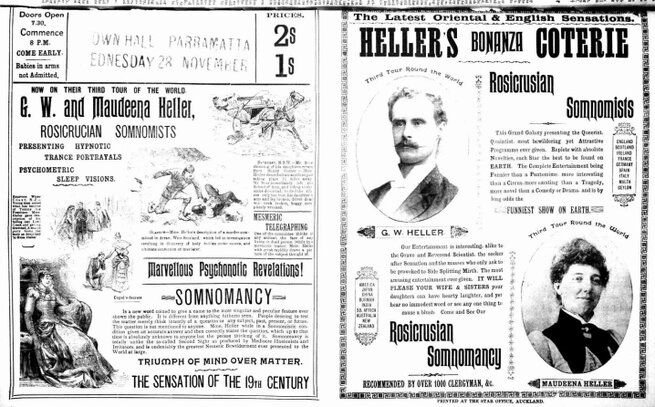
The Hellers toured throughout 1894, sometimes retracing their steps to play return seasons, and their success was nothing short of remarkable. They concluded at Wellington in early November, and returned to Australia where, in the Cumberland Argus of November 24 they distributed a four-page flyer which had been printed in Auckland. A couple of exaggerations are evident – this was not their third world tour, a quote from the Prince of Wales is dubious, and a review attributed to the Cape Argus (South Africa) does not align with the fact that they were playing in New South Wales at the time, although they would later travel to South Africa.
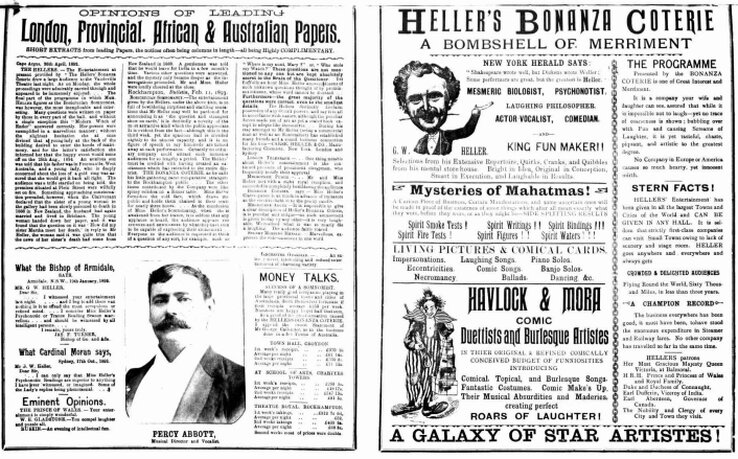
By March the Coterie had travelled across to South Australia, and eventually to the Bijou Theatre in Adelaide (from May 4). A review by the People’s Weekly (18) gives us another small insight into the presentation of Maude’s question-answering:
“Persons in the hall were given slips of paper, upon which they wrote questions. This being done they were all gathered into a small bag, and there being too many – which, no doubt, is very often the case – they were mixed up by one of the audience, so that everyone might have a chance of their question being answered. After this the bag was again passed around, and about thirty of the slips were distributed. Madame Heller then wrote the questions on a blackboard, and answered them, the following being among them …” So the slips to be answered were held by various members of the audience, and Maude would say “Someone is thinking of …” and give her answer.
All three of the performers regularly gave comic songs, and Mr Abbott was featured with his banjo, which were well received. Other news reviews mention George performing magic with eggs, growing and shrinking handkerchiefs; also the Aerial Bell and the Spirit Dial in which a clock dial, hung high on the stage, pointed to any hour requested. These last tricks were familiar parts of the original Robert Heller’s repertoire.
In late May 1896 the company boarded the s.s. Rockton and sailed to Fremantle in Western Australia, where they would take on an extra performer, ventriloquist Oscar Smith. At Perth, Maude gave a detailed but unverifiable answer to a question concerning an old murder case. She described the murderer as a tall dark man, about 6ft. high, and said he used broken English. The murderer was now in Equador, but would return to the colony in about two years’ time, and proceed to Coolgardie, where he would confess his crime on a bed of sickness. Needless to say, had this ever happened, Maude would have been hailed to the skies as a psychic of the greatest ability.
George’s trek westwards across the country was done with a purpose. After performing extensively for some months through the coastal regions of Western Australia and further inland to goldfields Coolgardie and Kalgoorlie, and finally at Albany until September 7, the Bonanza Coterie departed for South Africa. Although records for that time are very sparse, they can be traced to South Africa in early December 1896. At the time of the botched British insurrection (The Jameson Raid – see note 20), the company was at Kimberley, later at Harrismith, and on January 27 were at Tathan’s Hall, Ladysmith, on January 27 where, according to the Otago Witness (19) the company cleared £100 in a two-night season. Ventriloquist Oscar Smith had been dropped from the troupe at Capetown, the report saying that he had “an awful thirst” or, in plainer terms, he was a drinker. The company was still in Africa at least into March. Our best information comes from the West Australian (January 9 1896) publishing a letter from George:-
“PROFESSOR HELLER, who with his wife, Madame Heller, performed in Perth a few months ago, has written from South Africa to a friend, giving some interesting details of theatrical matters in that part of the world. He writes from Queltshorn [not known – possibly Oudtshoorn?], under date of December 1st. In the course of his remarks he says "everything is expensive over here, and business not to be relied upon. Most of the dramatic companies are doing poorly at Capetown and other places, except the Rand (ie. Johannesburg), where there are two music halls and a couple of theatres. The London Gaiety Company, however, did well. From what I can see so far, it is too mixed a country and the Dutch-speaking crowd too indolent to go to a show. There is not much attached to it, but I am doing all right, my wife's hypnotic sleep visions being the attraction. The climate where I am at present is like that of Rockhampton. Travelling here puts you in mind of going to Coolgardie, but with less comforts. All vehicles are two-wheeled, called Cape Carts, and carry about four people and 100lbs. of luggage, so you can fancy my troubles. The Payne Family were here for six nights. I had a 125 miles' coach trip to the next town, a two days' journey. On the railway "pros." travel second class at third-class rates. Fifty pounds of luggage are allowed, and all in excess is charged for at the rate of 1d. per lb.
There are about fifty companies all struggling to pull through, and most of them do not. Circus and semi-religious shows pay best. The principal towns are Johannesburg (100,000 inhabitants), East London (15,000), Port Elizabeth (15,000), Durban (10,000), Pretoria (4,000), Pietermaritzburg (3,000), Cape Town (8,000), and Kimberley (8,000). The others are all small, so that you can form an idea when you deduct natives and Dutch what attendances to expect. The prices charged by the theatricals are the same as in Australia, from 1s. upwards, except at the Rand, where 2s. or 2s. 6d. is the lowest figure. There is a duty of 100 per cent. on printed placards, etc., brought into the Rand. The Goddard-Ryan fight has just come off. It was a fizzle, but they got big money. I shall stay in the country for about eight months, and shall then go to London, visiting India and Australia again in 1897 if my present ideas are carried out."
There are about fifty companies all struggling to pull through, and most of them do not. Circus and semi-religious shows pay best. The principal towns are Johannesburg (100,000 inhabitants), East London (15,000), Port Elizabeth (15,000), Durban (10,000), Pretoria (4,000), Pietermaritzburg (3,000), Cape Town (8,000), and Kimberley (8,000). The others are all small, so that you can form an idea when you deduct natives and Dutch what attendances to expect. The prices charged by the theatricals are the same as in Australia, from 1s. upwards, except at the Rand, where 2s. or 2s. 6d. is the lowest figure. There is a duty of 100 per cent. on printed placards, etc., brought into the Rand. The Goddard-Ryan fight has just come off. It was a fizzle, but they got big money. I shall stay in the country for about eight months, and shall then go to London, visiting India and Australia again in 1897 if my present ideas are carried out."
Heller and the Cinematograph
It is certain, through a single letter written by George Heller, which will be detailed shortly, that he did travel to England. Although newspapers of February 1897 claimed that he had made a successful tour of South Africa and England, no performances have been discovered for his English visit, and it may be that he was there purely on business. A paragraph in the Otago Witness of May 8, 1898, remarked that after “settling down in private life in the old country for a brief period, they resolved to make another tour of the colonies. Mr G.W. Heller then visited America and Paris in search of fresh novelties.” No evidence has been located for those visits.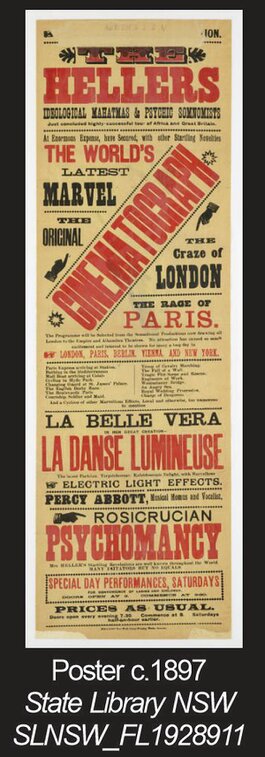
He was back in Australia sometime around February 1897, having initially gone to Calcutta, India, only to discover that an horrific outbreak of Bubonic Plague was ravaging the country (the Third Global Plague Pandemic), so he left hastily, and returned to Australia via the Torres Strait, contracting a dose of fever which put him out of action for a while.
George began to advertise two new attractions. The first was ‘La Belle Vera’ variously spelled as Vera Havlock or Havelock. Ostensibly having been brought out from England, this must have been her stage name, since it cannot be traced otherwise. Miss Havelock’s specialty was the Serpentine Dance, originated by Loie Fuller and extensively replicated by dancers across the world, including magicians Adelaide Herrmann and ‘Edmunda’ Eliason, wife of Oscar ‘Dante’ Eliason. In the most famous of what was a series of dances, the performer was swathed in many yards of silk, using handheld rods to extend the cloth outwards. Lit by ever-changing coloured lights, the swirling mass of silk formed an entrancing spectacle onstage. Vera Havlock remained with the Heller troupe for many years to come.
The other addition to the Hellers’ show was a Cinematograph, sourced in England from film pioneer Birt Acres. Animated pictures were still in their infancy and, in Australia, magician Carl Hertz takes the prize for the introduction of the Cinematographe on August 24, 1896 at the Opera House, Melbourne. There were many exhibitors, both touring and static (in Sydney, at the Salon Lumiere, 237 Pitt Street – see note 21 ), but clearly George Heller was quite an early adopter of the new craze and, in later years, the film presentations became the larger portion of his touring show.
In his first reappearance in Australia, after what his temporary advance man boldly promoted as being “an absence of Five years having travelled the entire globe” (22), George was at Penrith NSW with his Royal Cinematograph, featuring animated views of an express train leaving the station, a rough sea at Dover, a review of troops by the German Emperor, the wedding of Denmark royalty, and the finish of the English Derby. His gas engine had been damaged and was barely working, and George could not obtain a reliable electric current on the first night, so free tickets were given to the audience, and on the following evening things ran better, but Heller had to go into Sydney for a replacement gas plant. The early movie projectors had a range of flaws, notably the small size of the image, and the bad flickering such that newer and more efficient machines were highly sought after. Alfred S. Silvester (son of the Fakir of Oolu) was another magician featuring thirty movie reels in early 1897, starting with a Cinematograph which he later abandoned for his ‘Biolograph’.
The Hellers, Abbott and Havlock travelled throughout New South Wales and up into Queensland as far north as Charters Towers. They were now a versatile group, with magic, spirit antics, mindreading, films, songs and comedy, and the new dancer was warmly reviewed – “the dance was graceful and artistic, the various colors thrown on by the limelight made it most pleasing to the eye, the bright colors blending to perfection, making it a most brilliant spectacle.”
Up until July 23, the Hellers were noted performing in the Hunter Valley region of New South Wales. The date is significant, as a disaster was only days away.
Wreck of the s.s. Tasmania
During the night of July 29, 1897, off Table Cape on the Māhia Peninsula in New Zealand, the steamer ‘ Tasmania’ foundered on rocks while sailing between Auckland and Wellington. It sank within an hour, and although six boats were launched to save those on board, eleven lives were lost, principally crew members. Jewellery merchant Isador Rothschild lost a suitcase of jewels valued at £3,000 which were only salvaged in 1975.
What connection did George Heller have to this wreck? There is a mystery to be solved, with only the most scant evidence. On September 19 of that year, Heller wrote to British illusionist and cinematic pioneer, David Devant, and said, “The truth is I have had a lot of trouble since I left London ... To finish my bad luck I lost all my stuff in the wreck of the Tasmania off the coast of N.Z. All passengers got off safely in fact all but few of hands in a small boat upset in breakers landing got drowned. Came back to Sydney fixing up to start again and as I must have fresh films ...”
It seems almost impossible that Heller could have been in New South Wales on July 23, but aboard a ship in New Zealand on the 29th. More to the point, his name does not appear on the passenger list for that journey (23). But Heller didn’t say he had been aboard, only that he lost his “stuff.” The troupe’s cinematograph had not been mentioned in new reports since July 14. We are left with the speculation that some of his equipment and possibly his stock of films were, for some reason, being transported to a destination in New Zealand. Heller would have had no reason to lie to Devant about his disaster, and there are signs that his show was impacted for several months to come.
A Letter to David Devant
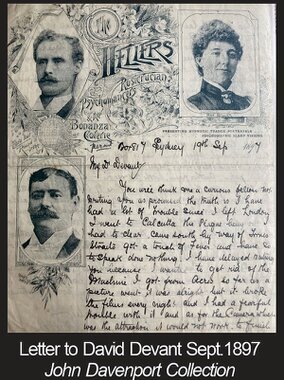 With the foregoing commentary about Heller’s journeys since leaving South Africa, we have some insight into the letter (24) written to David Devant (September 19,1897):-
[Letterhead] The Hellers: Geo W Heller , Mme. Heller, Musical Director: Percy Abbott
19 September, 1897
Box 817 Sydney 19th September
My D[ear] Devant,
You will think me a curious fellow not writing you as promised. The truth is I have had a lot of trouble since I left London. I went to Calcutta the Plague being on I had to leave. Came South by way of Torres Strait got a touch of fever and have so to speak done nothing. I have delayed writing you because I wanted to get rid of the machine I got from Acres. So far as a picture went it was alright but it broke the films every night. And I had a fearful trouble with it and as for the Camera, which was the attraction, it would not work. To finish my bad luck I lost all my stuff in the wreck of the Tasmania off the coast of N.Z. All passengers got off safely in fact all but few of Hands in a small boat upset in breakers landing got drowned. Came back to Sydney fixing up to start again and as I must have fresh films so I would like a list of subjects you can send me with lowest cash prices. I want some comic subjects make a laugh - give particulars.
[Charles] Morritt is out here contract with Rickards doing your bat & card trick "poorly", flowers, Bill[iard] Ball , passing 5 cards to pocket, the lifting of Table & Chair 'Ring' on finger fake. Finishes with an illusion producing 4 girls a table on stage. Same as Convicts Escape. Stage draped Red, draws off side Blinds then front. Now presumably audience can see through affair which has a net round it then placing a light frame covered white tissue paper in front fires pistol girl appears busting through paper. Another frame, another girl & so on - Exit Curtain - the table has steps as you know. I give an outline of table top the dotted lines show the mirrors. (25)
I believe [Carl] Hertz is doing fairly well altho a frost in Melbourne on his own. The American Biograph is playing at the same house as Morritt, it is the drawing card. Mrs Morritt does a very slick S[econd] Sight show the third party Biz & chess tour. They are not setting this place on fire coming so soon after Hertz.
Put signification Word against your best comic films as I may wire you cash to save time and say if you can supply with perforations to suit a Lumiere machine as I have an offer of one for sale here. The Jubilee pictures I have been sent by Watson are very poor. Trusting to hear from you at earliest. Believe me.
Yours truly
Geo W Heller
George’s letter fills in some of the gaps from this period of overseas travel. It is apparent that he had previously visited Devant who, in association with projector manufacturer Robert W. Paul, had become heavily involved with exhibiting ‘animated photographs’ at Egyptian Hall in London, supplying films and projectors to others, including magician Carl Hertz, and the legendary George Méliès. The popularity of the new entertainment was so strong that Devant and Maskelyne went into production of their own films, and began sending out traveling units around the country.
Some part of Heller’s original stock of films, sourced from Birt Acres, may have been lost in the ‘Tasmania’ wreck, as some of those films are not mentioned in later news reports. The Jubilee Procession films sourced from Messrs. W Watson & Sons, of 313 High Holborn, may not have impressed George, but he would use them at least until 1900. Devant seems to have come good with a new supply of films, and after Méliès had created his famous work, “A Trip to the Moon”, Heller acquired a copy and toured it as one of his main attractions for years to come. It seems also that the Lumiere machine which had been offered to him was purchased, and promoted as the Royal Biograph. It was said to have a larger image, and less irritating screen flicker.
However, a strong indication that the Hellers had been affected by the ‘Tasmania’ disaster is that they were out of public sight for the whole of August 1897 through to November 15, when the show reappeared at Nowra with the new Biograph (“200 Startling and up-to-date subjects”) and the familiar team of George, Maude, Abbott and Havlock, with George Callender once more heading up the advance publicity. They were not to remain long in New South Wales as, on December 27 the “Hellers and their White Mahatma Co.” opened a return season at Napier, New Zealand.
Third New Zealand Tour – 1898-1899
It may be that the Hellers had not yet decided that Australia was their home, instead of a convenient and profitable touring destination. Though Australia was a reliable and welcoming place, New Zealand welcomed the return of the Hellers with open arms and open purses. The troupe, performing their show basically ‘as known’ toured the North and South islands for fully thirteen months (26), meeting with nothing but success in small towns and the largest cities. In this time, they travelled incessantly to at least fifty locations including some return visits, occasionally taking on local singers such as Hilda Talma (Johnston), soprano from Dunedin, and baritone Mr. H Carlisle.
Without going into repetitive detail, these two newspaper articles show the happy state of affairs being enjoyed by the Heller troupe, capably managed by George Callender.
Otago Witness July 14, 1898
“The Hellers have struck a Bonanza claim at the Exchange Hall [Wellington] - no need to emigrate to the Colden Golden North. Though the weather has been cold up here, the Hellers haven't done a freeze by any manner of refrigerator; in fact their reception has been so warm every night that gold has melted and ran into their treasury. I swear this by the 'calendar' which registers the takings every night, and upon whose statements I wouldn't re-lie for all the cold in the Klondyke. So good was the biz that the season was extended by a week.”
“The Hellers have struck a Bonanza claim at the Exchange Hall [Wellington] - no need to emigrate to the Colden Golden North. Though the weather has been cold up here, the Hellers haven't done a freeze by any manner of refrigerator; in fact their reception has been so warm every night that gold has melted and ran into their treasury. I swear this by the 'calendar' which registers the takings every night, and upon whose statements I wouldn't re-lie for all the cold in the Klondyke. So good was the biz that the season was extended by a week.”
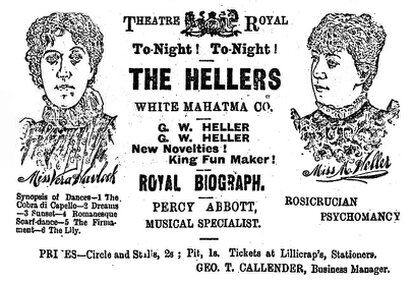
Nelson Evening Mail, December 28, 1898
HELLER'S MAHATMA COMPANY
HELLER'S MAHATMA COMPANY
“The Boxing Day holiday was spoilt in the forenoon by the rain, which continued just long enough to compel a postponement of all the amusements arranged for the occasion. The weather, however cleared up in the afternoon and the evening was fine.
As a consequence the Theatre Royal [Nelson] was crowded to the doors, and Heller’s Mahatma Company drew one of largest audiences that has ever assembled in Nelson to see a visiting show. A good many people who desired to get into the shilling seats could not find room, and had to seek some other pleasure. The company is very deserving of patronage, and gives an excellent entertainment. Mr Heller’s conjuring and palming feats were very cleverly done. He produced a whole umbrella-full of paper flowers from a roll of cartridge paper, and ha seemed to procure shillings from the air, from men's moustaches, and from all sorts of unlikely places, throwing them into a hat through the rim. He also did the canary trick, which is very extraordinary; the illusion by which Madame Heller vanishes from the sight of the audience while she is swinging was perfect.
The Lumiere Biograph showed some splendid and life-like pictures, and entertaining songs were given by Mr Heller (Mr Percy Abbott, pianist and banjo player) and Mr. Carlisle. The skirt dancing by -Miss Havelock, with coloured light effects, was very beautiful, and it was greatly admired, being re-demanded on each occasion. The most interesting portion of the performance was the answering of written questions by Madame Heller, presumably while she is in a clairvoyant state. However the thing is managed or contrived, it is obvious that Madame Heller replied to several questions and gave various initials of the questioners with marvellous and mysterious skill.
The system adopted is for a number of slips of paper to be distributed among the audience, who write their questions. The slips are then collected in a bag, and someone in the audience dips into the bag and takes out a number the slips, apparently haphazard. These Madame Heller answers, and she does so to the satisfaction of the questioners.
The issue of clairvoyancy need not be considered; but as an entertainment Madame Heller’s exhibition is excellent and well worth seeing. The company performed again last evening, with several changes of programme, and the season closes tonight, with several additional attractions, when another large audience is expected.”
The remark that “the illusion by which Madame Heller vanishes from the sight of the audience while she is swinging” brings us to the period from around November 1898 when the Hellers started to introduce some large-scale illusions into their show. Aside from wanting their relatively small troupe to look like a much larger production, there was another influence at work.
Oscar ‘Dante’ Eliason in Australasia 1898-1899
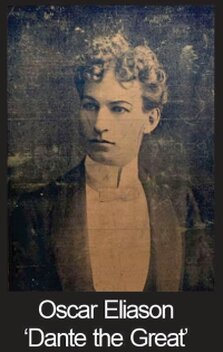 The Hellers were in the middle of their tour when a magician arrived on the shores of New Zealand and swept through the theatrical world like a fresh breeze. This was Oscar ‘Dante the Great’ Eliason, en route to Australia for the first time. He stayed only two months in New Zealand, arriving as an unknown 29-year old. Within a month, he was drawing reviews of this kind:
Otago Witness, August 4, 1898
“Professor Dante must be a very clever fellow, for he says mighty little about himself, a fact which is sufficiently remarkable in a player, especially a variety player, to be taken note of ..."
“Professor Dante must be a very clever fellow, for he says mighty little about himself, a fact which is sufficiently remarkable in a player, especially a variety player, to be taken note of ..."
Hawkes Bay Herald Sept 13 1898 - AN EVENING WITH A WIZARD.
"MYSTERY AND MAGIC - Dante strikes you as being about the smartest man in his line that has visited the colonies. That phrase is probably applied to every new artist who comes, but no matter. It's a real fact. He is the most mysterious individual who's happened along. After seeing a few of his feats you begin to think that he is one very much out of the common. By the time he's finished you not only think so, but are absolutely certain that he licks creation, the mystic creation. Dante met with a splendid reception from an audience that simply packed the lower portion of the Theatre Royal and comfortably filled the circle last night.
"MYSTERY AND MAGIC - Dante strikes you as being about the smartest man in his line that has visited the colonies. That phrase is probably applied to every new artist who comes, but no matter. It's a real fact. He is the most mysterious individual who's happened along. After seeing a few of his feats you begin to think that he is one very much out of the common. By the time he's finished you not only think so, but are absolutely certain that he licks creation, the mystic creation. Dante met with a splendid reception from an audience that simply packed the lower portion of the Theatre Royal and comfortably filled the circle last night.
Dante is fresh, bright, and of the nineteenth century. Though the Davenports, Baldwin, Anderson, and others of the old school have shown us many of the tricks he performed last night, and made us acquainted with them by repetition, Dante embellishes all this old conjuring with something of a decidedly new and original order, clean-cut, spruce and perfect, and hey, Presto! before you know where you are he leaves everybody bewildered by his marvellous dexterity and skill. It is this finished style, this moving like clockwork and clean-oiled machinery that fascinates the audience."
The Wairarapa Times, September 1, 1898 - “He goes into the regions of mystification. He adds dramatic effect. The Asiatic Miracle, ‘Nanko’, startling in itself, was wonderfully heightened by the dramatic setting it was given. And the ‘Beggar’s Dream’ was pure drama.”
Dante’s influence was so great that the programmes of many Australian magicians can be seen to immediately start emulating both his style and his repertoire. Eliason himself was not performing illusions of great originality; his magic owed a great deal to Alexander Herrmann. But his dramatic and artistic presentations, coupled with the personal good looks of himself and his wife Edmunda (Verge Eliason), and a modest, friendly approachability made him a favourite of audiences, theatre critics, and magicians alike. Considering that such talent as Carl Hertz and Charles Morritt had just been in the country, Dante’s surpassing success was a wake-up call to every performer. What further triumphs he might have experienced in Australasia can only be guessed at, for in November 1899 he was accidentally cut down by a bullet during a hunting party near Dubbo, and he died aged thirty.
Following his short 1898 season in New Zealand, Eliason had gone on to break box-office records in Australia, where the Evening News of October 10 said, “There can be no two opinions about Dante. His entertainment on Saturday evening was in several respects a revelation in the art of legerdemain. Nothing approaching it has been seen before this side of the equator. During the two and a half hours the performance lasted the clever young American, assisted by Mlle. Edmunda, ran up and down the whole gamut of his art without the semblance of a dull moment.”
He returned to New Zealand in January 1899, playing the South Island while the Hellers were in the North. George Heller cannot have been unaware of this new wave, even though his own show was still highly successful and he faced no direct competition from Eliason. They came within 500km of each other (Gisborne and Auckland) but did not cross paths.
It was a time when the “Sphinx and Protean Cabinet” style of illusion had become old hat, and magicians were presenting larger-scale illusions which would eventually evolve into the era of The Floating Lady, and Sawing Through a Woman. George must have felt that, in order to keep up, his show needed to grow and modernise.
It was a time when the “Sphinx and Protean Cabinet” style of illusion had become old hat, and magicians were presenting larger-scale illusions which would eventually evolve into the era of The Floating Lady, and Sawing Through a Woman. George must have felt that, in order to keep up, his show needed to grow and modernise.
We do know that Heller went to see Eliason’s show. Historian Will Alma wrote (27), “Among my collection of Dante memorabilia is a hand-written copy of his patter – a most interesting study of his style. It was given me by George Waldo Heller.” (That copy, unfortunately, has not yet been located in Alma’s collection.)
It is of little surprise, then, that in October 1898 the Hellers’ show introduced a number of new full-scale stage illusions. We will examine those, and return to make a comparison of Heller’s repertoire against that of Oscar Eliason.
Heller the Illusionist
It cannot be a coincidence that barely a fortnight after Oscar Eliason departed New Zealand for Australia, George Heller advertised four new attractions for his show, and one of those was almost a direct take from Eliason’s repertoire. The most notable feature of Heller’s introduction of illusions to his show, is how infrequently they seem to have been performed, and how little they are mentioned in press reviews; and there are a few good reasons for this.
These are the first illusions to be advertised in New Zealand:
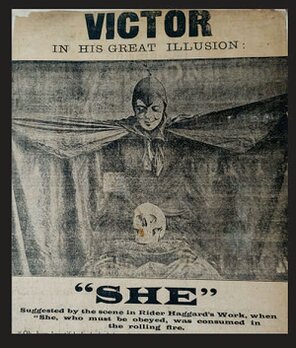 Cremation of Trilby – In which the assistant (Maude) stands upon a table, around which is a light cloth cabinet on three sides. A cloth canopy is lowered over her, and she “disappears in fire and brimstone”.
This illusion was a major feature of Dante/Eliason’s show since August 1896, under the title ‘The Beggar’s Dream’. Eliason’s presentation featured him as Mephistopheles, attempting to seduce a young beggar girl; and when he is rejected, she is set alight, leaving behind only a skull and crossed bones on the cremation table. In Heller’s presentation George took the role of Svengali, and Maude was Trilby.
He would later re-name the illusion as ‘The Outcast’s Dream’ and then ‘Under the Red Robe’, in order to connect with the recent play of the same name, based on the historical novel by Stanley J. Weyman (1894). In this guise, Heller played Mephistopheles burning an ‘outcast’; a direct copy of Dante’s presentation, shown by Heller in Queensland while Dante was still performing in Melbourne. (28) Heller was by no means alone in this practice of copying. There were certainly others who emulated this illusion, including Claude Guest (Wong Toy Sun), and Victor Knight whose programme featured a number of direct ‘takes’ from the Eliason repertoire.
He would later re-name the illusion as ‘The Outcast’s Dream’ and then ‘Under the Red Robe’, in order to connect with the recent play of the same name, based on the historical novel by Stanley J. Weyman (1894). In this guise, Heller played Mephistopheles burning an ‘outcast’; a direct copy of Dante’s presentation, shown by Heller in Queensland while Dante was still performing in Melbourne. (28) Heller was by no means alone in this practice of copying. There were certainly others who emulated this illusion, including Claude Guest (Wong Toy Sun), and Victor Knight whose programme featured a number of direct ‘takes’ from the Eliason repertoire.
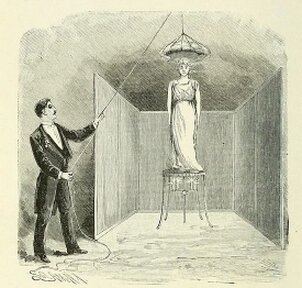
Originally, this illusion was known as ‘She’. There is some contention (29) over the originator; Hercat (R. D. Chater) had presented it at Egyptian Hall in 1888. Hercat, by coincidence, had made Australia his home for many years during the Gold Rushes.
‘She’ had been introduced to the Eden Musée in New York (1891-1892) by Frederick Eugene Powell. The effect was originally staged to match the gothic novel by H. Rider Haggard, in which the immortal Ayesha perishes in the Pillar of Fire. When all is said and done, it was a novel use of the “Sphinx Table” mirror principle, most likely using a strong light to suggest flame.
‘She’ had been introduced to the Eden Musée in New York (1891-1892) by Frederick Eugene Powell. The effect was originally staged to match the gothic novel by H. Rider Haggard, in which the immortal Ayesha perishes in the Pillar of Fire. When all is said and done, it was a novel use of the “Sphinx Table” mirror principle, most likely using a strong light to suggest flame.
The Escape of Dreyfus / The Convict’s Escape – Of all Heller’s illusions, this one had the longest life. From George Callender’s description:- There is a large double cage representing a prison cell standing on the centre of the stage. The audience can see around, over, and underneath it. A policeman brings in a prisoner who is locked in the cage, but in a moment he disappears, to be replaced by a well-dressed lady. The policeman then enters the cage, and he like the prisoner instantly vanishes and reappears in the dress circle.
Charles Morritt had been in Australia in late 1897, with this illusion. His creation, ‘The Convict’s Escape’ was a copy of J.N. Maskelyne’s cabinet from his playlet, “Will, the Witch and the Watchman” (itself an evolution of the old Protean Cabinet) (30), which Morritt had every opportunity to observe, as one of Maskelyne’s team. His improvement was to create an apparently open-sided cage, and Morritt would go on to evolve the principle used into a multitude of deceptive illusions.
As a contemporary topic, Alfred Dreyfus was wrongfully convicted in 1894 of treason and sent to Devil’s Island. For him, there was no ‘escape’; he was eventually pardoned in 1906.
Egyptian Casket - This title presents a mystery, until we learn that an illusion by the same name was being presented in June 1898 by Rowley’s Waxworks in Thames and Auckland.
“Another novelty was introduced at Rowley's Waxworks last night, viz. The Egyptian Casket, a handsome box of polished: wood, bound in metal. The casket was first shown to the public by Mr Woods, being followed by a close inspection by two local residents, who were asked to come on the stage. ‘Rexo’ then entered, and after being handcuffed, was locked in the box, which was tightly corded and placed in the cabinet. Time was taken and in less than two minutes a voice was heard and on the curtains being opened Rexo was seen sitting calmly on the outside. The box was again examined, the rope and locks being found the same as before. Mr Woods then thanked the gentlemen for their services and they left the stage, astonished.”
So the routine was an early Substitution Trunk and, since the Hellers had formerly presented their ‘Saratoga Trunk Mystery’ when they were known as the Wezners, it can be concluded that they are the same. Regardless, it does not seem to have remained in the Hellers’ shows.
The Blue Chamber - Advertised briefly, but this unknown magical effect was either not performed in the show, or was quickly abandoned. There was a Gothic romance novel written by Emma Garrison Jones, titled ‘The Young Wife’s Secret, or, the Heirs of Wycombe Hall’ which was serialised in the NZ press in 1896, involving a forbidden ‘blue chamber’ possibly similar to the Bluebeard tale.
Gone – (or Out of Sight)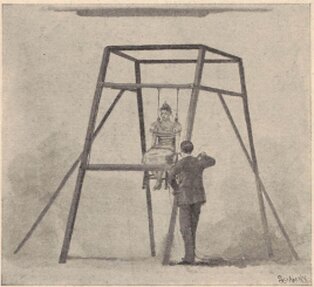
George Callender’s description – “Madame Heller is placed on a chair, which is then hoisted in mid-air. At the shot of a pistol, the chair falls, while Madame disappears into - well, space.”
George Callender’s description – “Madame Heller is placed on a chair, which is then hoisted in mid-air. At the shot of a pistol, the chair falls, while Madame disappears into - well, space.”
Seen in the Heller show until at least April 1899, this was the creation of William E. Robinson for the use of Alexander and Adelaide Herrmann. (Harry Kellar presented a different illusion under the same name.) The hoist was an easel-like framework, and it also served the purpose of concealing the necessary mechanics. Although the Scientific American magazine (31) detailed a complex arrangement of glass, lighting and stage drapery, the more practical version of this illusion was titled ‘Out of Sight’ and relied upon the Black Art principle. It is most likely that Heller would have been travelling with ‘Out of Sight’.
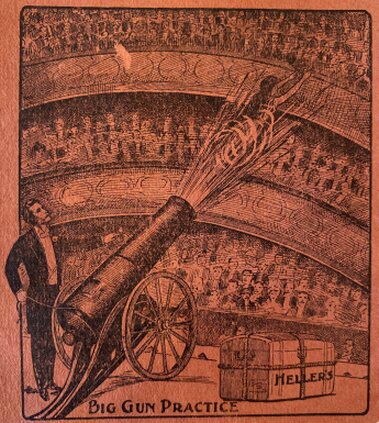
Cannon and Boxes - Billed as 'Big Gun Practice'. Maude Heller is ‘fired’ from a prop cannon, to reappear inside the innermost of three nested boxes suspended in the centre of the hall. Whatever the history of this illusion, which perhaps was bought for use in overseas tours, the fact remains that not a single mention of its performance can be found in Australia, and only the briefest performances in New Zealand during 1908. Collector/historian, Harrie Ensor, refers to it as one of Heller’s pet effects, but that seems unlikely; it was entirely out of keeping with the sort of venues in which the Hellers played.
Bridal Chamber – Another spectacular piece of stage equipment which could not possibly have suited Heller’s show. It was little more than a puzzle; a large empty cabinet is shown, and covered with curtains which, when reopened, reveal an entire bedroom suite of furniture and accessories, and a woman in the bed.
Illusionist Gustave Fasola (Fergus Greenwood) performed both the Bridal Chamber and the Cannon and Boxes effects in Australia in 1911. Horace Goldin and Fasola tussled over the patent rights to this illusion, but in 1907 Charles de Vere advised Houdini’s “Conjurer’s Monthly” that the trick was the creation of Baron Hartwig Seeman as ‘The Great Cannon of Strasburg.’ It seems also that in 1907 there had been a veritable glut of performers showing both the Cannon and the Chamber illusions.
Illusionist Gustave Fasola (Fergus Greenwood) performed both the Bridal Chamber and the Cannon and Boxes effects in Australia in 1911. Horace Goldin and Fasola tussled over the patent rights to this illusion, but in 1907 Charles de Vere advised Houdini’s “Conjurer’s Monthly” that the trick was the creation of Baron Hartwig Seeman as ‘The Great Cannon of Strasburg.’ It seems also that in 1907 there had been a veritable glut of performers showing both the Cannon and the Chamber illusions.
The notebooks of Will Alma notebooks refer to an (unreferenced) advertisement in June 1916 of illusions for sale by Heller – “Bridal Chamber, Cannon & Boxes and other good acts. Big time magicians. Ready to stage. Cash, cheap, stamp - Box 584 GPO Melbourne.” (32)
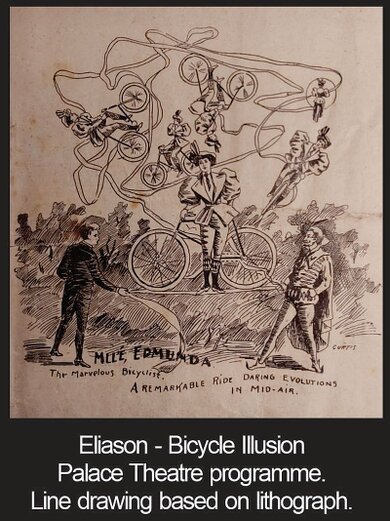 Marvellous Bicycle Ride – Most intriguing of all is this direct copy of Oscar Eliason’s “Marvellous Bicyclist”, and it would appear that two of these mechanisms existed in Australia. It is seen advertised as early as June 1899, which means the apparatus cannot have been something obtained from the Eliason show after Oscar’s death in November 1899.
 The illusion involved the female performer sitting on a bicycle which floated in the air, moved around the stage, and at one point turned upside down in the air. Some press reports indicate that the bicycle climbed around the sides and top of the proscenium. Heller was performing it until at least November 1900. If the publicity aspects of the illusion are stripped away, it is most likely that this was actually a ‘floating lady’, to whom the bicycle was connected.
The exact mechanism of the Bicycle Ride remains speculative, possibly a version of the belt mechanism used in the ‘Astarte’ illusion and further developed by W.E. Robinson, or perhaps related to Roltair’s ‘Rollo on the Wheel’ for which the mechanics are not known.
George Heller was not, by nature, an illusionist. His commercial preference was to play in small towns; in fact his 1894 promotional brochure read: “Stern Facts! Hellers’ Entertainment has been given in all the largest town and cities of the world and can be given in any hall. It is seldom that strictly first-class companies can visit small towns owing to lack of scenery and stage room. Heller goes anywhere and everywhere and always gets crowded & delighted audiences.”
To cart large and cumbersome apparatus, when many of his venues were simply unsuited to the requirements of stage illusions, must have quickly sapped any of George’s enthusiasm for the feats listed above. Possibly Maude, also, was disinclined to be the featured assistant in these acts.
George retained, at least for a time, the Convict’s Escape, Gone, and the Bicycle Ride, but otherwise the Heller repertoire remained the same for all their career – small magic, the spirit cabinet, animated pictures, and the undoubted star of the show, Maude Heller’s message reading and question answering.
Magicians and Art of Borrowing
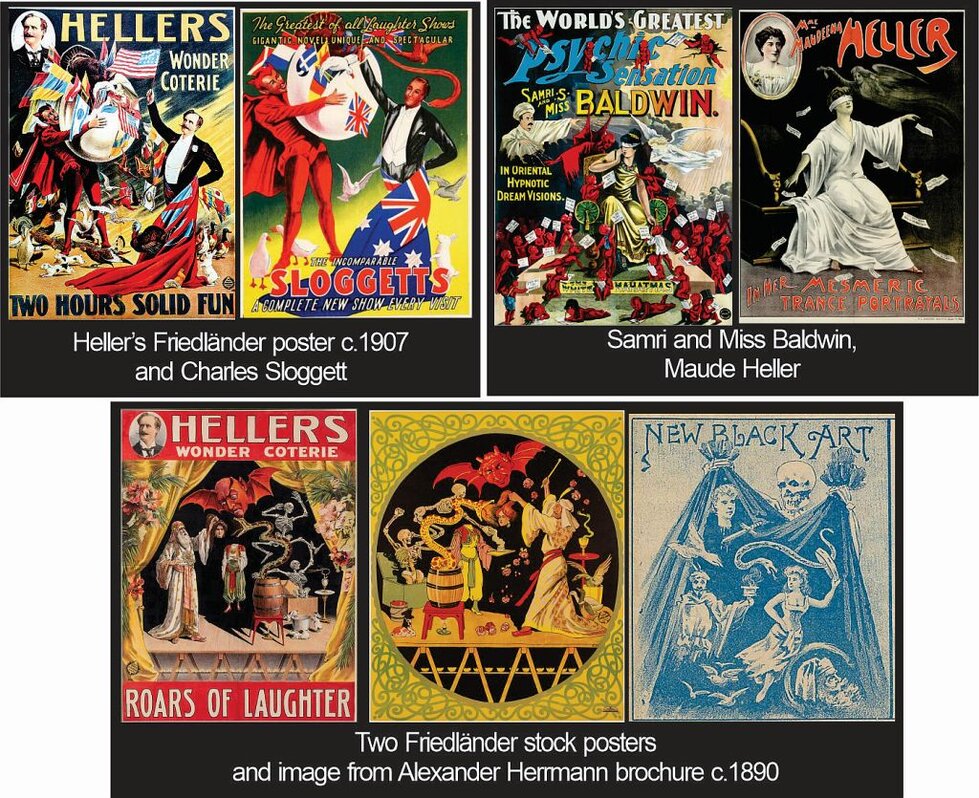
It may seem harsh to single out Heller and point out that he appropriated or modified the artwork of others, but this section highlights the very common practice, amongst magicians, of copying – artwork, magical routines and patter, and secret methods.
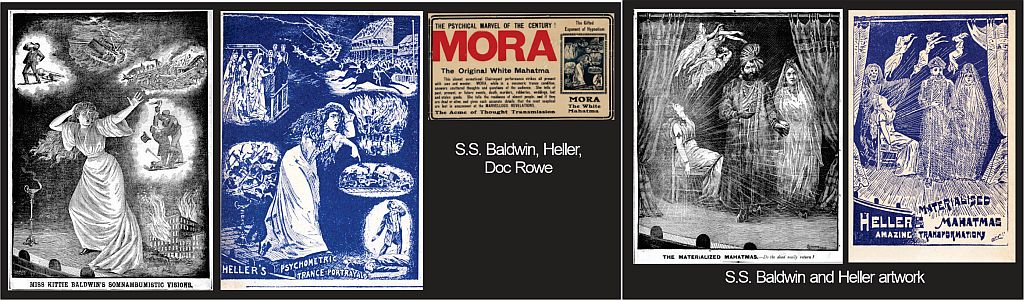
Heller was by no means a sole offender in this regard. He borrowed and adapted the art of Samri Baldwin. Baldwin stole pages of text from H.B. Wilton’s ‘The Somatic Conjuror’ for use in his own work, ‘Spirit Mediums Exposed’. Friedlander’s stock posters may have come from earlier examples. Charles Morritt borrowed from J.N. Maskelyne. Oscar Eliason worked in the shadow of Herrmann. Richard ‘Doc’ Rowe and Charles Sloggett pinched some of Heller’s artwork – and so the cycle continues. Moralising has never changed the fact - and all history owes us is the truth.
Heller was by no means a sole offender in this regard. He borrowed and adapted the art of Samri Baldwin. Baldwin stole pages of text from H.B. Wilton’s ‘The Somatic Conjuror’ for use in his own work, ‘Spirit Mediums Exposed’. Friedlander’s stock posters may have come from earlier examples. Charles Morritt borrowed from J.N. Maskelyne. Oscar Eliason worked in the shadow of Herrmann. Richard ‘Doc’ Rowe and Charles Sloggett pinched some of Heller’s artwork – and so the cycle continues. Moralising has never changed the fact - and all history owes us is the truth.
Eliason and the Spiritland Poster
 Noting, above, that George had at least emulated some of Oscar Eliason’s repertoire, we now come to examine some posters, and make some bold speculation.
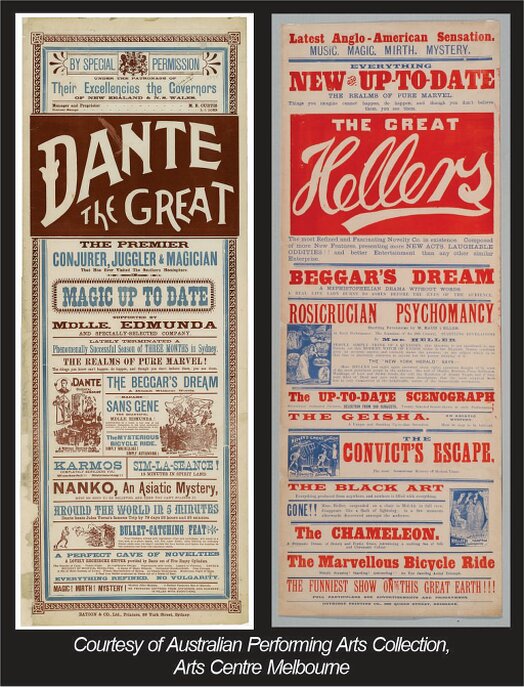
The Australian Performing Arts Collection, Arts Centre Melbourne (33) holds two posters featuring very similar routines – one for Dante the Great with a notation “Dec12/98 1898” which places it just days after the end of his first big Sydney season with over sixty consecutive performances. The other is for The Great Hellers, which very likely comes from the Brisbane Opera House season in June 1899, at a time when Eliason was performing in Melbourne.
A close comparison of the posters shows a similarity of wording in phrases such as “Magic Up to Date”, “must be seen to be believed” and “the realms of pure marvel – things you imagine cannot happen, do happen, and though you don’t believe them, you see them.”
Black Art was advertised by Heller, though his routine is unknown. Dante’s was a ‘Faust’ scene in which a dancing skeleton separated into pieces, and Edmunda was wrapped with a clock from which she vanished, leaving three doves hovering in the air.
Hellers ‘The Geisha’ is unknown and not mentioned in Australia or New Zealand press, though as it is billed as “An Asiatic Mystery” it may be a duplicate of Dante’s ‘Nanko, An Asiatic Mystery’, an early substitution trunk mystery using two nested trunks.
Several routines were similar, although Heller had featured them for some years before Dante’s arrival – Eliason’s ‘Karmos’ was a less elaborate version of Maude Heller’s psychomancy. His Sim-La séance was equivalent to Heller’s spirit cabinet routine which was also being performed by a great many others; the spirit medium for this routine was Oscar’s brother, Franklin, and it was performed by Frank for many years to come.
Heller’s ‘Chameleon’ was the Loie Fuller dances performed by Vera Havlock, which Edmunda Eliason also performed. The Marvellous Bicycle Ride and The Beggar’s Dream are direct duplicates of Dante’s show, already mentioned above.
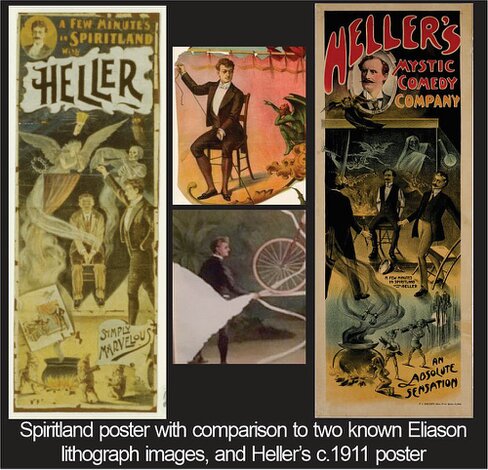
We are led to an interesting conundrum concerning a poster, ostensibly for Heller’s “A Few Minutes in Spiritland”. As this question will be explored in more detail by an article to be written for another publication on magic history, we will only look briefly at the issue.
The W.G. Alma Conjuring Collection holds a rather poor photograph of a poster marked with Heller’s name and images of a spirit cabinet routine. It is unfortunate that we have no proper poster, nor a better quality image, but the portrait at the top looks to hold a full head of curly hair, which Heller never possessed; but for which Eliason was famous.
The lower two views of the magician in black show a performer who does not appear to be Heller, but does look like the images of Oscar Eliason seen in his very few posters that are extant. In particular, he is wearing knee breeches, in Eliason’s style. George Heller later created a spirit cabinet poster which is unquestionably himself. Other points might be mentioned, but the speculation is whether this poster might be an original Eliason poster with “Heller” over-pasted, or possibly original Eliason artwork acquired after his death, and altered by a printer for Heller. Confirmation will be difficult to achieve, but the prospect of discovering another Eliason poster, when so little artwork exists, is tantalising.
Australia and Fourth New Zealand Tour – 1899-1900
It was late March 1899 when the Hellers Mahatma Company arrived back in Sydney after what can only be described as a hugely successful tour. With barely a pause they launched back into travel in northern New South Wales and into many areas of Queensland, with some of their tested illusions (Convict’s Escape, Gone, Under the Red Robe). The Royal Biograph featured ‘A Phantom Ride’ in which the audience enjoyed the sensation of being at the front of a speedy train journey, and various new reels of ‘The Steeplechase’, ‘The Water Chute’, ‘Three Knockabouts’, ‘Russian Cavalry’, ‘Sea Bathing’ and ‘Snowballing.’
Havlock, Abbott and Carlisle added their talents, Maude continued to be the act most remarked upon by the newspapers, and the Marvelous Bicycle Ride illusion was premiered in Brisbane in June.
There were various trips mooted by Callender, including a return to South Africa, or the United States, or Java and Singapore. Instead, the Heller’s Mahatma Company returned to New Zealand.
This return tour, a shorter visit from early November 1899 to March 1900, was referred to in the newspapers as "a flying trip prior to returning to the old country", "prior to retirement" and a "farewell tour". Perhaps it was the start of a running joke concerning the Hellers, that they had decided to retire, and yet returned time and time again to the road. In the next few years there would be events that could justify a wish to step back, but for now retirement was just a talking point. Alma (34) states that “touring did not fit in with [Maude’s] change of life, hence the many retirements.”
The Mahatma Company started in the north island and was touring with the usual degree of acclaim, before diving south to Invercargill and up into the Canterbury district. Gradually, the show was dividing into two distinct sections, magic in the first part and animated films in the second. Heller’s advertising mentions Edison's Sceneograph, but also the Cinematograph and Lumiere Biograph, so his actual equipment at this time is uncertain.
One interesting encounter, in Invercargill, was with a New Zealand resident, Madame Heller (Minna Kober), who by coincidence worked as a Psychomestrist. There was a little flurry of excitement as Madame made it known that she was not that person who resorted to ‘stage trickery’.
There is not much new to say of this tour other than to note the warm welcome and expressions of regret that this might be their final tour (it was not). But in late March the Otago Witness reported, “should the plague have an early abatement Mr. Heller goes to Sydney to fix up some legacy matters. If the plague lasts any time it is Mr and Madame Heller’s intention to take a hurried trip Home.”
Indeed, the Bubonic Plague had hit both New Zealand and Australia. Only nine died in New Zealand, but the toll in Australia, for which the epicentre was Sydney in January 1900, was more than 100 deaths out of 300 cases. By March 22 the company had departed, and were headed for the more isolated Australian island, Tasmania. George Callender would later report, “we had a splendid six night’s season at the Theatre Royal, Hobart, the opening night turning money away ... we open at Queenstown Saturday May 5, which is a pay day of £7000, so we expect big business there.”
In Launceston, a citizen took offence at the Heller’s supposed lampooning of Theosophy and their implication of it being a “black art”. Vocalist Percy Abbott, however, was not in a conciliatory mood, and wrote back to the Daily Telegraph, “Col. Olcott, with Yankee cuteness, worked the latter lady’s [Madame Blavatsky] powers in the cause of an alleged religion called theosophy, whereas the Hellers merely make use of theirs as an exhibition …. Madame Heller on the stage … answering questions, and Madame Blavatsky in the room … answering questions … are both doing the same thing, ie. making money. If Madam B. could call the occupation theosophy, why may not Madame H. call it by the same name, seeing that she does it a great deal better, and at a much smaller price.”
The Hellers toured with success for a couple of months in Tasmania, before returning to Victoria and across to South Australia and Western Australia, where they were seen into November 1900 as far north as Geraldton, featuring the ‘Aerial Cycle Ride’ even in some of the smaller townships. Gradually, in 1901 they returned the long distance back to Victoria, where the Hellers disbanded the troupe for a short time while they rested, but they were soon touring country towns again. The ‘Age’ reported one of Maude’s bold clairvoyant claims – “A fatal mining accident occurred at the Chiltern Valley Gold Mining Company’s No.2 shaft this morning to Andrew McMillan, an employee of the company for the past 22 years … a remarkable circumstance … is that on last Monday night Madame Heller, of Heller’s Coterie, was giving a clairvoyant exhibition before a large audience in the Star Theatre [Chiltern] … she said that Andrew McMillan would shortly be killed by an accident, and warned him to be very careful.”
Disaster struck, with the death of company musician Percy Abbott, of heart failure, on November 10, 1901. As a considerable asset to the show, Abbott’s passing must have thrown matters into confusion, since planning had been underway to take the troupe to Ceylon and the Indian subcontinent.
In early December, the Hellers, the Carlisles, George Callender and Mr. H. G. Parker (operator of the projector) departed for Colombo. Vera Havlock was also along on the trip, as was a Mr Jas. A. E. Dodds, acting as replacement Musical Director. He had recently been touring with Mr E. Stevenson’s Bioscope and was described as a ‘London musician.’
Something worthy of noting is that the troupe, sailing on the ‘Rhein’, were in steerage, and while the Saloon passengers were registered as ‘Ladies and Gentlemen’, all the steerage passengers were lumped together under the description of ‘Labourers and Domestics’; not even a classification as ‘theatricals’ for the Heller troupe. The significance of this is that ultimately, upon George Heller’s death, his certificate described him as a ‘labourer’. So much for the glamorous life.
While it is difficult to trace the full path of the travels during 1902, the company can be found at West Bengal (India) in February , Calcutta in March, Lahore (Pakistan) and Delhi in April/May. About June the NZ Mail reported that the Indian tour had finished and Heller was in Burmah, after which he “intended visiting England to engage fresh novelties for a return visit to South Africa, Australia and New Zealand.”
Tour Disbanded and Retreat to Scotland - 1902
The Daily News (Perth) of Oct 11, 1902, reported that “Heller’s Mahatma Co. disbanded in Colombo recently. Mr. and Mrs. Heller went on to England to organise a new company, and they purpose returning to Australia towards the end of the year.”
In fact, the Hellers would not be seen in Australia for another eighteen months. Was the disbanding a planned end to the tour, or was there another problem? We have a clue from notes made by Will Alma, and although he does not specify a date, it seems likely that it was during this tour in 1902.
“During a tour of India, at Calcutta, a soda-water bottle exploded in his [George’s] hand, disabling him for several weeks, and with a large company to pay the tour was abandoned with severe financial loss. On his return to Australia the Hellers were content to play the ‘tanks’ with a small company, and drove thousands of miles in a Dodge car.”
During the whole of 1903, the Hellers are out of sight. We have a single letter, written by George Callender to the Otago Witness:-
“Brisbane June 24, 1903. Dear Pasquin – It is some time now since I wrote you from India with the Hellers. After the Hellers’ tour of the East they returned to Scotland, and have settled down there, having made enough to keep them all the rest of their lives. Being their manager-agent for 14 years, I don’t feel inclined to settle down yet, so have returned to Australia, and have secured Mr. Clement L. Wragge, the meteorologist and astronomer, for a lecturing tour. I intend bringing him to New Zealand shortly. I shall drop you a line from time to time and let you know my movements. Yours truly, George T. Callender, the Midget Globe-trotter.”
“Brisbane June 24, 1903. Dear Pasquin – It is some time now since I wrote you from India with the Hellers. After the Hellers’ tour of the East they returned to Scotland, and have settled down there, having made enough to keep them all the rest of their lives. Being their manager-agent for 14 years, I don’t feel inclined to settle down yet, so have returned to Australia, and have secured Mr. Clement L. Wragge, the meteorologist and astronomer, for a lecturing tour. I intend bringing him to New Zealand shortly. I shall drop you a line from time to time and let you know my movements. Yours truly, George T. Callender, the Midget Globe-trotter.”
Indeed, Callender had taken on his only other client aside from the Hellers, and with Clement Wragge he toured in Australia and New Zealand into 1904. If, however, George and Maude had chosen to retire gracefully, their resolve lasted only fourteen months, as in May 1904 the NZ Mail reported that Mr Callender would be rejoining the Hellers’ new company. From June 13 the company returned to touring in Victoria and Tasmania, starting at the Masonic Hall, Maldon; hardly a spectacular re-launch, but perhaps indicative of their intention to focus once again on small-town appearances.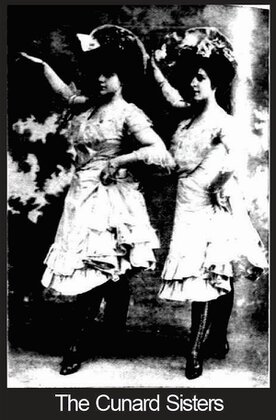
The new company included Mr James Dodds in the musical specialities role, with various artists, probably locals, contributing vocal items. George had obviously been active during his time back in Britain, as his current stock of Bio-Tableau films included Russo-Japanese war scenes, the Great London Fire, and most importantly, the legendary George Méliès 1902 film, ‘A Trip to the Moon’ in colour, which Heller would feature prominently for some years to come.
Notably, the serpentine dancer Vera Havlock/Havelock is seen no more. Her name was only ever used in connection with the Hellers, and was most likely a stage name. Later in the year the cast would include Mr W. E. Scott ‘the Living Yodelling Ventriloquist’ and Mr J. Norrie, vocalist. Of interest is that the troupe was joined for quite some time by the Cunard Sisters, song and dance artistes, and their mother, soprano Miss Helen Gordon who was married to Archimedes Litherland ‘Cunard’ (died 1905), one-time member of the Harry Kellar troupe, and a partner of magician Alfred Silvester.
All of the big illusions seem to have been set aside and, as always, the main magical features of the show were the Spirit Cabinet and Maude’s psychic revelations.