Tom Selwyn - Walking Around the World with a Pack of Cards
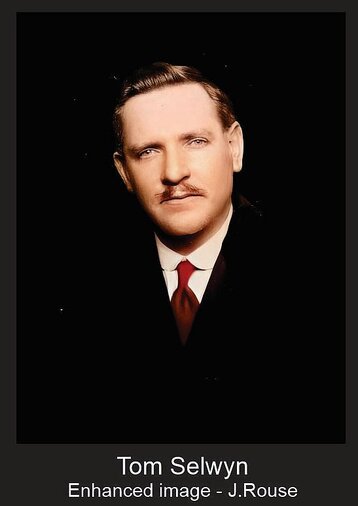
Tom Selwyn. Thomas Oliver. Charles Selwyn. Hobart Conroy. Tom Lorimer. All of these were the same person, and not one of them was his real name.
This is a story filled with contradictions and anomalies, mysteries and missing pieces. We may never fill in all the details of Tom Selwyn’s life, nor understand his motivations, but now we have a far greater understanding of this magician, soldier and magical mentor.
Why Tom Selwyn?
Before starting on a complex story, why should we be interested in Tom Selwyn or his involvement in the world of magicians? Although he is not unknown in the annals of history, he was neither a famous performer during his life, nor one who has a prominent profile today.
The answer is that Selwyn was the mentor to Leslie Cole, ‘The Great Levante’, Australia’s foremost illusionist of the twentieth century; he may have been the person who gave Levante his stage name. As a magician undeniably skilled in sleight of hand, he was a friend and guide to other magicians, possibly including mentalist Sydney Piddington, and was held in high regard by magicians throughout Australia for his personal skills and his friendly comradeship – to such a degree that magicians contributed to the cost of erecting a headstone for his grave. Selwyn was a regular correspondent to overseas magic magazines and, it appears, had a wide circle of correspondents around the world.
The Tom Selwyn story – According to Tom
A major difficulty is that most biographical information about Selwyn in the magical press has come from Selwyn himself. His friends re-tell the stories that Selwyn told them, lending credibility and directing attention away from some areas of his life; which is, no doubt, what he intended. Also, because there are periods of his life for which no documentation exists, and little way of discovering the facts, we are left with only Tom Selwyn’s tale of where he was and what he did at certain times. Though there is no doubt that he travelled extensively, in such cases we will have to say “according to Selwyn”, and hope that, over time, more detail will come to light. The fact is that, in some aspects of his life, Selwyn was less than honest, and it has a negative effect on some of his history.
So, this is Selwyn’s biography (1) according to himself:-
- Born in Lowell, Massachusetts, on May 22, 1878, of British parentage, and brought to England (Manchester) as a baby.
- Apprenticed as a sailor at age fourteen, travelled round the world twice but then walked off the ship in New York.
- Worked in United States at Huber’s Dime Museum, Buffalo Bill’s Wild West shows, Dr. Bigelow’s Medicine show, Reynolds’ Waxworks Liverpool, and circuses as a magician.
- Travelled to South America, South Africa, British provinces.
- Fought in the Boer War (Africa) then went to India, Ceylon, Burma, Malay States and Siam, across China to Korea and Japan and French Indo-China. Through the Philippines, Indonesian islands, and down to Australia & New Zealand, known as “The Globe-Trotting Magician”.
- Enlisted in the army during WW1 and was wounded at Gallipoli and gassed in France.
- Met Kellar, Herrmann, J.N. Maskelyne, Devant, Carter, Morritt, Oswald Williams, Ching Ling Foo, Chung Ling Soo, Malini, Hertz, Goldin, Leipzig, Houdini, Thurston, Bertram, Stilwell and more.
- Through ill health caused by the war, worked at the Sydney Stock Exchange before retiring. Lived in Queensland, then Tasmania before dying on January 26, 1950.
- Through ill health caused by the war, worked at the Sydney Stock Exchange before retiring. Lived in Queensland, then Tasmania before dying on January 26, 1950.
Jim Rouse and Military Research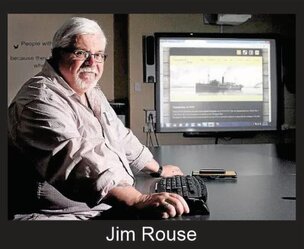
This author can claim but little credit for unravelling the untold facts of Selwyn’s military life, or locating his true name. The breakthroughs are entirely down to Jim Rouse, a military researcher based in Tasmania. My contribution to his discoveries was limited to offering some sources from magical publications. Jim was researching the history of the 40th Infantry Battalion of the A.I.F. (Australian Imperial Force), bumped across the name of Tom Selwyn, the Battalion’s regimental sergeant major, and soon discovered that his background was rather obscured. This led Rouse to dig deeply into military records and, with some clever reverse-engineering and sleuthing, he penetrated Selwyn’s family history and uncovered a trail of military misadventures which now gives us a far greater understanding of Selwyn.
Jim Rouse’s lengthy article has been published in ‘Digger’ No.87, June 2024, Magazine of the Families and Friends of the First AIF, inc. edited by Graeme Hosken [ISSN 1834-8963] which is not widely available to the general public. This current essay rests heavily on Jim’s research and, where appropriate, will quote passages from his article, but has been re-worked for a reading audience of magicians. Those who might wish to read the finer military detail of the original article could contact Kent Blackmore via this website.
Les Levante and Selwyn
From Les Levante’s reminiscences - (2)
“Mother [Sarah Catherine Cole] died at forty years of age [December 26, 1908] (3) and I was then a little more than sixteen. I was taken down to Melbourne to attend the funeral and for the first time I saw the sea and this magnificent city and I was enthralled. After the funeral I went back to the farm to help my father and on his return to the farm, I gave him no peace, hammering away at him until he gave me permission to go to Melbourne to get a job.
“Mother [Sarah Catherine Cole] died at forty years of age [December 26, 1908] (3) and I was then a little more than sixteen. I was taken down to Melbourne to attend the funeral and for the first time I saw the sea and this magnificent city and I was enthralled. After the funeral I went back to the farm to help my father and on his return to the farm, I gave him no peace, hammering away at him until he gave me permission to go to Melbourne to get a job.
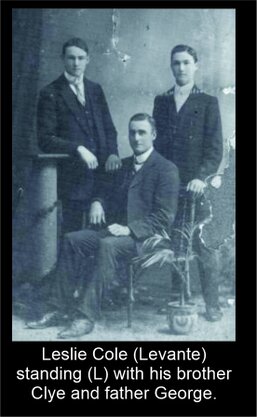 Ultimately it turned out after my seventeenth birthday, he had arranged with a Mr. Frank Rout, who owned the Vine Hotel in Bridge Road, Richmond, for me to become the billiards marker. Mr. Rout had purchased from my father a number of horses which had become trotting horses and he had been successful with them. So I finally went to Melbourne [c. 1909] and became the billiards marker at the Vine Hotel where I learnt a lot about trick shots on the billiard table and, as I was a tall gangling youth, I became more or less very popular. One of the people who visited the Vine Hotel occasionally was Fred Lindrum, the elder of the brothers who in his day was one of the top billiards players in the world. Fred needed somebody to practise with him in the morning, so at seven o'clock I would go down from my bedroom and join him, and he would go 300 behind and give me 200 on, and we would play 500 up, and I never ever won a game. What I learnt about billiards and positions and that sort of thing did me a lot of good because I became a very good billiards player. Also I became more proficient at trick shots taught to me by Fred Lindrum.
Some little time after I was the billiards marker, the barman in this hotel fell ill and I was called upon to go into the bar to assist. Into the bar one day came a man named Tom Selwyn who hailed from Manchester, walking around the world with a pack of cards. Tom was about as wide as a door and about 5'6" or 5'7" in height. He was a fine athlete and a very fine exponent of sleight of hand. He was a nomadic type of fellow and his business was to go from one type of country to another, and how he ever ended up in the Vine Hotel in Bridge Road, Richmond, is something I have never fathomed. But he started to do his tricks in the bar and a lot of customers, not knowing any better, said to him, "Oh yes, young Les can do all these tricks." Young Les couldn't do them. This man was really an expert of sleight of hand. In those days pints of beer were threepence so, to keep Tom in the bar, because it was good for business, I slipped him the extra pint of beer and he, in turn, took me in hand and taught me the fundamental principles of sleight of hand with cards. He went away and came back some five or six weeks later. I had practised continually and I had become quite expert at what he had taught me. He then really went to work on me and gave me the insight into manipulating thimbles, coins and billiard balls.
Away he would go again and come back some couple of months later and would be astonished at the progress I had made. After my eighteenth year he said to me one day, "Why not take this up professionally? You have very good address. If you improve your vocabulary, I am sure you would be successful at it because you're going to be good." I gave this some consideration and finally I listened to him and then I joined the A.V.A - The Australian Vaudeville Association, and I received some small bookings.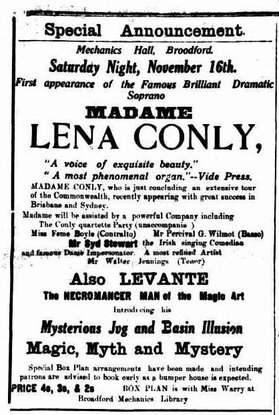
I must tell you, in the meantime, Tom had settled in Melbourne and he was the Secretary of the A.V.A. Naturally he pushed me along and made sure I did get some reasonably good bookings, if bookings at ten and sixpence per night could be considered good. That was what I received. Some nights I would be called up to stand up in front of a cinema sheet out in an open cricket ground. How on earth some of the people there saw what I was doing I do not know. In the meantime I purchased some small tricks from a small magic shop in Melbourne owned by a man called Claude Guest, who was later to become a Chinese exponent of magic under the title of Wong Toy Sun. I did a great deal of work around the suburbs of Melbourne.
Fortunately I had saved some money, for I can assure you that many times, if I had been depending upon the amount of money I earned from doing magic, I would have gone to bed hungry. When Selwyn arranged for me to go on tour [November 1912] with a Madam Lena Conly, an oratoric soprano who came from Victoria and was doing a tour, it was necessary for me to buy some clothes, for I had been working around in my ordinary street clothes. I went to a second-hand shop and purchased a suit of tails and went away on tour with Madam Lena Conly and she had a great deal to do with teaching me how to use the right knife and fork, how to tie a white bow by hand and, generally, how to deport myself as a good performer.The builder of Luna Park, T.H Eslick, came to me one night and said to me, "I'm going to build a park in Sydney called the White City. How would you like to come over there and handle the Theatre of Illusions?" I said, "I think that would be delightful." So he said, "But, in the meantime, would you like to come over and be my 'tiger'?" I said to him, "Well, what do you mean by 'tiger'?" He said, "Well, I've got to have someone to run the messages and to generally make sure that the people who come to see me are on business and that sort of thing. I shall employ you at £4 per week and you can have about three months before White City opens." Of course, I agreed, and in the meantime I had to do some other work, and I was booked by Tom Selwyn to go to Broken Hill to what was then known as the Sods Opera, which was sort of a tough Music Hall which was run by a man named [Ross?] Hayward. I played there for a month and then went across to Western Australia to the then Shaftesbury Theatre, Perth, and played there. In those days, of course, there was no railway and I had to go there and back by steamer. I was then sent up to Kalgoorlie and played there and finally came back to Melbourne where I did some more work around the suburbs and then over to Sydney in [November] 1913 where I became the Tiger for T.H Eslick at the White City in Sydney, which was then being constructed.”
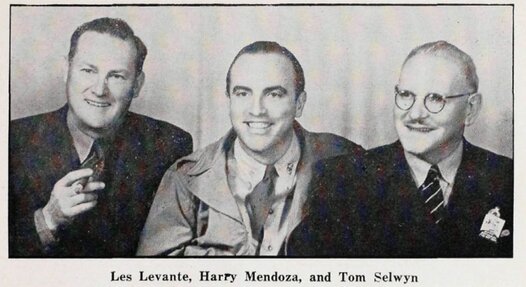
An anecdote regarding Levante’s adopted stage name is that following a show in Sydney, the promoter decamped, or 'levanted' with the proceeds. A more likely origin is that Tom Selwyn gave his protege the title 'Levant', a name he claimed to have had used himself (this cannot be confirmed). He told Les that the word meant not only the 'east wind of the Mediterranean', but also 'a vanisher, one who gets away with things'. The stricter definition is 'a bet made with the intention of absconding if it is lost'.
In a recorded interview given in 1975, Les recalled that the magician who had made the biggest impact on Australia up to the turn of the century was Oscar Eliason (1869-1899), billed as 'Dante the Great'. Impressed by the magician's reputation, and feeling that Dante was a classy name, Les tacked on the letter 'e' to his own stage name and became Levante. (Elsewhere it was stated that it was Jean Hugarde's name, rather than Dante's, which appealed.)
Levante and Selwyn remained fast friends for years to come, and at a later stage when Selwyn was ill, he moved to live at Levante’s holiday cottage on Cribb Island at Brisbane (since resumed for the expansion of Brisbane airport). Levante seems to have absorbed much of Selwyn’s attitude to life and performance. He was always a down-to-earth man who socialised easily with every class of person, taking business opportunities wherever they arose, unfazed by problems onstage or off, and willing to venture around the world always under his own management and direction. While Levante was not a sleight-of-hand performer, his early repertoire did include a thimble routine which may well have been Selwyn’s own.
Tracing the True Selwyn
To discover the true origins of Tom Selwyn requires a jump to the years 1895 and 1914, when he filled out his ‘attestation’ paper for enlistment in the army. The document he signed on August 28, 1914 refers to his next of kin being a Mrs. J. Law (sister) of Pendleton, Manchester, England. (4)
Jim Rouse reverse-engineered this information to discover, from Census 1901 records, that Mrs John Law was Alice Emma Noon (1867-1927) and that she had two brothers, Archibald Noon (1875-1901) and John Thomas Noon.
Their parents were Catherine Noon (nee Oliver) and John Henry Noon, a general wood turner who in 1878 was living at Howley Lane, Warrington, about 20 miles outside Manchester England.
Having identified the wider family, further confirmation of those facts became available through birth and baptismal records, census records of 1881 and 1891, and death records.
Tom Selwyn was John Thomas Noon. He was born on May 22, 1878 and baptised on June 9 at St. Elphin, Warrington. Given that he was baptised in England so soon after birth, the possibility that he was, as he usually claimed, born in Lowell, Massachusetts, or that his parents might have been in the United States at his birth, is extremely low.
The claims about his birth also extend to Selwyn’s marriage certificate of 1916, on which he falsely named his parents as John Henry and Catherine Selwyn, stated that his father was a stockbroker, and listed his birthplace as Tyngs Island in Massachusetts. Although close to Lowell Mass., Tyngs Island was the location of the Vesper Country Club, a boating club founded in 1875. Today it remains a small island with a single road leading to the existing country club; not a likely place for a child to have been born.
What little we know of John Noon’s childhood gives us no more than hints as to why he would wish to conceal his upbringing. His father’s trade as wood-turner, for instance, was not necessarily a low class position. The 1891 census records John as an errand boy aged 12. In July 1892, the Liverpool Assizes charged a John Thomas Noon with burglary along with an accomplice, resulting in a ‘not guilty’ finding; we might reasonably assume that this was our subject.
John attested for the military on December 1, 1892, for six years’ service with the Yorkshire Light Infantry, but was later struck off the list after not attending any parades in 1893. A possible reason for this brief enlistment is given shortly.
John’s brother, Archibald, was sent to London’s ‘St. Mary the Less’ school in 1885. Archibald would then attest in 1892 and serve for nine years with the Yorkshire Light Infantry, including six months South African service during the Boer War. It might be assumed that he suffered injury or illness, since he was listed with the Royal Hospital Chelsea Pensioner Service Records, and in the 1901 UK Census he was recorded as living with his sister Alice Emma and her husband and children at 11 Booth Street, Pendleton. Archibald died in late 1901.
John’s father, John Henry Noon, died in the first half of 1893, and his mother Catherine in 1894. So in 1893, John was in his mid-teens, without a brother in the household, and soon to lose his parents.
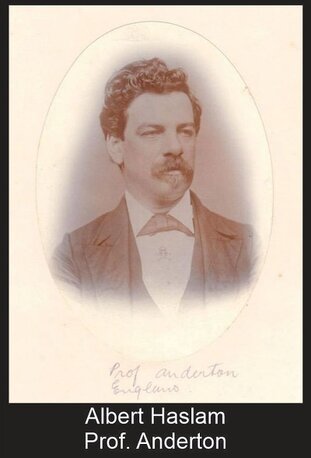
Selwyn would later claim (6) to have given his first magic show at the age of nine (1887) in Manchester, but all we know of his magical training comes from a photograph and pencilled note (5) stating that John had seen the magician Professor Anderton as a boy. Anderton’s real name was Albert A. Haslam, c.1851-Aug 5 1900 – a minor sleight of hand artist at English fairs until c.1890, when he left magic to become a circus worker and later a movie exhibitor. He lived at Sheffield, not a great distance from Manchester, but there is little reason to suspect that he was ever a mentor to young John.
Anderton’s magic, according to Sidney W. Clarke’s ‘Annals of Conjuring’ consisted of such tricks as the Chinese Rings, the production of bowls of water from a shawl, the Flying Bird Cage, the Rising Cards with a mechanical pack, the Aerial Treasury and the Inexhaustible Hat, DeKolta’s Vanishing Lady and the Aerial Suspension. A favourite effect of his was to apparently freeze the water in one of the bowls and show it as a solid lump of ice. In 1909, Anderton accidentally fell into the River Sid; his cries went unheard and he drowned.
Jim Rouse found an interesting connection to music hall which may have influenced young John Noon. His brother-in-law, John Law, was a hairdresser. The 1921 census showed he had an apprentice, working for and living with his family, named Rikimatsu Akimoto,who proves to have been the son of a Japanese performer/artist, Senkichi Akimoto who had a travelling troupe of Japanese artists which was in Liverpool during 1896. ( https://ninjin.co.uk/akimoto-troupe-1896-1908/ ). If it happened that John Law had some earlier links with music hall artists, it is quite possible that John Noon had met them and learned from them.
This is as much as has been learned about John Noon’s magical education. Doubtless he had access to formative works such as Professor Hoffmann’s ‘Modern Magic’ (1876) and others, and perhaps he was fortunate enough to have found teachers and mentors whose names are lost to history. We do know that young John speedily acquired skills in performing magic, and that he showed great ability.
Early Days – Royal Navy from 1893
“On his (1892) Militia attestation the young John Thomas had claimed to be a 17 years and 10 months old wood-turner, however in the census from the previous year he was more correctly described as a 12 year-old errand boy. However this brief period of military service was perhaps explained by the fact that he had then enlisted as a boy sailor in the Royal Navy a few weeks later in January of 1893, at which point he claimed he was then a 16 year-old errand boy. It appears that from early days truth, was something Tom often got creative with.
He had signed up for a period of 12 years, which term would not begin until his 18th birthday. Life as a sailor did not seem to suit the young John Thomas however, as a few weeks later he absconded from the training ship ‘Caledonia’ to become in Naval parlance a ‘runner’.
He had signed up for a period of 12 years, which term would not begin until his 18th birthday. Life as a sailor did not seem to suit the young John Thomas however, as a few weeks later he absconded from the training ship ‘Caledonia’ to become in Naval parlance a ‘runner’.
He was caught some months later and resumed his Naval career on the 22nd of July 1893; this time he lasted a bit longer before doing a runner once again on the 5th of October. He did a better job of avoiding the authorities this time as he wasn’t apprehended until 1896 at which time he was charged with desertion and awarded at least one term of 42 days detention with hard labour.” [ Jim Rouse ]
Charles and Harry Selwyn, and Thomas Oliver
Here, John’s story becomes even more complex, and only by a fortuitous mention of his adopted name in magic magazines, are we able to pick up some threads of his military history.
In a discovery made following the publication of Jim Rouse’s story, we find that magicians’ magazine ‘Stanyon’s Magic’ between 1903 and 1904 ran monthly advertisements under the name “Chas. and Harry – Bros. Selwyn – Legerdemain and Second Sight Act. Now in India”. Though it seems that this was the first mention of John Noon as ‘Selwyn’, the connection is confirmed by later reference to his military career.
Magicians’ magazines ‘Mahatma’ and ‘The Sphinx’ (1904 and 1905) also refer to a Thomas Oliver (Chas. Selwyn) of H Company, K.S.L.I. Regt. Peshawar, India. (7)
The name ‘Thomas Oliver’ is a fairly clear combination of his middle name, and his mother’s maiden name; a ploy frequently used by enlistees in the military who wished to use an alias.
Who, though, was Harry Selwyn, the other half of the ‘Bros. Selwyn’? We have only the clue that a Harry Selwyn, member of the Magic Circle, is seen in London between 1906-1914, performing in concerts and acting as an Auditor for the Circle. (8) Also, a Lieutenant Harry Jasper Selwyn was involved in the Boer War with 16 company 5Bn Imperial Yeomanry.
Harry Selwyn’s identity cannot yet be confirmed, but it does raise the question as to whether John Noon decided to adopt the stage name ‘Selwyn’ to match that of his performing partner.
Harry Selwyn’s identity cannot yet be confirmed, but it does raise the question as to whether John Noon decided to adopt the stage name ‘Selwyn’ to match that of his performing partner.
King’s Shropshire Light Infantry Regiment
Armed with the names Thomas Oliver and Charles Selwyn, Jim Rouse was able to track backwards to the late 1800s to find the elusive John Noon. The discovery was rather amazing. On August 16, 1895, John had attested to the King’s Shropshire Light Infantry Regiment (Shrewsbury, England), using the assumed name Thomas Oliver, providing his sister Alice’s names and address as next-of-kin, and describing his calling as “conjurer”. The significant problem with this is that he was still absent without leave from the Royal Navy! He was spinning himself a complex web of trouble for the future. Even more, within three months of joining, ‘Thomas’ went AWL for seven days, resulting in a stoppage of pay and his transfer to the 2nd Battalion of the regiment. It appears that he spent the next year without trouble, at the Regiment’s Shrewsbury depot, or at Portland Barracks.
On October 29, 1896, John was “recovered from desertion” by the Royal Navy, and returned to the training ship Caledonia, charged with desertion and sentenced to 42 days of imprisonment and hard labour on November 13. Not only was he undergoing punishment, he was building up trouble with the K.S.L.I. from which he would have been absent without leave, unless he had contrived some means of obtaining leave.
United States
At the end of his detention though, young John Thomas was discharged as ‘Services no longer required’, around the end of 1896. From this point onwards, tracing John Thomas becomes more difficult, however, shipping records show a 19 year-old John Thomas Noon (travelling steerage and described as an ‘artist’) sailing from Liverpool in April of 1897 bound for New York. I’m confident it was the same person. I could find no trace of Tom Selwyn in the USA, nor of John Thomas Noon. If he performed as a Vaudeville entertainer it was not using his real name or his alias.” [ Jim Rouse ]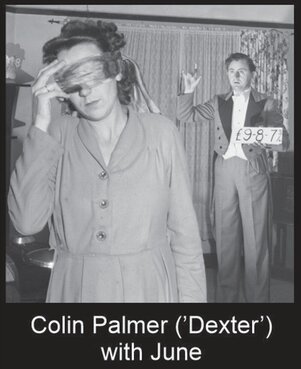
The probable facts of John’s arrival in the United States bear little resemblance to his later story that he had been apprenticed as a boy sailor, travelled twice around the world, and walked off the ship in New York. There followed a period of about eighteen months during which, as recounted above, no information can be discovered about our subject’s movements, identity, or performing engagements. Tom Selwyn would claim that he had worked at Huber’s Dime Museum (New York), Buffalo Bill’s Wild West shows, Dr. Bigelow’s Medicine show, and various circuses. Of course, none of that is beyond a possibility, but the proof cannot be found, and he would have been kept very much on the move to have worked with such a varied number of shows.
One of the most remarkable stories about Selwyn was related by Colin Palmer, an Australian magician and hypnotist who performed under the name ‘Dexter’, and was tutored by his friend Selwyn around 1948, in mentalism and memory work. Dexter would perform his two-person mindreading act with his wife, June, for many years afterwards. In the club magazine ‘Magic Chatter’ (9) Colin Palmer wrote, “Tom was the original Levante in England. He was the only man I knew who could wheel a card around a large area, following it with another and yet another card, snipping some of them in halves with scissors as they wheeled back toward his deck that he was double-triple-quadruple cutting as flying cards lobbed neatly ‘twixt the cuts – his hands and forearms were extended from the wings; and then when the spot picked up his whole body as he stepped forward, it was always to thunderous applause. He was Buffalo Bill Cody’s right-hand man in the dime circuses in the U.S.A … in his circus act chairs were smashed across his head, then a thick plank of wood; but the audience was never to know that he was born with two skulls! In fact, a bullet lodged between the skulls was there to the time of his death; a freakish event.”
Aside from the sheer implausibility of these claims, both regarding a double skull and a lodged bullet, it is clear that Palmer was re-telling a story that Selwyn had told him; indicating that he was quite prepared to gild the lily even to close friends. The whole tenor of Selwyn’s evasiveness was to tell stories with enough grains of truth to be possible, but without enabling anyone to check up on the facts. Did Selwyn ever perform under the name ‘Levant’ or ‘Levante’? We have no evidence of that.
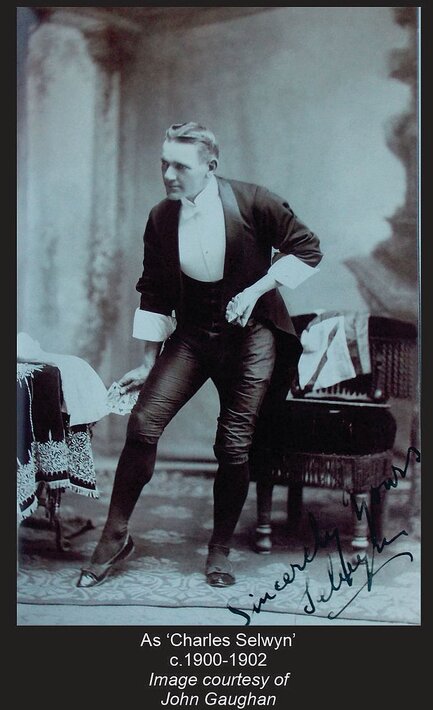
Yet, in terms of his performing ability, there is no question that Selwyn must have been working and learning and, as Colin Palmer wrote above, his skill level was quite remarkable. In 1902, ‘Mahatma’ magazine carried this commentary on his performance in Secunderabad, India: (10)
“Charles Selwyn … showed me a lot of new slick moves, including several original ones that took a lot of getting on to. I had the pleasure of seeing his show and I must thank him for the pleasure I had in witnessing the smartest and best exhibition of the art that I have seen in the country. Selwyn’s every move is neat and clean, not a false move right through his act, and what is more, there was none of the exposing that is quite a customary item in the programs of conjurors out here now. Selwyn’s program consisted of torn and restored ribbon, handkerchief colour change in assistant’s mouth, handkerchief and candle transportation and card and coin. In his first program he works Thurston’s rising cards with good effect. Selwyn gives a fine show and fully deserves the success he is having, he fully demonstrates that if an artist has the ability there is no need to add exposures to his program to make it interesting.” What a shame that Selwyn has so obscured his identity and travels, that we have little chance of tracing his magical career.
Return to King’s Shropshire Light Infantry Regiment - 1898
“The next stage in Tom’s story happened when Tom “re-joined” his [army] unit in October of 1898 after having spent an indeterminate period of time in the USA, (potentially 18 months).
On the 21st of October he was tried by his OC in a District Court Martial and was sentenced to 2 months imprisonment with stoppage of pay. His previous service was forfeited and the date of commencement of service reckoned to be from his date of conviction (21 Oct 1898). Following his internment, Tom was then transferred back into the 1st Battalion K.S.L.I.
The battalion at that time were stationed in Poonah in West India. Tom’s records state that his time in India began on the 27th of December 1898. For the best part of the next 3 years Tom seems to have been well behaved, in fact he was granted Good Conduct pay in December of 1900. But he blotted his copy book once again when he deserted on the 3rd of September 1901.
The circumstances surrounding his latest desertion were not revealed in his records, but must have been unusual, in that he was tried and given the severe sentence of 6 calendar months’ imprisonment. Once again his previous service was forfeited on being convicted and his service commencement reckoned from the 12th of October 1901. He returned to duty 6 months later.
In January 1903 he transferred once again back to the 2nd Bn, who were based in Ranikhet in northern India.
The next significant item in his records was entered on the 16th of June 1905. This entry showed he had transferred to the Army Reserve and had requested and been granted permission to reside in India. Since the order authorising this transfer was issued from Brigade HQ in Fyzabad in North-West India, it is assumed he was posted in that area, probably in Poonah.
This transfer in effect ended his overseas posting in terms of service pension and allowances. Although he remained in India, his records show that after he transferred to being a reservist, his service was counted as Home service.
During his time in India he had been posted across the entire country from the North-West Frontier region in Peshawar to Fyzabad in the North-East and to Ranikhet in the North. He was officially discharged from service on the 30th of August 1909 having forfeited 5 years of his total service after having managed to buy some of it back under a provision of Military Regulations. I believe he used the last few years in his Reserve service to further his profession of conjuror and also to give credence to having performed in “most countries of the world” as he often claimed. Whilst officially Tom should have been still in India in 1908-09, he had been true to form and made the most of his reservist status with the British Army and had left India earlier than that; most likely, without the knowledge or approval of the military authorities.” [ Jim Rouse ]