Tom Selwyn - Walking Around the World with a Pack of Cards
Post-War: 1918 – 1919
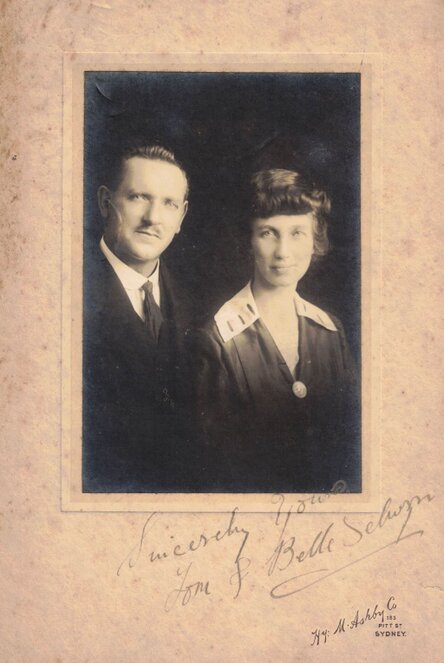
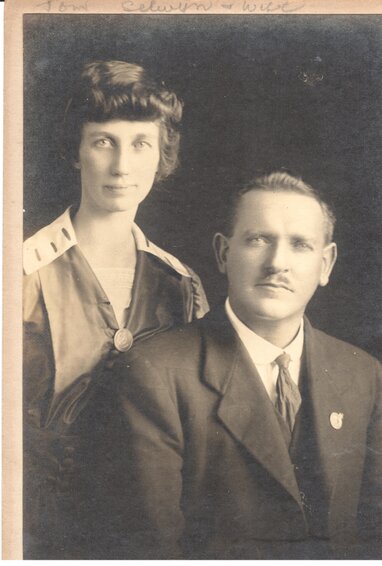 Tom Selwyn’s post-war activities, once again, are sparsely documented and difficult to trace. He had appeared in a charitable concert during his short time in Hobart in 1916, and on April 24 and 24, 1918 while awaiting his release for departure to Australia, he appeared in a Grand ANZAC Entertainment given at the Jubilee Hall, Weymouth. The army, either very forgetful or endlessly forgiving, would in 1920 make him a Reserve officer with the 3rd Military District at the substantive rank of Lieutenant.
In the years to come, Tom made the most of his military background, performing as Lt. Selwyn or even as Captain Selwyn (he was not) for old diggers’ concerts, military dinners and with performing troupes composed of former soldiers. A single clue about his working life emerges in a newspaper paragraph from 1917 (23) quoting a letter from a Launceston man fighting at the front: “You asked me once for personal items. Well, you remember Tommy Selwyn, whom I introduced to you one day in Launceston. He is now a second lieutenant in our company, as also is Jack Dell. You may not remember him, but he lived in Launceston for some years before he moved to Hobart, and took a position in P.O. Fysh’s.” Fysh’s was a large concern in Murray Street Hobart, selling shoes, boots, stockings, suits and overcoats. Selwyn would have had a need to support himself on more income than magic could supply, so it is no surprise that he would at times have taken on routine employment; one reason he is not more visible in public records. It might also be wondered whether his re-enlistment in 1914 might have been motivated by better employment opportunities, or even a more exciting life than working in a store.
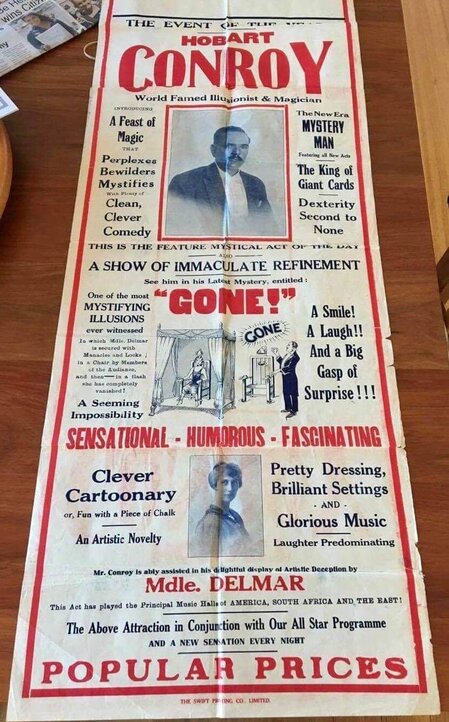
This difficulty in dating some parts of Selwyn’s life extends to some of his promotional material and the performing role of his wife, Belle Selwyn. A daybill poster exists, showing Selwyn under the stage name of Hobart Conroy “The Mystery Man” together with Belle as Mdle. Delmar. The poster, printed in Sydney, gives no indication of dates, and cannot be tied to any known performance or any information about the names ‘Conroy’ or ‘Delmar’; though the use of Hobart as a first name is commonplace among theatricals, tying themselves to the city of their birth or residence (ie, Nellie Melba, Ada Fitzroy). The poster is also somewhat remarkable in that Selwyn advertises a full-size staged illusion, titled “Gone”, although it is actually the [Thayer] Electrocution Mystery (24) which may date to 1917.
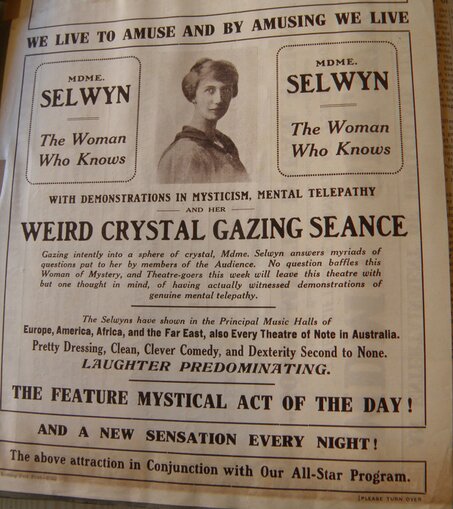
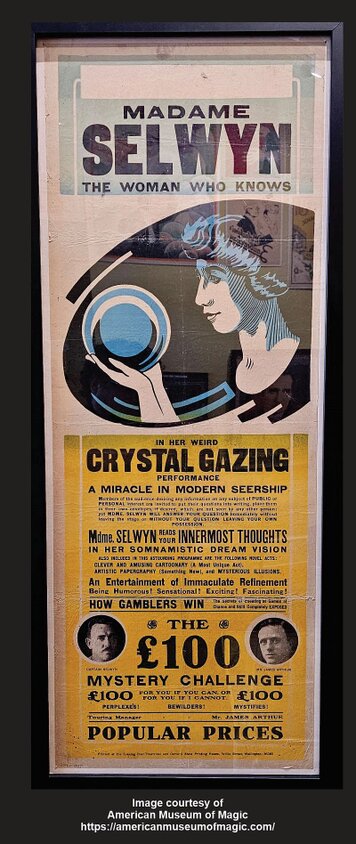
The remaining mystery is that although quality promotional material was created for Belle Selwyn, including a flyer for ‘Mdme. Selwyn – The Woman Who Knows … and her Weird Crystal Gazing Séance” and an attractive poster (possibly from 1923 New Zealand), not a single reference can be located either advertising or speaking of her performances. There is not much question that Belle would have trained up as a partner for Selwyn, and likely gave many performances, but the proof waits to be found.
A curious sidelight occurs during June and September 1917. The ‘Lyric World’s Entertainers’ were on tour in New South Wales and Victoria, featuring the usual array of singers, comedians and moving pictures. Heavily promoted was one ‘Selwyn the Great’, a magician and hypnotist who nevertheless seems to have principally featured a Rope Tying escape act. But this was not Tom; the Rutherglen Sun Advertiser (August 28) said, “Mr Roy Hamilton, who is known throughout New Zealand and a great part of Australia as ‘Selwyn the Great’ gives some very clever feats of magical acts and featured well in getting out of the ties in his rope tying act.” It turns out that both a Ron and Roy Hamilton were performers with this troupe, and the escape artist may have been Ron. Sadly for posterity, Mr Roy (or Ron) Hamilton cannot be discovered anywhere outside these few months, either in Australia or New Zealand.
Selwyn reappeared in November 1918, touring Northern Tasmania, and Hobart, with apparent success, in a troupe calling themselves the ‘Soldier Stars’, with every male member a returnee from the war. Notably, the cast was headed up by Sergeant Charles L. Copeland, presenting his 8-year old son (Nathaniel Julius Copeland) as “The Kid – the youngest clairvoyant in the world, in an amazing act of telepathy, mind reading, thought transference.” In later years, the child wonder became known, firstly as ‘Zoe the boy with the 1000 eyes’, then as ‘Argus the Prophet’. His act, which he continued to perform in the 1930s, was convincing enough that New Zealand authorities charged him with alleged fortune telling; he had certainly been promoted as “assisting thousands of people in locating missing friends, lost articles, advising in references to business…. send your question in full detail … with voluntary donation …”
Selwyn, who was also the touring manager of the Soldier Stars, was well reviewed – “Mr. Selwyn is an amazing wizard with his pack of cards, and gave a mystical exhibition.” “Lieut. Tom Selwyn presents something new in the way of conjuring, and his thimble manipulation is worth going a long way to see.”
The ‘World’ of November 14 also makes a commentary which probably came direct from Tom’s pen – “When in London, just prior to his return to Australia, Mr. Selwyn performed his mirthfully mystic act with his cards in aid of the Y.M.C.A. funds at the Aldwych Theatre. His remarkable ability obtained him many offers of metropolitan engagements which, of course, owing to military circumstances, could not be accepted. However, during convalescence in England his talent was in constant demand for the benefit of any patriotic body that assisted the boys in camp.”
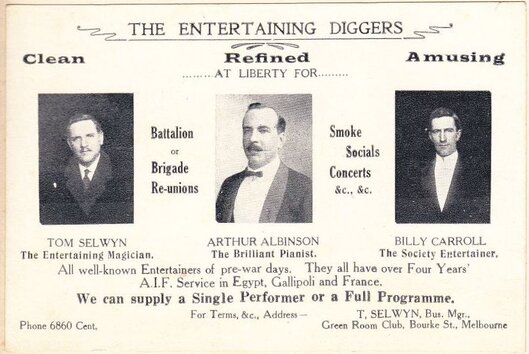
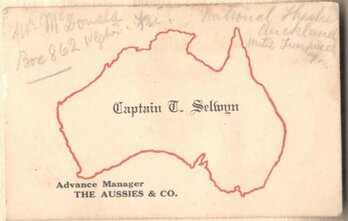
Following his return from Tasmania, Selwyn involved himself with other entertainment teams comprised of ex-military artists – he was Business Manager for The Entertaining Diggers, and later in 1919 the Soldier Stars combined with the ‘Dinkum Diggers’ at Geelong. In September 1920 another group calling themselves ‘The Aussies & Co.’ were seen briefly in New South Wales, and a business card of Tom’s names him as their business manager. After this, he once again fades from public view, to reappear in New Zealand.
New Zealand 1921 - 1923
It is unclear whether Selwyn remained in New Zealand for the whole of 1921-1923, but he is noted in the press between April 1921 – January 1922, and again from March - August 1923.
His 1921 mentions are mainly for appearances at society dinners, and at a charitable benefit night held at the Wanganui Opera House, for which a number of glowing references from Australian newspaper were printed; none of which can be traced back to their source (However the comments on his actual performances are highly complimentary. ) Selwyn had also now become “Captain Selwyn”, a promotion he seems to have bestowed upon himself.
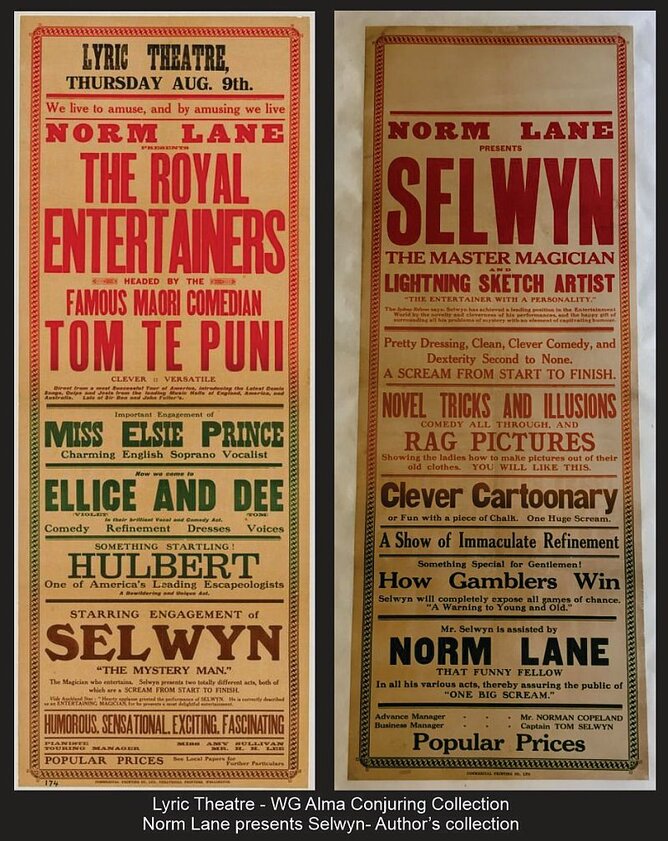
Tom’s doings during 1922 remain a mystery, since he does not appear in either New Zealand or Australian news reports. It is not until late March 1923 that “Everyone’s” mentions him with the Petone Carnival (lower North Island of New Zealand), and perhaps he had been travelling with some small touring show, or on his own account, as Everyone’s of July 18 reported, “Tom Selwyn, with his small show, is meeting with a poor reception in the smaller towns.” At last, in August 1923, Selwyn surfaces at the small towns of Otaki and Levin, with a troupe named The Royal Entertainers. Along with Selwyn “The Mystery Man” was sidekick Norm Lane, Tom Te Puni (Māori comedian), Elsie Prince (a singer with a fair reputation), and ‘Hulbert’ an escape artist purportedly from America, but of whom nothing is known.
Selwyn informed the local press that he had his first lessons from an old Indian Fakir, and later from Mr David Devant in London.
These appearances can be linked to a poster for the Otaki Lyric Theatre. Another poster, seemingly from the same general time, is billed as “Norm Lane presents Selwyn” with a variety show in which Tom performed magic, lightning sketches and rag pictures, with Lane as the assistant. Norm Lane is unfortunately unknown to posterity, though a business card shows him as representing “The Mysterious Selwyns”; and here is another mystery, since Belle Selwyn is completely invisible at this time. The attractive poster of Madame Selwyn was printed in Wellington NZ at the time when Tom was calling himself ‘Captain Selwyn’, but no evidence of an actual performance has been located. ‘Everyones’ of August 22 reported “Royal Entertainers, small show, touring the smalls, headed by Tom Selwyn and Tom Te Puni, playing to very small houses.”
By August 16, Selwyn moved by himself to Greymouth in the South Island where he appeared at the Opera house in a bill with Pollard’s Pictures, and his self-written puff piece for the newspaper reported that he had just concluded a successful tour of the North Island, “where the press reports him as one of the most skilful entertainers now before the public.” The Evening Star, however, did report the next day that in his 30-minute act he “more than held attention, and thoroughly entertained the good attendance present by his remarkable exhibition of sleight-of-hand, while his continuous patter caused ripples of laughter … disappearing thimbles, cards, handkerchiefs … the apparent pushing of a full-sized candle down the assistant’s throat, and its subsequent discovery in Selwyn’s pocket… Selwyn will give a change of programme, including his famous gambling expose.”
Hokitika was the next town on the list, but then Tom seems to have given it away, and no more is heard of him in New Zealand.
Later Years: 1924 – 1940
For all practical purposes, Tom Selwyn’s professional career as a magician was now finished. In later times he regularly stated that his voice was periodically failing him (from around 1928) as a result of having been gassed in France. Historian Jim Rouse has checked the official history of the 40th Battalion and found no record of enemy gas attack until the battle of Messines in June 1917, by which time Tom would have been back in Britain as Quartermaster; so while this claim again seems unlikely, it is clear that Selwyn was becoming unwell and would be increasingly unable to indulge his passion for travel and performing.
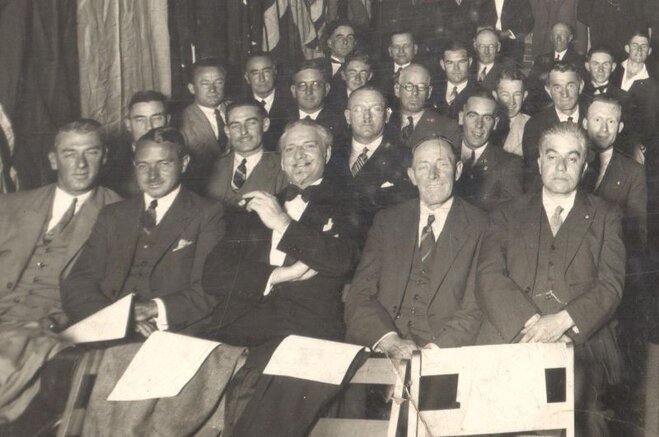
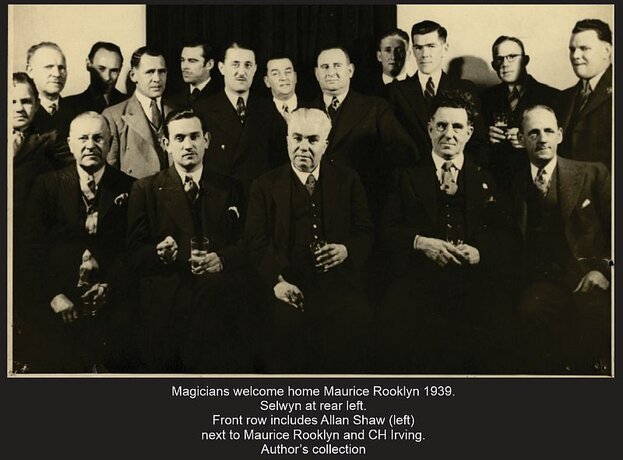
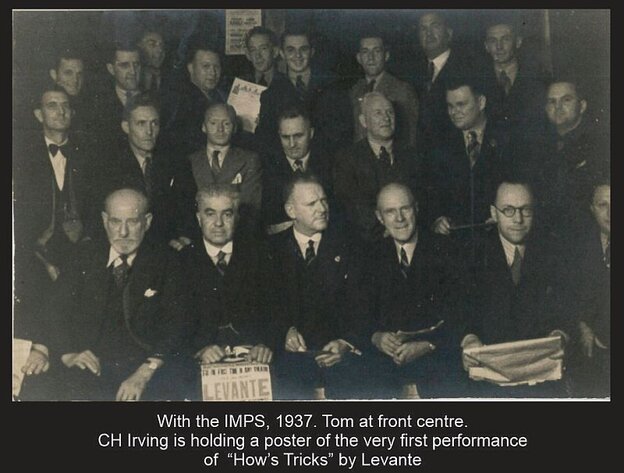
In his interactions with magicians of Australia, it is clear that Selwyn was gregarious and very well liked. His magical knowledge and skills were held in great esteem, and he seems to have had the same easy-going sociable nature as his protégé, Les Levante. Tom had also performed with the IMPS and the Australian Magicians’ Club on some of their public shows, as well as helping out with various ‘smoke nights’ and reunion dinners for military groups.
As a member of both the I.M.P.S and the International Brotherhood of Magicians, Tom found many friends, such that when he ultimately died, Charles Waller wrote, “… one who was the much-beloved friend of Australian magicians; indeed, scattered throughout the world there must be many to whom the knowledge of his passing will bring acute sorrow. He was a kindly man and lovable, with hand and heart, always ready to help from his own vast knowledge and experience. Fortunate were they who were able to make the personal acquaintance of Tom Selwyn.”
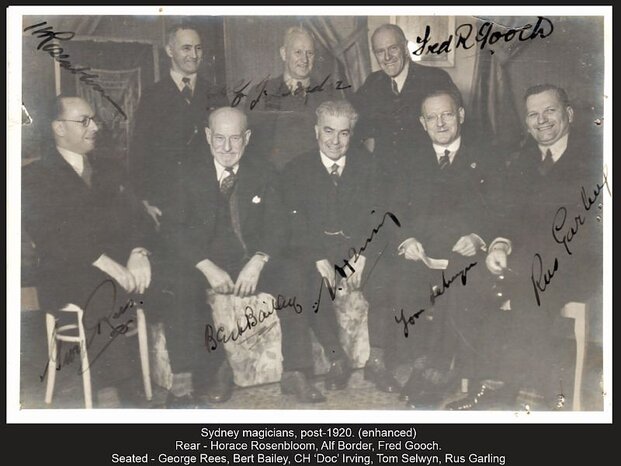
We know that Selwyn mentored Colin ‘Dexter’ Palmer and his wife, June, in 1948. It was also mentioned (25) that he was the first to give a very young Sydney Piddington an insight into mental magic, though most likely Piddington, as the youngest member of Sydney’s IBM, was just one of many who benefitted broadly from Selwyn’s knowledge.
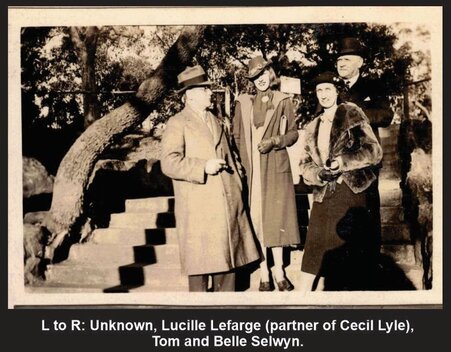
It might be suspected that Tom and Belle Selwyn struggled financially at times. In Sydney they lived in Darlinghurst (4 Harford Place), but one of their addresses (1941) is shown as Gould’s Private Hotel in George Street, a place which would have been little more than a bed-sitter, though ironically it was directly across the road from what became the clubroom of the Wizard’s Club around the same time (26). Tom must have made himself useful as, in July 1936, he was charged with selling liquor without a licence, at a dance held in the central city. He was fined £30, a hefty sum during the Depression years.
Tom eventually retired from his job in 1940, having the previous November written to the IMPS President Felix Booth, “It is with regret that I have to tender this, my resignation as a member of The Imps. As you know that for some time my health has not been too good, and on top of that all my spare time is taken up with other matters which does not give me any time for magic …”
The Selwyn Albums
Having stepped back from performing, Tom now declared himself “Once a magician, now a collector” (27) and his stationery (28) was printed with the footnote “A photograph, programme, or bill of yours would be appreciated.”
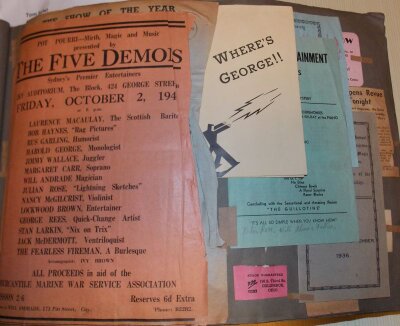
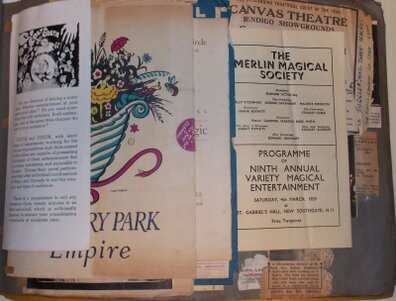
It seems that many of his Australian and overseas correspondents obliged. From an estate auction of 2018, this author purchased two huge albums which are almost certainly Selwyn’s. Although there is no ownership labelling, the pages contain a number of very personal items which only Tom would have been likely to own – business cards, his IBM membership card, a programme from one of the shows in which he performed at Weymouth during his military years, and greetings from the likes of Will Alma and ‘Doc’ Mahendra.
One album is devoted to clippings and ephemera of his good friend, Les Levante. The main album is eighty pages of a wonderful assortment of ephemera, programmes, cards and flyers received from all over the world, and each page is covered with multiple layers of items, unfortunately attached to the page with little pieces of brown packing tape. Selwyn must have been a vigorous correspondent (he wrote regular letters to the Linking Ring magazine) so there must be some hope that a collector somewhere across the world holds a cache of his letters.
Finale: 1941 - 1950
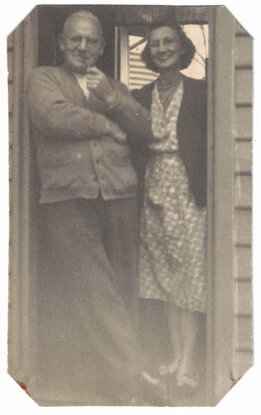 On his return to Australia at the end of 1940, Les Levante allowed Selwyn to make an attempt at management duties for his show; but after just a week his health prevented him from continuing, and he was reported to be more or less immobilised at home.
 There was one last military hurrah; on the 21st of April 1941, Tom again enlisted in the Army, declaring himself to be 58 years old, and born in the United States. His records show that he was medically classified as ‘Class II’, and his service saw him being utilised as a clerk with the rank of corporal in Sydney. However, his service was short-lived as he was discharged as “unfit for service” in February 1942.
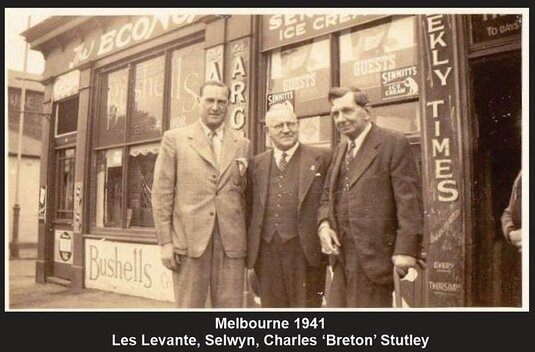
Levante proved his friendship to the Selwyns in 1942 by inviting them to live at one of his properties in Queensland, and they stayed at Cribb Island, welcoming the occasional magical visitor, including Ade and True Duval, Len Sewell, Will Alma and numerous overseas artists.
In early 1945, they returned to live in Tasmania, at Lindisfarne close to Hobart. They were welcomed with open arms by the Silver Star Magician’s Club – “those present were deeply appreciative of the vast knowledge of magic conveyed to them by Mr. Selwyn…”
In the following years, little is heard of Tom, and even less of his wife Belle, about whom so little is known. For Tom, living a sedentary existence by compulsion must have been especially difficult after his travels and undoubtedly adventurous career. It seems they moved to 99 Derwent Park Road Moonah, closer to Belle’s sister at some stage. A distressing report in the May 1948 Sphinx magazine said that Tom lost half of a finger while operating a lawn mower.
Hobart magician Tim Paul wrote to his friend Jim Bennier on June 19, 1949, “Albert Dunn … drives me to Tom Selwyn’s place about eleven miles away … Tom is not in good health – he is having trouble with his heart and is not permitted to do any work or even walk. I saw Tom today … he is very cheerful under his circumstances.” By August, the Linking Ring magazine was reporting that he had suffered a bad heart attack and was confined to bed.
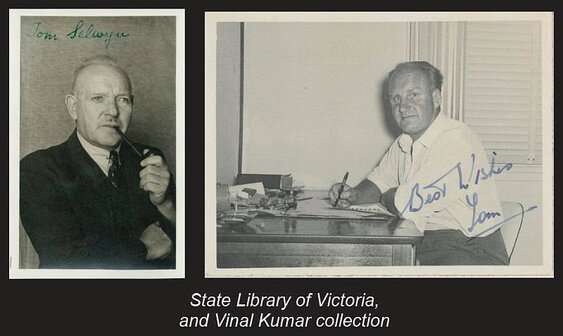
Tom Selwyn died on January 26, 1950 at the Hobart Repatriation Hospital, and was buried at the Hobart Garden of Remembrance. In what was perhaps both a financial assistance to Belle, and a recognition of the high esteem in which Tom was held, magicians around the country contributed to a fund to erect a monument stone, and by the start of 1952 the stone’s inscription included the text “A tribute to the memory of Tom Selwyn. A great magician. A fine citizen. From all members and clubs of Australian magicians.” Isabel Selwyn joined Tom after dying on August 4, 1957, aged 68.
What are we to say of Tom Selwyn’s life? He was without doubt a talented magician and a friend to many. He did travel. He did land with the ANZACs at Gallipoli. If his military record and concealed identity do not reflect credit upon him, he was at least not a person who caused harm. There are many mysteries about Selwyn left to uncover, and perhaps they will come to light in future years. History owes just the truth, and in Selwyn’s own words, “We live to amuse, and by amusing we live.”
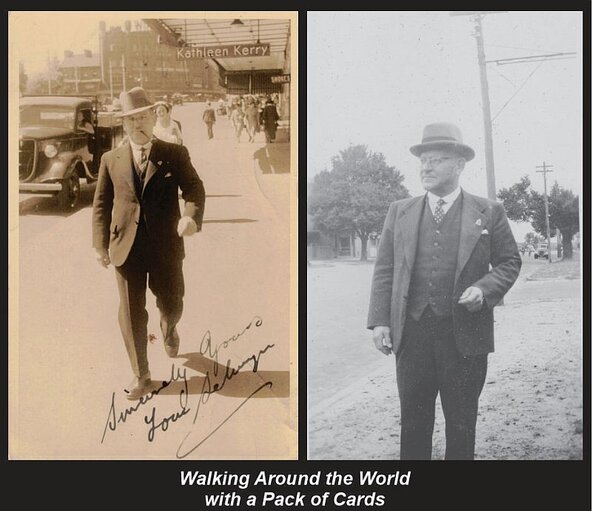
'PLEASANT MAGICAL MEMORIES' By TOM SELWYN
'The Magic Circular' 1941
I know that most magicians like to hear of the old-times so I will to you about some of the old-time Australian magicians that I met in India.
When the South African war terminated I went to India, mainly with the idea that I should see, first of all, the Indian Rope trick and second, some of the celebrated Mahatmas or Yogis; to say that I was disappointed in both cases is only to put it mildly. But anyhow I am out to tell you of Australian magicians, not Indian.
The first I met was Fred West, his professional name was West Divine. He was with an Anglo-Indian Circus owned by Mr Abel who was at the time of my meeting him then very old, also deaf, but nevertheless he was a fine old trouper and used to put a team of ponies through a very fine act. Fred was Mr Abel's right hand man, he not only did his conjuring act in the ring but attend to most of the business. As near as I can remember Fred did such tricks as the Linking Rings, Flowers from Cone, Passe Passe bottles, etc. He was a very likeable man and gave me quite a good idea of Australia. He was from Marrickville, Sydney. Poor Fred was always telling me what he intended to do when he returned to Australia, but fate intervened, and as far as I can gather he died in the Central Provinces, fever being the cause.
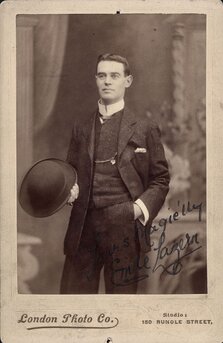
Another good magician who I met was Emil Lazern, another Sydney-sider. Laz, as we used to call him, came to India with Victor Kelly and Agnes, who played the Tivoli circuit; the three of them with a piano, played through the soldiers' cantonments, and when I met them they were doing wonderful business, many of the English soldiers remembered Vic Kelly and Agnes at home in England where they were headliners on the music hall stage. Lazern was a good performer, with a nice personality, his chief trick was smashing a watch and finding it in a loaf of bread or nest of boxes; he got everything possible out of the trick. He told me of his travels through New Zealand and all the States, even as far up as the opal fields of White Cliffs. I met Laz in Sydney years afterwards, he had given up magic and had a photographic business in Randwick, Sydney, where he died.
<< Lazern. State Library of Victoria
George Waldo Heller was another Australian performer who toured the East. George came from Melbourne, his main feature was a Mind Reading act with his wife Maudeena, plus his own magical act which was a very fine one in every way. He was a good showman as well as magician; they usually carried a comedian and a couple of girl performers. We crossed each other’s paths a few times, and on a couple of occasions stayed in the same hotel, consequently we became firm friends, for George was a grand chap to meet. The last time I saw him he was running a moving picture show through New South Wales. I heard that he passed away, but I don't know where or when.
Now we come to another Melbourne magician, "Alva", whose name I believe was Highett, and came from Malvern. He came to India with Tom Liddiard and Jack Ross, who brought out quite a big vaudeville show; but they hadn't been going very long before there was a split in the show, and some went with Liddiard and others (including Alva) went with Hans Drewitz (who was the original advance man of the show before the split); but this time Alva was billed as "De Villiers" the South African Magician, as no doubt many of the old boys in Melbourne will remember him. His billiard ball production was a feature, and although I saw him perform many times I have forgotten his programme. I afterwards met him in Sydney, where he died. I don't think he ever performed after coming back from India. If I remember rightly, he told me that he was a cousin to Alma, who was also known as "Pharos" with his Black Art show, father of Bill Alma of South Melbourne.
Another Australian magician I met was Professor Rollo (not the skater). I know his name will convey nothing to you as he never performed in Australia. Rollo was the son of Charles Taylor and Ella Carrington, the well-known musical comedy stars of days gone by, and young Charlie Taylor, instead of following in his parents footsteps, became a professional pianist, and as such he toured the Far East with Carl Hertz, the world renowned illusionist.
After Hertz went back to England, young Taylor blossomed out as Professor Rollo, the world renowned wizard. The tricks he did were some that Hertz used to do: Flowers from Cone, watch vanish from cone and found in nest of boxes, etc; tricks that seem to be favourites of the majority of conjurers in those days - I only saw Rollo perform once and then he just faded away, perhaps back to the piano which suited him much better than hanky-panky. He was the last of the Australian conjurers that I saw in the East with the exception of Jim Bell (and you couldn't call him a conjurer) and Ada Delroy who did a Mind Reading act using the pad method similar to George and Maudeena Heller.
Miss Delroy with her Butterfly and Fire dances was the star of the show, seconded by the late Teddy Ford, who was a great favourite. Fred was well known in Melbourne as the man who could laugh on one side of his face and cry on the other. This company had a good run in India and their Thought Reading act created quite a stir. This is the same Jim Bell who was for many years stage manager at Melbourne Tivoli. And that concludes the Australian magicians whom I met. But I met quite a number of others who had played through Australia and I am sure their names will be familiar to you.
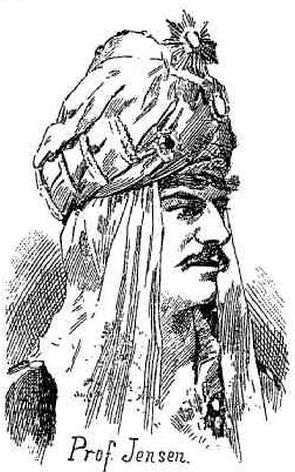
I was performing in Lucknow and after my show one evening a middle aged man came round to see me. He introduced himself as Jensen, the Illusionist, and after several minutes chat about the show and magic in general, he told me he had played Australia with his Black Art show years ago, but was now retired. I paid him many visits while in that city, he was making a very comfortable living for himself and his family by keeping a soldiers' restaurant. I had forgotten the year he told me he had visited Australia, but Mr Charles Waller told me that it was 1889.
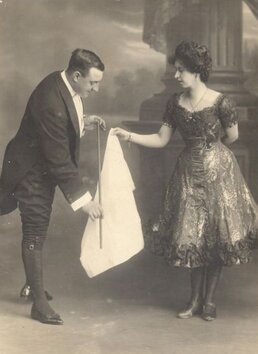
For the visit to India of the Duke and Duchess of York, Calcutta held an Exhibition for which they brought out from England quite a number of first class entertainers, and amongst these was the late Fred Culpitt whom many of you would remember on the Tivoli Circuit. He was known as the Magical Comedian and rightly so for Fred was not only a splendid magician, but a natural comic also. At this time I was having a spell in Calcutta and Fred and I spent quite a lot of time together, he was a grand chap and made a host of friends, besides giving his humorous magical act in the theatre in the Exhibition grounds, he had a Hall of Illusions, and used to lecture and show about eight or nine sideshow illusions. Fred and I used to go for a walk every morning and our usual pastime was “baiting the Goroodu Wallahs", meaning having some fun with the native conjurers, and Calcutta swarms with them.
Fred Cullpitt >>
A short time before Culpitt came to India I was travelling from Asansole to Calcutta and noticed two or three white men board the train. On sight I recognised "professionals" and so made up to them right away.
It appears they belonged to Fitzgerald's Circus and were going for a look round Calcutta. The one that I spoke to was a young man not long out of England, and on learning that I was also a pro, he introduced himself as "Mokana" a handcuff king, and I replied, then you are Will Goldston's brother, at which he seemed surprised, but I told him that I was a subscriber to his brother's paper "The Magician". After they got settled in their hotel which all pro's stayed at in those days, the Savoy Hotel, and kept by Mrs Barrett, we decided that we should go and see "John Clempert”, the man they couldn't hang, who was with a variety show in the Opera House, both Mokana and myself were in the committee on stage, and Mokana put up the usual bluff challenge gaq, etc., which went down well with the audience, and Clempert being a fine showman the act got a wonderful reception. The next day I went to see Mokana again and he had a very high temperature, was taken to hospital, but died a few days later.
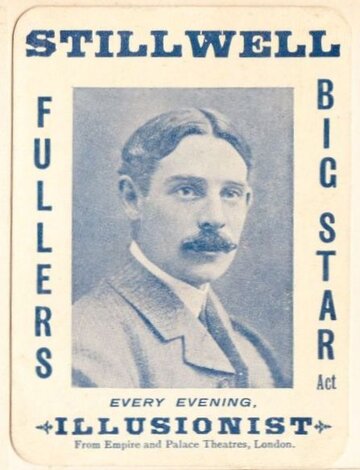
I could tell you a good deal about Mokana and Clempert, but I am afraid it would bore you, so I will go on to my next magician, George Stillwell, the Handkerchief Manipulator. He had paid Australia a visit before coming to India with the Eugene Sandow company. It was wonderful to meet Sandow again, as I had played in his show in England and knew him and his wife (who was formerly Miss Maud Brooks, of Manchester), also her brother who managed the show. Stillwell left the show in Calcutta and stayed there for a time. He was very anxious to build a full night magic show, and I gave him what help I could, and during rehearsals I had to tell George that I considered he would be better sticking to his handkerchief act, as, to my firm belief, he was not cut out to be an illusionist.
Of course George wouldn't listen, he completed the show and booked the Theatre Royal for one week. In the show he had two or three illusions and half a dozen native assistants. It should have been, and would have been, a success in another man's hands, but you could not tell George anything at all. He knew; and consequently the show was duly advertised and opened, and played one night only, instead of a week. You never saw such a mess in all your life. After that George packed up and went away to the Islands. I met him afterwards in Sydney where he managed a conjuring depot for Frank Albert, the music dealer of King Street. George died in the islands, Java or Sumatra, I am not sure which. Poor old George, one of the best, but would never take any advice from anyone, and to think what a success he was with his handkerchief act. He was one of the three manipulators who played the Palace Theatre, London, for six months, the other two were Nelson Downs, the King of Coins, and Howard Thurston, the King of Cards.
And now a few words about Thurston. He came to India after he left Australia, and on his arrival in Calcutta I immediately went to see him, and after introductions were over, almost the first words he said were "Have you seen the rope trick?" and I replied that I had travelled in every city and town in India, also before the majority of Indian Princes and Rajahs, but I had never seen it, or even met anyone who had. I spent quite a lot of time with Howard and at that time I was performing at the Opera House in a vaudeville programme. Thurston and his company paid me the compliment of coming to our theatre to see my act. I did not know that they were there until I walked on the stage. I glanced up to the boxes and there to my astonishment I saw Thurston and family, and the rest of his company. As I was doing a card act you can imagine what I put into it that night, with the acknowledged King of Cards in my audience; my act went well and when I concluded there was Thurston in the wings, waiting for me, he shook my hand and congratulated me on my performance, after which we all adjourned to his hotel for supper. Thurston had a wonderful show and was not only one of the world's best magicians, but a gentleman to his fingertips.
Now, there are only two more magicians who I met in India; Charles Bertram, the great English conjurer, and Frank Dante, brother of the original Dante (Oscar Eliason), so I will take Bertram first.
I believe he had visited Australia somewhere about 1901, and when I heard that he was visiting India I made arrangements with my company to leave them for a few days (we were playing Bangalore, Southern India, at the time) and travelled to Bombay where Bertram was to open. I met him on arrival and peculiarly he asked the same question as Thurston did, "Have you seen the Indian Rope Trick?" I spent a couple of days with him before he opened in the Novelty Theatre, and what a show he gave and what a performer; did about twelve tricks and two illusions in his two hours entertainment. I could tell you a lot about him but I must cut things now, as space is limited. He was billed as "The King's Conjurer", because, I suppose, he had performed so often before King Edward, to whom he bore a startling resemblance. He travelled through India showing chiefly in Officers Clubs and to Native Princes.
And now for my last magic man, Frank Dante, or properly speaking Frank Eliason. I was performing in Rangoon, Burma, when Frank and his wife came to my hotel to see me, also to ask my advice as to towns to play, routes etc. Frank's wife was a Sydney girl, and she played the piano whilst Frank put over his two hours of small tricks. I soon put him wise as to the best places, etc. to show. There was all that time only one place for any small show to play, and that was to the soldiers, and there were barracks in almost every town or cantonment.
I left Rangoon but met Frank in Mandalay shortly afterwards and he told me he was doing well, and had quite got into the ways and habits of the English Tommy, who usually lets you know whether he likes your show or not. Frank told me all about his brother's tragic death (Oscar Eliason, Dante, was accidentally shot in Dubbo, N.S.W.) and about Australia in general.
I will conclude now, having been very brief in my remarks about the various magicians I met in India, but to me it brings back many happy memories of which I shall never forget.
REFERENCES
(1) Biographical notes. See, for instance:-
The Linking Ring magazine Vol 23 No. 10, December 1943.
The Linking Ring Vol 30 No.1, March 1950
Munro’s Magic Miscellany, June 1947
The Linking Ring magazine Vol 23 No. 10, December 1943.
The Linking Ring Vol 30 No.1, March 1950
Munro’s Magic Miscellany, June 1947
(2) The autobiographical notes of Leslie George Cole, ‘The Great Levante’ are published in ‘Levante – His Life No Illusion’ by Kent Blackmore, pub. Mike Caveney’s Magic Words, 1997
(3) Levante’s mother was Sarah Catherine Cole. She is buried with her husband George (d. 1921) at Boroondara General Cemetery, Kew Victoria
(4) The next of kin details are crossed out and replaced by the name of his wife Isabelle Effie Selwyn, presumably after their marriage in 1916.
(5) Photograph of Prof. Anderton from the Harrie Ensor Scrapbooks, volume 1, annotated by Ensor
(6) The Linking Ring magazine, Vol 23 No. 10, December 1943
(7) Mentions of Charles or Chas. Selwyn and Thomas Oliver (misspelled as Olliver in one instance):
Mahatma magazine, January 1905, and The Sphinx Vol.3 (1904) numbers 6 and 10
(8) If Harry Jasper Selwyn was indeed the other half of the Brothers Selwyn, he came from distinguished stock as the son of Sir Charles Jasper Selwyn. HJ Selwyn died in 1919 and is buried at Nunhead Cemetery, London.
(9) Magic Chatter, magazine of Sydney Ring 102 of the International Brotherhood of Magicians, November 1986.
(10) Mahatma magazine, Volume 6 No. 9, 1902 page 476 “Eastern Jottings” by F. West-Devine
(11) The Linking Ring magazine, Volume 23, No. 10, December 1943. Aristide Scola was President of IBM Ring 44, and a member of the IBM welfare committee.
(12) The Linking Ring magazine, March 1943
(13) Evening News November 26 1906, Australian Star December 20 1906, and in 1907 the Newcastle Morning Herald October 8, and Referee October 9.
(14) The Magic Mirror, journal of the Australian Society of Magicians, December 1909
(15) The Sphinx Vol. 6 No. 11 1908 p.4
(16) ‘Dante in Australia’ by Arthur Valli. The Magic Mirror, March through July, 1910. “My admiration for the conjuror was so great that I frequently visited the grave long after his death, and on many occasions I would come upon his wife and little daughter Ethel, arranging fresh flowers on the grave and caring for it generally.’
(17) See a full modern recreation of a photograph of Hanco and troupe:
https://www.abc.net.au/news/2024-11-04/photographer-grandson-quest-solve-mystery-australia-houdini/104522108
https://www.abc.net.au/news/2024-11-04/photographer-grandson-quest-solve-mystery-australia-houdini/104522108
(18) Genealogical Database of Australia’s Travelling Showpeople, 2009 searchable database by Mark St. Leon ISBN 978 0 947284 73 2
(19) Cora Trevor - Geelong Advertiser, November 11, 1899 p.2 “A balancing act that excited a good deal of enthusiasm amongst those present, was performed by Mons. Trevor and little Cora Trevor.” Edward Trevor – Manning River Times, Augst 8, 1903 with Foley’s Circus.
(20) These two articles are the most descriptive of those available concerning the scandal:-
- Truth (Brisbane) December 11, 1910 p.6 populist magazine report
- Daily Record (Rockhampton) January 2, 1911 p.2 interview with Cora Trevor
(21) Wagga Wagga Advertiser, December 1, 1910
(22) The Newsletter: an Australian Paper for Australian People, May 4, 1912
(23) Zeehan and Dundas Herald, May 16, 1917
(24) Thayer Electrocution Mystery - see Magical Bulletin, Vol. 5 No. 2, February, 1917.
(25) Hugard’s Magic Monthly magazine, Volume 9, 1951
(26) Gould’s Hotel at 700 George St, Wizards Club at 617 George Street
(27) Linking Ring magazine, June 1943
(28) Selwyn magic file, W.G. Alma Conjuring Collection, State Library of Victoria
(29) Magic file for Tim Paul (‘Ishaq the Indian Mystic’) W.G. Alma Conjuring Collection